-
Resources
-
Pricing
The Federalist Era was the early period of the United States government, marked by efforts to strengthen national institutions, establish economic stability, and define the balance between federal and state power. More Less
Build a timeline like this one in minutes, for free. Start Yours →
Mar 1, 1781
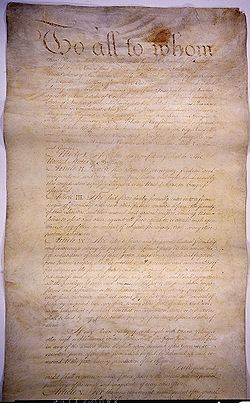
The Articles of Confederation took effect after Maryland became the final state to ratify them. They created the first national government of the United States but left Congress without reliable taxing power, effective regulatory authority, or an independent executive.
Image source: Articles of Confederation
Jan 14, 1784
The Confederation Congress ratified the Treaty of Paris, formally ending the American Revolutionary War. Britain recognized American independence and ceded territory east of the Mississippi River, while unresolved debts, borders, and Loyalist claims remained major national problems.
Image source: Treaty of Paris (1783)
Aug 29, 1786 - Feb 25, 1787
Massachusetts farmers led by Daniel Shays resisted court actions and debt collection during an economic crisis. The uprising exposed the Confederation government's inability to respond effectively and strengthened arguments for a more powerful federal government.
Image source: Shays' Rebellion
Sep 11, 1786 - Sep 14, 1786
Delegates from five states met in Annapolis, Maryland, to discuss interstate commerce. Their call for a broader convention to address the weaknesses of the Articles of Confederation helped lead directly to the Constitutional Convention.
May 25, 1787 - Sep 17, 1787
Delegates from twelve states assembled in Philadelphia to revise or replace the Articles of Confederation. Instead, they drafted a new Constitution establishing a stronger federal system with separate legislative, executive, and judicial branches.
Image source: Constitutional Convention (United States)
Jul 12, 1787
Delegates agreed to count three-fifths of enslaved people when allocating representation and direct taxes. The compromise strengthened the political power of slaveholding states while embedding slavery in the constitutional settlement.
Image source: Three-fifths Compromise
Jul 16, 1787
The convention adopted the Connecticut Compromise, creating a bicameral Congress. Representation in the House would be based on population, while every state would receive equal representation in the Senate.
Image source: Connecticut Compromise
Sep 17, 1787
Thirty-nine delegates signed the proposed Constitution in Philadelphia. The document created the framework for the federal government that Federalists would defend during the ratification debates.
Image source: Constitution of the United States
Oct 27, 1787 - May 28, 1788
Alexander Hamilton, James Madison, and John Jay published 85 essays under the name Publius. The essays explained and defended the Constitution, addressing concerns about faction, federal power, executive authority, and republican government.
Image source: The Federalist Papers
Dec 7, 1787
Delaware became the first state to ratify the Constitution, approving it unanimously. Its action began the formal state-by-state ratification process.
Image source: Article Seven of the United States Constitution
1789
New Hampshire became the ninth state to ratify the Constitution, reaching the threshold required for it to take effect among the ratifying states. The new federal government was scheduled to begin in 1789.
Sep 25, 1789
Congress proposed twelve constitutional amendments drafted largely by James Madison. The first ten would become the Bill of Rights, addressing Anti-Federalist concerns about individual liberties and limits on federal power.
Image source: United States Bill of Rights
Dec 15, 1791
Virginia's ratification made the first ten amendments to the Constitution effective. They protected freedoms including speech, religion, press, assembly, due process, and protections against unreasonable searches.
Jun 15, 1804
The Twelfth Amendment changed Electoral College procedures so electors voted separately for president and vice president. It responded to the electoral crisis of 1800 and helped prevent a repeat of the Jefferson-Burr tie.
Feb 4, 1789
The Electoral College unanimously elected George Washington as the first president of the United States. John Adams finished second and became vice president under the original constitutional electoral system.
Image source: 1788–89 United States presidential election
Apr 30, 1789
George Washington took the presidential oath at Federal Hall in New York City. His inauguration established precedents for the ceremonial and constitutional conduct of the new executive office.
Image source: First inauguration of George Washington
Sep 11, 1789
Alexander Hamilton became the first secretary of the Treasury. He soon developed an ambitious program to stabilize federal finances, assume state debts, establish public credit, and promote national economic development.
Image source: Alexander Hamilton
Sep 24, 1789
Congress established the federal judicial system through the Judiciary Act of 1789. The law created the Supreme Court, district courts, circuit courts, and the office of attorney general.
Image source: Judiciary Act of 1789
Jan 1, 1790 - Aug 4, 1790
Congress adopted key elements of Hamilton's financial program, including federal assumption of state Revolutionary War debts and funding of the national debt. The measures strengthened national credit and tied influential creditors to the federal government.
Image source: Hamiltonian economic program
Jul 16, 1790
The Residence Act authorized a permanent national capital on the Potomac River and temporarily located the federal government in Philadelphia. The compromise helped secure support for federal assumption of state debts.
Feb 25, 1791 - 1811
Congress chartered the First Bank of the United States for twenty years. Hamilton argued that the bank would manage government funds, support public credit, and provide a stable national financial institution.
Image source: First Bank of the United States
Jun 1791
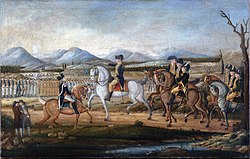
Congress approved an excise tax on distilled spirits, a major source of revenue for servicing the national debt. Western farmers strongly opposed the tax because they often distilled surplus grain and faced difficult market conditions.
Image source: Whiskey Rebellion
Aug 1, 1794 - Nov 13, 1794
Western Pennsylvania resistance to the federal whiskey excise escalated into attacks on officials and property. Washington mobilized a large militia force, and the rebellion collapsed, demonstrating the new federal government's ability to enforce its laws.
Jun 18, 1798 - Jul 14, 1798
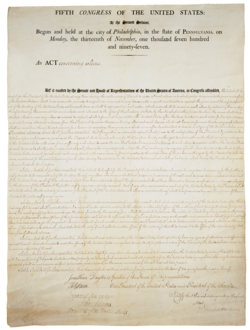
Federalist-controlled Congress passed four laws lengthening the residency requirement for citizenship, expanding presidential authority over noncitizens, and criminalizing certain criticism of the federal government. The measures were denounced as threats to civil liberties.
Image source: Alien and Sedition Acts
Apr 8, 1793 - Sep 22, 1793
French envoy Edmond-Charles Genêt recruited American privateers and sought public support for France despite Washington's neutrality policy. The affair alarmed Federalists and demonstrated the domestic political risks of European revolutionary conflict.
Image source: Edmond-Charles Genêt
Apr 22, 1793
After Revolutionary France went to war with Britain and other European powers, Washington issued a proclamation of neutrality. The decision established a central principle of early American foreign policy and intensified conflict between Federalists and Democratic-Republicans.
Nov 19, 1794
John Jay negotiated a treaty with Great Britain to resolve outstanding disputes from the Revolutionary War. The agreement secured British evacuation of western forts and limited commercial concessions, but its perceived generosity to Britain provoked fierce opposition.
Image source: Jay Treaty
Jun 24, 1795
The Senate ratified Jay Treaty by the required two-thirds majority. The treaty temporarily reduced the risk of war with Britain but deepened partisan divisions and contributed to the emergence of organized national political parties.
Oct 27, 1795
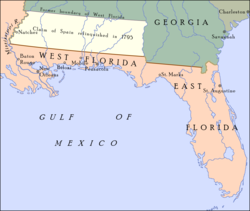
The United States and Spain signed Pinckney's Treaty, establishing the boundary between the United States and Spanish Florida and securing navigation rights on the Mississippi River and access to New Orleans.
Image source: Pinckney's Treaty
Sep 19, 1796
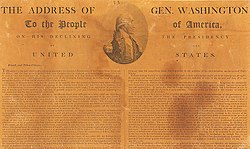
Washington announced that he would not seek a third term and published his Farewell Address. He warned against permanent foreign alliances and destructive factionalism while offering guidance that shaped American political culture.
Image source: George Washington's Farewell Address
Nov 4, 1796 - Dec 7, 1796
The election of 1796 was the first contested presidential election organized around competing political parties. Federalist John Adams won the presidency, while Democratic-Republican Thomas Jefferson became vice president under the constitutional rules then in force.
Image source: 1796 United States presidential election
Mar 4, 1797
John Adams succeeded Washington as the second president. His administration inherited growing tensions with France, intense partisan conflict, and disagreements within the Federalist Party over foreign policy.
Image source: Inauguration of John Adams
Mar 4, 1798 - Apr 22, 1798
Adams disclosed that French intermediaries had demanded payments before negotiations could begin. The XYZ Affair provoked anti-French outrage in the United States and produced the popular slogan “Millions for defense, but not one cent for tribute.”
Image source: XYZ Affair
Jul 7, 1798 - Sep 30, 1800
The United States fought an undeclared naval conflict with France after French forces seized American merchant ships. The Adams administration expanded the navy, while the crisis intensified Federalist calls for military preparedness and political unity.
Image source: Quasi-War
Oct 7, 1798 - Nov 10, 1798
Kentucky and Virginia adopted resolutions condemning the Alien and Sedition Acts. Drafted by Thomas Jefferson and James Madison, they advanced the argument that states could challenge federal actions they considered unconstitutional.
Image source: Kentucky and Virginia Resolutions
Sep 30, 1800
The Convention of 1800 ended the Quasi-War with France and formally dissolved the Franco-American alliance of 1778. Adams's decision to pursue peace divided his party but prevented a larger war.
Image source: Convention of 1800
Oct 31, 1800 - Feb 17, 1801
Thomas Jefferson and Aaron Burr tied in the Electoral College, sending the election to the House of Representatives. After numerous ballots, Jefferson was chosen president and Burr vice president, marking a peaceful transfer of national power between rival parties.
Build a timeline like this one in minutes, for free. Start Yours →
Or browse the full history timeline directory, with more than 2,500 topics.
This Federalist Era timeline was generated with the help of AI, using information found on the internet.
We work hard to keep these timelines accurate, but mistakes do get through. If you spot one, email us at [email protected] and we'll fix it for future visitors.
Generate yours with AI or build it from scratch, for free.
Export your timeline, add your own events, edit or remove AI-generated events, and much more
No credit card required.
15-day money-back guarantee.
You can create an unlimited number of timelines with up to 10 events on each one, customize how they look, export them to PDF, PNG, PowerPoint, CSV, and Excel, and share them with a link. Timelines made with Timeline Maker AI keep every event the generator created, and you can add up to 5 events of your own. Paid plans remove the event limit, add spreadsheet imports and hide Preceden's branding, and the higher-priced plan also adds collaborators, a custom logo and a custom domain.
Yes. You can cancel your subscription from your account page at any time, and you will not be charged again. Your subscription stays active for the rest of the period you already paid for.
Yes. We email you a reminder 15 days before your annual renewal, and we email you a receipt after every payment.
Yes. You can email us within 15 days of any payment, and we will issue you a full refund.
Check out our pricing docs or send us an email anytime: [email protected].