-
Use Cases
-
Resources
-
Pricing
The Georgian Era was a period of British history spanning from 1714 to 1837, named after the four successive Hanoverian kings George I, George II, George III, and George IV, with a brief inclusion of William IV's reign. It was marked by major transformations including the Industrial Revolution, the growth of the British Empire, Enlightenment thinking, and flourishing arts and architecture. The era saw significant social change, urban expansion, and cultural developments that shaped modern Britain. More Less
1713
% complete
Bethel Hospital in Norwich was established in 1713 as one of the first asylums for the mentally ill; lunatic hospitals later opened in Manchester (1766) and York (1777).
1717
% complete
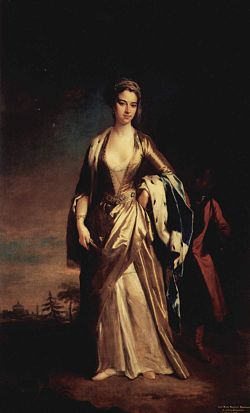
In 1717 Lady Mary Wortley Montagu introduced inoculation against smallpox to Britain, and by 1740 it was in wide usage.
Image source: Lady Mary Wortley Montagu
1721
% complete
Guy's Hospital was founded in London in 1721, part of a wave of new hospitals established during the Georgian era; a ward for incurable lunatics was added in 1728.
Image source: Guy's Hospital
1729
% complete
The Royal Infirmary of Edinburgh was founded in 1729, contributing to the expansion of medical institutions during the Georgian era.
Image source: Royal Infirmary of Edinburgh
1739
% complete
Queen Charlotte's maternity hospital was founded in 1739, reflecting growing attention to maternal care during the Georgian era.
Image source: Queen Charlotte's and Chelsea Hospital
1745
% complete
The Middlesex Hospital was founded in London in 1745, continuing the era's expansion of charitable medical institutions.
Image source: Middlesex Hospital
1772
% complete
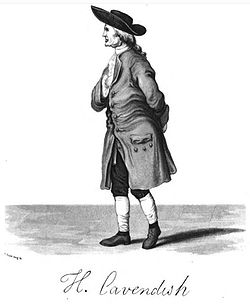
Chemist Henry Cavendish identified hydrogen in 1772, a milestone in the era's flourishing scientific discovery.
Image source: Henry Cavendish
1774
% complete
Daniel Rutherford isolated nitrogen in 1774, while Joseph Priestley discovered oxygen and ammonia, advancing the chemical sciences.
Image source: Daniel Rutherford
1714
% complete
Upon the death of his second cousin Queen Anne, George Louis, Elector of Hanover, succeeds as the new King George I of Great Britain and Ireland, beginning the Georgian era.
Image source: George I of Great Britain
1714 - 1760
% complete
The Whig party is dominant in British politics from the accession of George I until 1760, shaping much of the early Georgian political landscape.
Image source: Whigs (British political party)
1723
% complete
The Black Act of 1723, sponsored by Robert Walpole, strengthened the criminal code for the benefit of the upper class.
Image source: Black Act 1723
1753 - 1754
% complete
The Jewish Naturalisation Act 1753 was repealed a year after it had been passed because of widespread opposition, illustrating hostility to religious minorities in Britain.
Image source: Jewish Naturalisation Act 1753
Jan 1, 1801
% complete
The Act of Union 1800 comes into effect on 1 January, uniting the Kingdoms of Great Britain and of Ireland into the United Kingdom of Great Britain and Ireland.
1811 - 1820
% complete
George IV had been the effective ruler since 1811 as regent for his seriously ill father, George III, before formally becoming king in 1820.
Image source: Regency era
1823
% complete
He founded the Catholic Association in 1823, which quickly became powerful, funded by a 'Catholic rent' of a penny a month from members, including poor peasants, and supported by Catholic priests.
Image source: Catholic Association
1828
% complete
In the 1828 County Clare by-election, Daniel O'Connell stood against the pro-emancipation Protestant MP Vesey Fitzgerald, triggering the emancipation crisis.
Image source: Roman Catholic Relief Act 1829
Apr 1829
% complete
King George IV reluctantly agreed, so in April 1829 Catholic emancipation became official through the Roman Catholic Relief Act 1829, removing almost all restrictions on Roman Catholics in Britain and Ireland.
1830
% complete
Historians debate the exact ending of the Georgian era, but the death of George IV in 1830 is the usual marker; the weakened Tories gave way to Whig parliamentary reform plans.
Image source: Georgian era
1837
% complete
When Victoria became Queen in 1837 the Georgian era was followed by the Victorian era; the deaths of William IV in 1837 is sometimes used as the era's end marker.
1714 - 1715
% complete
Riots broke out on the day of George I's coronation in 1714, followed by further unrest in 1715, reflecting hostility toward the new Hanoverian regime.
Image source: Coronation riots
1780
% complete
The 1780 Gordon Riots in London were directed against Catholics after the Papists Act 1778 removed some of their legal disabilities.
Image source: Gordon Riots
1791
% complete
During the 1791 Priestley Riots in Birmingham, the mob targeted Dissenters, including the prominent Radical Joseph Priestley.
Image source: Priestley Riots
1801
% complete
Irish Catholics felt betrayed, as the Act of Union 1800 had been agreed upon with the promise of granting Catholics full political rights—Catholic Emancipation.
Image source: Catholic emancipation
Mar 1817
% complete
After the Napoleonic Wars ended in 1815, Britain entered economic depression and social unrest; in March 1817 some 400 spinners and weavers marched from Manchester to London to hand the Government a petition.
Image source: Blanketeers
1819
% complete
The Peterloo Massacre in 1819 began as a protest rally which saw 60,000 people gathering to protest about their living standards.
Image source: Peterloo Massacre
1820
% complete
The Cato Street Conspiracy of 1820 sought to blow up the Cabinet and then move on to storm the Tower of London and overthrow the government.
Image source: Cato Street Conspiracy
1720
% complete
The South Sea Bubble was a brief financial setback in 1720, but it also led to improved financial regulation. The company issued stock four times that year, reaching about 8,000 investors.
Image source: South Sea Company
1773
% complete
The Inclosure Act 1773 is put into place by the British Parliament, facilitating the enclosure of common land during the agricultural transformation of the countryside.
Apr 1746
% complete
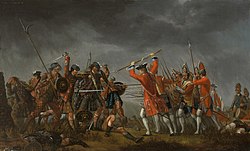
The final Jacobite rising is crushed at the Battle of Culloden in April 1746, ending Stuart hopes of restoring their dynasty to the British throne.
Image source: Battle of Culloden
1754 - 1763
% complete
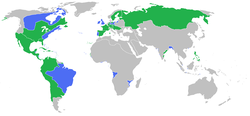
The Seven Years' War, known in America as the French and Indian War (1754–1763), was one of the major episodes of conflict during the Georgian era.
Image source: Seven Years' War
1763
% complete
The Treaty of Paris of 1763 grants Britain domain over vast new territories around the world following victory in the Seven Years' War.
Image source: Treaty of Paris (1763)
1775 - 1783
% complete
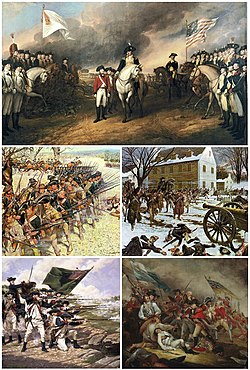
The American Revolutionary War (1775–1783) saw Britain's thirteen North American colonies fight for independence, one of the major conflicts of the Georgian era.
Image source: American Revolutionary War
Oct 1781
% complete
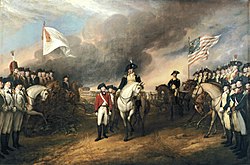
The British Army in America under Lord Cornwallis surrenders to George Washington after its defeat at Yorktown, Virginia, in October 1781.
Image source: Siege of Yorktown
1783
% complete
Great Britain formally recognises the independence of the original 13 American States in the Treaty of Paris of 1783.
Image source: Treaty of Paris (1783)
1805
% complete
Victory over Napoleon at the Battle of Trafalgar (1805) under Admiral Lord Nelson brought a sense of triumphalism and political reaction to Britain.
Image source: Battle of Trafalgar
1815
% complete
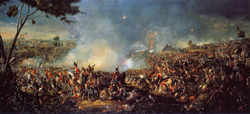
Victory over Napoleon at the Battle of Waterloo (1815) under the Duke of Wellington ended nearly a quarter century of wars with France (1793–1815) and brought triumphalism to Britain.
Image source: Battle of Waterloo
Or browse the full history timeline directory, with more than 2,000 topics.
This Georgian Era timeline was generated with the help of AI, using information found on the internet.
We work hard to keep these timelines accurate, but mistakes do get through. If you spot one, email us at [email protected] and we'll fix it for future visitors.
Generate yours with AI or build it from scratch, for free.
Export your timeline, add your own events, edit or remove AI-generated events, and much more
No credit card required.
Cancel anytime.
Cancel anytime.
You can create an unlimited number of timelines with up to 10 events on each one, customize how they look, export them to PDF, PNG, PowerPoint, CSV, and Excel, and share them with a link. Paid plans raise the event limit and add features like spreadsheet imports and collaborators.
Yes. You can cancel your subscription from your account page at any time, and you will not be charged again. Your subscription stays active for the rest of the period you already paid for.
Yes. We will email you a reminder before the annual renewal, and we will also email you a receipt.
Yes. You can email us within 15 days of any payment, and we will issue you a full refund.
Check out our pricing docs or send us an email anytime: [email protected].