-
Use Cases
-
Resources
-
Pricing
The Reconstruction Era was the period following the American Civil War during which the United States grappled with reintegrating the former Confederate states and defining the legal status of newly freed African Americans. It saw the passage of the Thirteenth, Fourteenth, and Fifteenth Amendments, the rise of Black political participation, and ultimately the withdrawal of federal troops that ended federal efforts to protect civil rights in the South. More Less
1865 - 1866
% complete
Southern state legislatures passed restrictive laws known as Black Codes to control the labor and behavior of freed African Americans. The codes limited mobility, forced many into exploitative labor contracts, and restricted access to property and courts, prompting outrage in the North and fueling congressional Reconstruction.
Image source: Black Codes (United States)
May 1, 1866 - May 3, 1866
% complete
White mobs, including many police officers, attacked Black residents and their neighborhoods in Memphis, Tennessee, killing 46 people, raping several Black women, and destroying homes, churches, and schools. The violence shocked the nation and strengthened support for Radical Reconstruction and federal protection of freedpeople.
Image source: Memphis massacre of 1866
Jul 30, 1866
% complete
A violent attack by white mobs and police on a convention of Black and white Republicans in New Orleans killed dozens of people, mostly African Americans. Like the Memphis massacre, the riot galvanized Northern public opinion and helped Republicans win sweeping victories in the 1866 congressional elections.
Image source: New Orleans Massacre of 1866
1871 - 1872
% complete
Federal prosecutors brought hundreds of cases against Ku Klux Klan members under the Enforcement Acts, securing convictions that dismantled much of the Klan's organizational structure. The trials demonstrated the federal government's capacity to protect Black voters, though the effort waned as Northern commitment to Reconstruction faded.
Image source: White Knights of the Ku Klux Klan
Apr 20, 1871
% complete
Also known as the Third Enforcement Act, this law gave President Grant sweeping powers to suspend habeas corpus and use federal force to suppress the Ku Klux Klan and other terrorist organizations. It enabled federal prosecutions that severely weakened the first Klan in the South during the early 1870s.
Image source: Ku Klux Klan Act
Apr 13, 1873
% complete
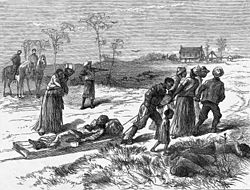
In Colfax, Louisiana, white militias attacked Black freedmen defending the local courthouse after a contested election, killing an estimated 60 to 150 African Americans. It was one of the deadliest incidents of racial violence during Reconstruction and foreshadowed the collapse of Republican rule in Louisiana.
Image source: Colfax massacre
Mar 27, 1876
% complete
The Supreme Court overturned convictions of white perpetrators of the Colfax massacre, ruling that the federal government could not prosecute private individuals for violating the civil rights of others. The decision crippled federal efforts to combat racial violence and protect Black citizens in the South.
Image source: United States v. Cruikshank
Jan 16, 1865
% complete
Union General William T. Sherman issued Special Field Order No. 15, setting aside coastal land in South Carolina, Georgia, and Florida for the settlement of freed African Americans. This policy gave rise to the phrase 'forty acres and a mule,' though the land was later returned to former Confederate owners under President Andrew Johnson.
Image source: Forty acres and a mule
Mar 3, 1865 - 1872
% complete
Congress created the Bureau of Refugees, Freedmen, and Abandoned Lands to assist formerly enslaved people in the South by providing food, housing, medical aid, education, and help negotiating labor contracts. The Bureau also helped establish historically Black colleges and played a central role in early Reconstruction efforts before its dissolution in the early 1870s.
Image source: Freedmen's Bureau
1870 - 1877
% complete
Beginning with Hiram Revels of Mississippi in 1870, African Americans were elected to the U.S. Congress during Reconstruction. In total, sixteen Black men served in Congress during the era, alongside hundreds more in state legislatures, marking an unprecedented, though temporary, period of Black political participation in American life.
Image source: Reconstruction era
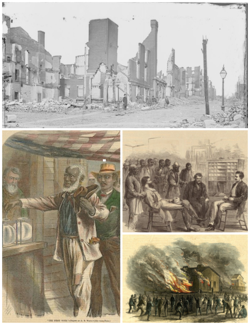
May 31, 1870
% complete
Congress passed the first of three Enforcement Acts, designed to protect African American voting rights guaranteed by the Fifteenth Amendment. The acts authorized federal supervision of elections and criminal penalties for interference with voting rights, laying the legal groundwork for federal intervention against white supremacist violence.
Mar 1, 1875
% complete
Sponsored by Senator Charles Sumner, this law guaranteed equal access to public accommodations such as inns, theaters, and public transportation regardless of race. Enforcement was weak, and the Supreme Court declared it unconstitutional in 1883, marking the end of federal civil rights legislation for decades.
Image source: Civil Rights Act of 1875
Mar 1, 1880
% complete
The Supreme Court ruled that a West Virginia law excluding Black citizens from juries violated the Equal Protection Clause of the Fourteenth Amendment. It was one of the few post-Reconstruction victories for civil rights, affirming that states could not discriminate on the basis of race in jury selection.
Apr 14, 1865
% complete
President Abraham Lincoln was shot by John Wilkes Booth at Ford's Theatre in Washington, D.C., and died the next morning. Lincoln's death placed Andrew Johnson in the presidency and dramatically altered the course of Reconstruction, as Johnson pursued a far more lenient approach toward the defeated Confederate states.
Image source: Assassination of Abraham Lincoln
Apr 15, 1865 - Mar 4, 1869
% complete
Andrew Johnson assumed the presidency following Lincoln's assassination. His Reconstruction policies emphasized rapid restoration of the former Confederate states with minimal protections for freedpeople, setting up repeated clashes with the Radical Republicans in Congress who sought stronger federal guarantees of civil rights.
Image source: Presidency of Andrew Johnson
Dec 6, 1865
% complete
The Thirteenth Amendment was ratified, formally abolishing slavery and involuntary servitude throughout the United States, except as punishment for crime. This constitutional milestone marked the legal end of slavery and created the foundation for the broader struggle over the rights and status of freed African Americans.
Image source: Thirteenth Amendment to the United States Constitution
Apr 9, 1866
% complete
Congress passed the Civil Rights Act of 1866 over President Johnson's veto, granting citizenship and equal civil rights to all persons born in the United States, regardless of race. It was the first major law in American history to be enacted over a presidential veto and laid the groundwork for the Fourteenth Amendment.
Mar 2, 1867
% complete
Congress passed the First Reconstruction Act over Johnson's veto, dividing the former Confederacy into five military districts and requiring states to draft new constitutions guaranteeing Black male suffrage before readmission to the Union. This marked the beginning of Radical Reconstruction and federal military oversight of the South.
Mar 2, 1867 - 1887
% complete
Congress passed the Tenure of Office Act to restrict the president's power to remove certain officeholders without Senate approval. Johnson's violation of this act by attempting to dismiss Secretary of War Edwin Stanton led directly to his impeachment in 1868. The act was later repealed.
Mar 30, 1867
% complete
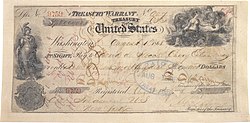
The United States purchased Alaska from Russia for $7.2 million in a deal negotiated by Secretary of State William Seward. Though unrelated to Southern Reconstruction, the acquisition reflected the expansionist ambitions of the Johnson-era government and was initially mocked as 'Seward's Folly' before proving strategically and economically valuable.
Image source: Alaska Purchase
Feb 24, 1868 - May 26, 1868
% complete
The House of Representatives impeached President Andrew Johnson for violating the Tenure of Office Act after he attempted to remove Secretary of War Edwin Stanton. The Senate fell one vote short of the two-thirds majority needed to convict and remove him, preserving Johnson in office but weakening his influence over Reconstruction.
Image source: Impeachment of Andrew Johnson
Jul 9, 1868
% complete
The Fourteenth Amendment was ratified, granting birthright citizenship and guaranteeing due process and equal protection under the law to all persons. It became one of the most consequential amendments in American constitutional history, providing the legal basis for countless civil rights claims in later generations.
Nov 3, 1868
% complete
Civil War hero Ulysses S. Grant won the 1868 presidential election, defeating Democrat Horatio Seymour with the crucial support of newly enfranchised Black voters in the South. Grant's victory signaled continued federal commitment to Reconstruction and the protection of African American civil and political rights.
Image source: 1868 United States presidential election
Feb 3, 1870
% complete
The Fifteenth Amendment was ratified, prohibiting the denial of the right to vote based on race, color, or previous condition of servitude. It represented the culmination of Reconstruction's constitutional revolution, though its enforcement would prove weak and its protections would be systematically undermined in later decades.
May 22, 1872
% complete
Congress passed the Amnesty Act, restoring full political rights, including the right to hold office, to most former Confederates, excluding only a few hundred high-ranking leaders. The act enabled former Confederate officials to regain power in Southern politics, accelerating the decline of Republican governments in the South.
Apr 14, 1873
% complete
In its first major interpretation of the Fourteenth Amendment, the Supreme Court narrowly defined the privileges and immunities of national citizenship, effectively gutting the amendment's protections against state action. The decision severely limited federal power to safeguard the civil rights of African Americans.
Sep 18, 1873 - 1877
% complete
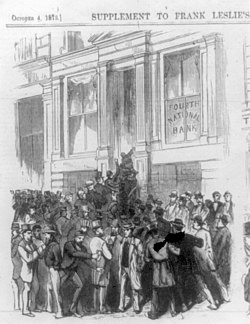
A severe economic depression triggered by the failure of the banking firm Jay Cooke & Company swept the nation. The economic crisis shifted Northern attention away from Reconstruction, weakened support for federal spending in the South, and strengthened Democrats in the 1874 midterm elections.
Image source: Panic of 1873
Nov 7, 1876 - Mar 2, 1877
% complete
The presidential election between Republican Rutherford B. Hayes and Democrat Samuel Tilden produced disputed results in Florida, Louisiana, and South Carolina. An electoral commission negotiated a resolution that awarded the presidency to Hayes, with the understanding that federal troops would be withdrawn from the South.
Image source: 1876 United States presidential election
Feb 26, 1877
% complete
The informal Compromise of 1877 resolved the disputed election by making Rutherford B. Hayes president in exchange for the removal of federal troops from the South. The withdrawal ended Republican control of the remaining Reconstruction governments and effectively concluded the federal effort to protect the rights of freedpeople.
Image source: Compromise of 1877
Apr 1877
% complete
President Hayes ordered the removal of the last federal troops from South Carolina and Louisiana in April 1877. With the soldiers gone, Democratic 'Redeemer' governments quickly took control, marking the symbolic end of Reconstruction and leaving African Americans without federal protection.
Oct 15, 1878
% complete
By the late 1870s, federal enforcement of the Reconstruction Amendments had largely collapsed. Court decisions and declining Northern will made prosecutions of white supremacist violence increasingly rare, allowing disenfranchisement, Jim Crow segregation, and racial terror to take root across the South.
Oct 15, 1883
% complete
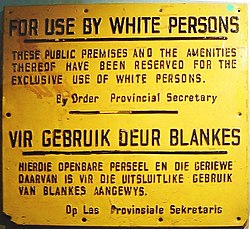
The Supreme Court struck down the Civil Rights Act of 1875, ruling that the Fourteenth Amendment did not give Congress the power to prohibit racial discrimination by private individuals and businesses. The decision opened the door for the rise of Jim Crow segregation throughout the South.
Or browse the full history timeline directory, with more than 2,000 topics.
This Reconstruction Era timeline was generated with the help of AI, using information found on the internet.
We work hard to keep these timelines accurate, but mistakes do get through. If you spot one, email us at [email protected] and we'll fix it for future visitors.
Generate yours with AI or build it from scratch, for free.
Export your timeline, add your own events, edit or remove AI-generated events, and much more
No credit card required.
Cancel anytime.
Cancel anytime.
You can create an unlimited number of timelines with up to 10 events on each one, customize how they look, export them to PDF, PNG, PowerPoint, CSV, and Excel, and share them with a link. Paid plans raise the event limit and add features like spreadsheet imports and collaborators.
Yes. You can cancel your subscription from your account page at any time, and you will not be charged again. Your subscription stays active for the rest of the period you already paid for.
Yes. We will email you a reminder before the annual renewal, and we will also email you a receipt.
Yes. You can email us within 15 days of any payment, and we will issue you a full refund.
Check out our pricing docs or send us an email anytime: [email protected].