
-
Resources
-
Pricing
The history of razors traces the evolution of shaving tools from prehistoric sharp stones and shells to bronze blades, steel straight razors, safety razors, and modern electric and disposable designs. More Less
Build a timeline like this one in minutes, for free. Start Yours →
Part of our collection of invention and technology timelines.
1700 - 1899
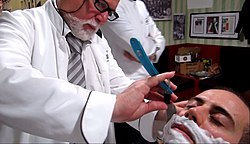
Wealthy people in the 18th and 19th centuries could also visit barbershops to receive a shave.
Image source: Barber
1700 - 1899
Straight razors with exposed steel blades, commonly called cut-throats, became the most commonly used razors before the 20th century.
1700 - 1899
Open steel-blade straight razors, also known as cut-throats, were the dominant form of razor use before the 20th century.
Image source: Straight razor
1700 - 1899
During the 18th and 19th centuries, England was regarded as the center of the cutlery industry, with Sheffield playing a major role.
Image source: Sheffield
1700 - 1899
The first modern straight razor, featuring decorated handles and a hollow-ground blade, was constructed in Sheffield, England.
1700 - 1899
Early modern straight razors produced in Sheffield included decorated handles as part of their construction.
1700 - 1899
The first modern straight razors included hollow-ground blades, an important refinement in blade construction.
1700 - 1899
In the 18th and 19th centuries, wealthy people often relied on servants to shave them.
Image source: Shaving
1800 - 1899
Daily shaving was not a widespread practice during the 19th century.
1800 - 1899
During the 19th century, some people did not shave at all.
1900 - 1959
Straight razors were the most common form of shaving before the 20th century and remained common in many countries until the 1950s.
1740
In 1740, Benjamin Huntsman produced the first superior hard steel grade through a special crucible process. The material was suitable for blade production, although it was initially rejected in England.
Image source: Benjamin Huntsman
1740
Although Benjamin Huntsman's new crucible steel was suitable for razor blades, it was initially rejected in England.
Image source: Crucible steel
1762
The first safety razor was most likely invented around 1762 by the French cutler Jean-Jacques Perret.
1762
Jean-Jacques Perret is credited with creating an early safety-razor design, an important step toward protecting the user from the exposed edge of a straight razor.
Image source: Levallois-Perret
1847
Henson's patent application described a comb-tooth guard intended to protect the user from the razor blade.
Image source: William Samuel Henson
1847
William Samuel Henson's 1847 patent application included an early description of a safety razor similar in form to modern designs.
1880
In 1880, safety razor described a basic razor with a handle attached to a head that accepted a removable blade.
1880
1900 - 1999
By the 20th century, clear gender-specific structural distinctions had emerged among razor offerings, although the point at which razors became prevalent among both men and women remains uncertain.
Image source: Razor
1901
In 1901, American inventor King Camp Gillette, assisted by William Nickerson, submitted a patent for a new safety razor using disposable blades.
Image source: King C. Gillette
1901
William Nickerson assisted King Camp Gillette in developing and submitting the patent for a safety razor with disposable blades.
1904
The disposable-blade safety-razor design submitted by King Camp Gillette and William Nickerson was patented in 1904.
Image source: Gillette
1960
In 1960, stainless steel blades that could be used more than once became available, reducing the cost of shaving with a safety razor.
1960 - 1969
Cartridge razors were developed during the 1960s, using a razor-and-blades business model pioneered in the early 20th century.
Image source: Safety razor
1960 - 1969
Cartridge razors eventually became the most common form of shaving in developed countries.
2023
In 2023, retailers in the United States sold 20 percent fewer razor blades than they had sold in 2019.
1898
1928
Jacob Schick obtained the patent that later served as the basis for Remington Rand's industrial production of electric razor machines.
Image source: Jacob Schick
1937
Industrial production of electric razor machines began in 1937 through the US company Remington Rand.
1937
Remington Rand's industrial production of electric razors was based on a patent obtained by Jacob Schick in 1928.
1939
1963
An electric shaving device was invented in 1963 by American entertainer and inventor Paul Winchell.
Image source: Paul Winchell
Build a timeline like this one in minutes, for free. Start Yours →
Or browse the full history timeline directory, with more than 2,500 topics.
This History of Razors timeline was generated with the help of AI, using information found on the internet.
We work hard to keep these timelines accurate, but mistakes do get through. If you spot one, email us at [email protected] and we'll fix it for future visitors.
Generate yours with AI or build it from scratch, for free.
Export your timeline, add your own events, edit or remove AI-generated events, and much more
No credit card required.
15-day money-back guarantee.
You can create an unlimited number of timelines with up to 10 events on each one, customize how they look, export them to PDF, PNG, PowerPoint, CSV, and Excel, and share them with a link. Timelines made with Timeline Maker AI keep every event the generator created, and you can add up to 5 events of your own. Paid plans remove the event limit, add spreadsheet imports and hide Preceden's branding, and the higher-priced plan also adds collaborators, a custom logo and a custom domain.
Yes. You can cancel your subscription from your account page at any time, and you will not be charged again. Your subscription stays active for the rest of the period you already paid for.
Yes. We email you a reminder 15 days before your annual renewal, and we email you a receipt after every payment.
Yes. You can email us within 15 days of any payment, and we will issue you a full refund.
Check out our pricing docs or send us an email anytime: [email protected].