
-
Use Cases
-
Resources
-
Pricing
The History of Rio de Janeiro traces the evolution of one of Brazil's most iconic cities, from its founding by Portuguese colonizers in 1565, through its periods as the seat of the Portuguese Empire and capital of independent Brazil, to its transformation into a major economic, cultural, and tourist hub known worldwide for landmarks like Christ the Redeemer, Sugarloaf Mountain, and Copacabana Beach. More Less
Jan 1, 1502
% complete
Guanabara Bay was first encountered by Europeans on January 1, 1502, when Portuguese explorers Gaspar de Lemos and Gonçalo Coelho arrived on its shores. The term carioca was first attested this year, marking the beginning of European presence in Rio de Janeiro.
Image source: Guanabara Bay
1555 - 1567
% complete
Between 1555 and 1567, the territory around Guanabara Bay was occupied by the French, who intended to install a colony called France Antarctique in the region that would later become Rio de Janeiro.
Image source: France Antarctique
Mar 1565
% complete
Aiming to prevent the occupation of the Frenchmen, the city of Rio de Janeiro was established in March 1565 by Estácio de Sá, securing Portuguese control over the region.
Image source: Estácio de Sá
1600 - 1699
% complete
In the 17th century, cattle raising and sugar cane cultivation stimulated the city's economic progress, laying foundations for future growth of Rio de Janeiro and its surrounding region.
Image source: Rio de Janeiro (state)
1700
% complete
In the 18th century, the city's progress was definitively assured when the port of Rio de Janeiro started to export gold extracted from Minas Gerais, making it a vital commercial hub of colonial Brazil.
1763
% complete
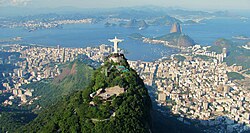
In 1763, Rio de Janeiro became the capital of Colonial Brazil, replacing Salvador as the seat of Portuguese colonial administration. Twenty years later, in 1783, fluminense was sanctioned as the official demonym of the Royal Captaincy of Rio de Janeiro.
Image source: Rio de Janeiro
1808
% complete
With the flight of the Portuguese royal family from Portugal to Brazil in 1808, the region soon benefited from urban reforms to house the Portuguese court, transforming Rio de Janeiro into the center of the Portuguese Empire.
Image source: Transfer of the Portuguese court to Brazil
1815 - 1822
% complete
From 1815 to 1822, Rio de Janeiro served as the capital of the United Kingdom of Portugal, Brazil and the Algarves, reflecting the city's elevated status following the transfer of the Portuguese court.
Image source: United Kingdom of Portugal, Brazil and the Algarves
1822
% complete
Upon independence in 1822, Rio de Janeiro became the capital of independent Brazil as a kingdom, and later continued as capital of the republic until 1960.
1834
% complete
In 1834, the city of Rio de Janeiro was transformed into a neutral city, remaining as the national capital, while the captainships became provinces, with headquarters in Niterói, a neighbouring city.
1889
% complete
In 1889, with the proclamation of the Republic, the city of Rio de Janeiro became the capital of the Republic, the neutral city became the federal district, and the province became a state.
1894 - 1902
% complete
In 1894, Petrópolis became the capital of Rio de Janeiro state, serving in this role until 1902, when Niterói recovered its status as state capital.
Image source: Petrópolis
1902
% complete
In 1902, Niterói recovered its status as the capital of Rio de Janeiro state after Petrópolis's brief period as capital from 1894.
Image source: Niterói
1960
% complete
With the relocation of the federal capital to Brasília in 1960, the city of Rio de Janeiro became Guanabara State. Only then did carioca become an official demonym along with guanabarino.
Image source: Guanabara (state)
1975
% complete
In 1975, Guanabara State was incorporated into Rio de Janeiro State, becoming the present City of Rio de Janeiro. A further change restored the former city-state to the status of a municipality governed by mayors.
1783
% complete
While carioca is an older term first attested in 1502, fluminense was sanctioned in 1783, twenty years after the city had become the capital of the Brazilian colonies, as the official demonym of the Royal Captaincy of Rio de Janeiro. From 1783 through the Imperial Regime, carioca remained an unofficial term used for inhabitants of the city and province.
1890
% complete
Native born Portuguese and their children accounted for 51.20% of the inhabitants of Rio de Janeiro in 1890, a total of 267,664 people, reflecting the city's strong Portuguese character.
1920
% complete
The Brazilian census of 1920 showed that 39.74% of the Portuguese who lived in Brazil lived in Rio de Janeiro, highlighting the city's role as the main destination for Portuguese immigrants.
2010
% complete
According to the 2010 Brazilian census, there were 7,324,315 Roman Catholics (45.8%), 4,696,906 Protestants (29.4%), 647,572 Spiritists (4%), and 2,416,303 people without religion (14.6%) in Rio de Janeiro state.
2022
% complete
According to the IBGE census of 2022, there were 16,055,174 people residing in Rio de Janeiro state, making it the third most populous Brazilian state and the most densely populated state in Brazil. The same census recorded 5,503,882 Roman Catholics (38.9%), 4,526,166 Protestants (32.0%), 499,189 Spiritists (3.5%), and 365,452 practitioners of Umbanda and Candomblé (2.6%).
1900
% complete
The area around Campos dos Goytacazes was most affected by the fall of sugar cane: at the beginning of the 20th century, Campos had 27 mills in operation and throughout the century was one of the largest producers in the world.
Image source: Campos dos Goytacazes
1967
% complete
The Presidente Dutra highway, the name given to the BR-116 on the section connecting São Paulo to Rio through Volta Redonda, Barra Mansa and Resende, was the first duplicated highway in the country in 1967.
Image source: Rodovia Presidente Dutra
1980 - 2020
% complete
The state harvested about 10 million tonnes of sugar cane in the 1980s but reached only 1 million tonnes in 2017, when it began to recover, harvesting 1.8 million tonnes in the 2019/20 season. By 2020, only two sugar mills were operating in Campos dos Goytacazes.
Aug 2004
% complete
Since August 2004, with the transfer of many flights from Santos Dumont Airport to Rio de Janeiro-Galeão International Airport, Rio de Janeiro has been served by the second international airport of Brazil.
Image source: Rio de Janeiro/Galeão International Airport
2009 - 2020
% complete
The state was an important producer of coconuts in Quissamã and the Lakes Region, ranking 7th nationally in 2009, but between 2010 and 2020 several producers abandoned the activity.
Image source: Quissamã
2014
% complete
The state maintains itself as the largest oil producer in Brazil with 80% of the total. Royalties and special participations brought the state 4.2 billion reais in 2014, when the barrel of oil reached $93.48.
Image source: Industry in Brazil
2016
% complete
The international price of a barrel of oil fell to USD 50.48 in 2016 and reached a low of USD 28, affecting the oil-dependent economy of Rio de Janeiro state.
2019
% complete
In agriculture, the State of Rio stands out for pineapple, where it is the 4th producer in the country with 116 million fruits in 2019, produced in São Francisco de Itabapoana, São João da Barra, Campos dos Goytacazes and Quissamã, alongside smaller productions of cassava, banana, orange, tangerine, lemon and persimmon.
2023
% complete
In 2023, Açu was the third largest private iron ore terminal in Brazil, responsible for 30% of the country's oil exports. It was also building the largest thermoelectric park in Latin America and houses the largest offshore support base in the world.
Image source: Superporto do Açu
Jul 16, 1950
% complete
Rio de Janeiro hosted the 1950 FIFA World Cup final at the Maracanã stadium, one of the most famous matches in football history, played before an enormous crowd.
Image source: Uruguay v Brazil (1950 FIFA World Cup)
1954
% complete
The state of Rio de Janeiro hosted the 1954 FIBA World Championship, bringing international basketball competition to Brazil.
Image source: 1954 FIBA World Championship
1963
% complete
Rio de Janeiro once again hosted the FIBA World Championship in 1963, cementing its reputation as a major venue for international basketball.
1978 - 1990
% complete
Jacarepaguá was the venue for the Brazilian leg of the Formula One Grand Prix between 1978 and 1990, hosting some of the era's most memorable races.
Image source: Autódromo Internacional Nelson Piquet
1985 - 2001
% complete
The WCT and WQS surf tours took place on Rio's beaches between 1985 and 2001, showcasing the city's world-renowned surf breaks to an international audience.
Image source: World Surf League
1995
% complete
The state hosted the 1995 FINA World Swimming Championships (25 m), among many other major international sporting events held in Rio de Janeiro.
1996 - 1999
% complete
After Formula One departed, the Jacarepaguá circuit hosted Champ Car racing from 1996 to 1999, continuing Rio's tradition of top-level motorsport.
2007
% complete
Rio de Janeiro hosted the 2007 Pan American Games. The Engenhão stadium was planned to host the athletics and football events of the games, joining Maracanã and São Januário, the largest private stadium in Rio.
Image source: 2007 Pan American Games
Jul 13, 2014
% complete
Rio de Janeiro hosted the 2014 FIFA World Cup final at the Maracanã stadium, the second time the city staged the tournament's decisive match after 1950.
Image source: 2014 FIFA World Cup final
Aug 5, 2016 - Aug 21, 2016
% complete
Rio de Janeiro hosted the 2016 Summer Olympics, the first Olympic Games ever held in South America, further establishing the city as a premier global sporting venue.
Image source: 2016 Summer Olympics
Or browse the full history timeline directory, with more than 2,000 topics.
This History of Rio de Janeiro timeline was generated with the help of AI, using information found on the internet.
We work hard to keep these timelines accurate, but mistakes do get through. If you spot one, email us at [email protected] and we'll fix it for future visitors.
Generate yours with AI or build it from scratch, for free.
Export your timeline, add your own events, edit or remove AI-generated events, and much more
No credit card required.
Cancel anytime.
Cancel anytime.
You can create an unlimited number of timelines with up to 10 events on each one, customize how they look, export them to PDF, PNG, PowerPoint, CSV, and Excel, and share them with a link. Paid plans raise the event limit and add features like spreadsheet imports and collaborators.
Yes. You can cancel your subscription from your account page at any time, and you will not be charged again. Your subscription stays active for the rest of the period you already paid for.
Yes. We will email you a reminder before the annual renewal, and we will also email you a receipt.
Yes. You can email us within 15 days of any payment, and we will issue you a full refund.
Check out our pricing docs or send us an email anytime: [email protected].