-
Use Cases
-
Resources
-
Pricing
Buenos Aires, the capital of Argentina, has a rich history spanning nearly five centuries. Founded twice—first in 1536 and permanently in 1580—it grew from a remote colonial outpost into a major port city. The city played a central role in Argentina's independence movement, experienced massive European immigration in the late 19th and early 20th centuries, and developed into one of South America's most important cultural, economic, and political centers. More Less
Feb 2, 1536
% complete
Spanish adelantado Pedro de Mendoza established the first settlement of Buenos Aires on the Río de la Plata, naming it 'Ciudad de Nuestra Señora Santa María del Buen Ayre'. The fragile colony suffered from hunger and conflict with indigenous Querandí peoples and was abandoned within a few years.
Image source: Pedro de Mendoza
Jun 11, 1580
% complete
Juan de Garay led an expedition from Asunción that permanently re-established Buenos Aires as a Spanish colonial town. Its deep-water port position on the Río de la Plata would gradually shape its destiny as the gateway to the interior of South America's Southern Cone.
Image source: Juan de Garay
1776
% complete
Spain created the Viceroyalty of the Río de la Plata with its capital in Buenos Aires, elevating the city from a minor outpost to the administrative center of a vast territory covering present-day Argentina, Bolivia, Paraguay, and Uruguay. This spurred population growth, trade, and urban development.
Image source: Viceroyalty of the Río de la Plata
Sep 6, 1778
% complete
Charles III's Reglamento de Libre Comercio allowed ports like Buenos Aires to trade directly with Spain and other Spanish American ports, boosting the city's economy and cementing its role as the commercial hub of the viceroyalty despite lingering smuggling restrictions with foreign powers.
Jun 25, 1806 - Jul 5, 1807
% complete
British forces seized Buenos Aires in 1806 but were driven out by local militias led by Santiago de Liniers. A second British invasion in 1807 was also defeated. These victories, achieved largely by criollo forces without significant Spanish military help, fueled local confidence and aspirations for self-government.
Image source: British invasions of the River Plate
May 22, 1810 - May 25, 1810
% complete
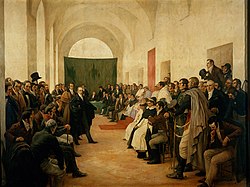
Amid Napoleon's invasion of Spain, citizens of Buenos Aires ousted Viceroy Cisneros and formed the Primera Junta, the first independent local government in the Río de la Plata. The week-long revolution is commemorated annually on May 25 as a national holiday in Argentina.
Image source: May Revolution
Jul 9, 1816
% complete
The Congress of Tucumán formally declared independence from Spanish rule for the United Provinces of the Río de la Plata. Though declared far from Buenos Aires, the city remained the political and commercial engine of the independence movement and the new nation.
Image source: Argentine Declaration of Independence
1820 - 1829
% complete
Following the collapse of central authority, Buenos Aires Province asserted autonomy amid factional struggles between Unitarians and Federalists. The city became the contested prize of civil wars that shaped Argentina's early national organization and its tension between centralism and provincial autonomy.
Image source: United Provinces of the Río de la Plata
1829 - 1852
% complete
Rosas dominated Buenos Aires and much of the confederation for over two decades, ruling with authoritarian Federalist control, censorship, and the Mazorca secret police. His fall after the Battle of Caseros opened the way for constitutional organization of Argentina.
Image source: Juan Manuel de Rosas
1852 - 1861
% complete
Rejecting the federalist settlement, Buenos Aires Province separated from the Confederation and functioned as an independent state for nearly a decade, controlling customs revenues from its port until reunification was forced by Bartolomé Mitre's victory at Pavón.
Image source: State of Buenos Aires
Feb 3, 1852
% complete
Justo José de Urquiza defeated Rosas at Caseros, near Buenos Aires, toppling the caudillo who fled into exile in England. The victory paved the way for the 1853 constitution and the eventual unification of Argentina under a national government.
Image source: Battle of Caseros
1870 - 1914
% complete
Millions of immigrants, chiefly Italians and Spaniards but also many other Europeans, arrived through the Port of Buenos Aires, transforming it into one of the world's great cosmopolitan cities and giving rise to distinctive neighborhoods like La Boca and new cultural forms such as tango.
Image source: Immigration to Argentina
Jan 1871 - Jun 1871
% complete
A catastrophic yellow fever outbreak killed roughly 8% of Buenos Aires' population, especially in San Telmo and other southern barrios. Wealthy residents fled north, accelerating a social geography shift that left the south poorer and shaped patterns still visible today.
1880
% complete
After defeating provincial forces in the Revolution of 1880, President Julio Argentino Roca federalized the city of Buenos Aires, making it the permanent national capital while separating it from Buenos Aires Province, resolving decades of rivalry over capital status.
1880
% complete
In the conventillos and portside districts of Buenos Aires, immigrant communities, Afro-Argentines, and gauchos blended musical traditions into tango, which spread to Paris in the early 1900s and became the emblematic cultural export of the city and nation.
Image source: Tango music
May 25, 1910
% complete
The centennial of the May Revolution featured grand parades, international exhibitions, and newly inaugurated monuments, presenting Buenos Aires as a prosperous, European-style 'Paris of South America' and marking the peak of the liberal oligarchic order before mass politics arrived.
Image source: Argentina Centennial
Dec 1, 1913
% complete
Línea A began service beneath Avenida de Mayo, making Buenos Aires the first city in the Southern Hemisphere and Latin America with an underground railway, a symbol of its rapid modernization and growing urban congestion.
Image source: Buenos Aires Underground
Jan 7, 1919 - Jan 14, 1919
% complete
A strike at the Vasena metalworks escalated into a general strike and violent repression involving police, army, and right-wing paramilitaries, killing hundreds of workers. The week exposed deep class tensions and anti-immigrant anxieties in the rapidly growing capital.
Image source: Tragic Week (Argentina)
1920 - 1929
% complete
The 1920s saw Buenos Aires become a vibrant intellectual hub, with writers like Jorge Luis Borges emerging, avant-garde journals such as Martín Fierro launching, and cafés like Café Tortoni hosting artistic life, cementing the city's reputation as Latin America's literary capital.
Image source: Recoleta, Buenos Aires
Sep 6, 1930
% complete
General José Félix Uriburu led a coup that toppled democratically elected president Hipólito Yrigoyen from his offices in Buenos Aires, initiating the 'Infamous Decade' and establishing a pattern of military intervention in Argentine politics centered on the capital.
Image source: 1930 Argentine coup d'état
May 23, 1936
% complete
The 67.5-meter Obelisk was unveiled at Plaza de la República to commemorate the city's 400th anniversary, becoming the definitive landmark of Buenos Aires and standing at the heart of what would be widened into the world-famous Avenida 9 de Julio.
Image source: Obelisco de Buenos Aires
Oct 17, 1945
% complete
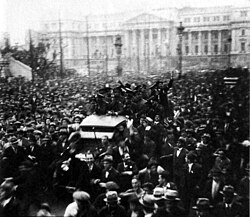
Hundreds of thousands of workers flooded Plaza de Mayo demanding the release of Juan Domingo Perón after his imprisonment, forcing the government to yield. The day, known as Loyalty Day, marked the birth of Peronism and made the plaza the epicenter of Argentine political life.
Image source: Loyalty Day (Argentina)
Jul 26, 1952
% complete
María Eva Duarte de Perón died of cancer at age 33, plunging the city into official mourning. Her funeral procession through Buenos Aires drew enormous crowds, and her legacy as champion of the descamisados profoundly shaped the capital's political culture.
Image source: Eva Perón
Jun 16, 1955
% complete
Navy aircraft attacked crowds of Peronist supporters in Plaza de Mayo, killing hundreds in one of the deadliest days in the city's history. Months later the Revolución Libertadora coup toppled Perón, ushering in years of proscription and instability.
Image source: Bombing of Plaza de Mayo
May 1969
% complete
The worker-student uprising in Córdoba reverberated through Buenos Aires, where protests, puebladas, and clandestine militancy grew throughout the late 1960s, setting the stage for rising political violence in the capital during the early 1970s.
Image source: Cordobazo
Jun 20, 1973
% complete
As Juan Perón returned from 18 years of exile, snipers attacked the massive crowd awaiting him at Ezeiza airport near Buenos Aires, killing dozens. The bloodshed foreshadowed the violent split between Peronist left and right wings that plagued the following years.
Image source: Ezeiza massacre
Mar 24, 1976
% complete
The military junta seized power in Buenos Aires, dissolving Congress and installing General Videla as president. From the capital it orchestrated the Dirty War, with ESMA in Buenos Aires serving as a notorious detention and torture center for thousands of desaparecidos.
Image source: National Reorganization Process
Apr 30, 1977
% complete
Fourteen mothers of disappeared children gathered in Plaza de Mayo asking for news of their loved ones, beginning weekly marches around the Pirámide de Mayo wearing white headscarves. Their courage made them an international symbol of resistance to state terror.
Image source: Mothers of the Plaza de Mayo
Jun 25, 1978
% complete
Argentina defeated the Netherlands 3–1 at the Estadio Monumental in Buenos Aires to win its first World Cup, triggering euphoric celebrations across the city even as the junta used the tournament for propaganda amid ongoing repression.
Image source: 1978 FIFA World Cup final
Dec 10, 1983
% complete
Raúl Alfonsín took office at Casa Rosada, ending nearly eight years of dictatorship. Jubilant crowds filled Plaza de Mayo as Argentina returned to democracy, followed by the CONADEP investigation and the Trial of the Juntas held in Buenos Aires courts.
Image source: 1983 Argentine general election
Apr 22, 1985 - Dec 9, 1985
% complete
Buenos Aires hosted the historic prosecution of the former junta leaders, who were convicted of crimes including kidnapping, torture, and murder. It was the first large-scale human rights trial against a former dictatorship in Latin America.
Image source: Trial of the Juntas
May 1989 - Jul 1989
% complete
Annual inflation surpassed 3000%, triggering supermarket lootings and riots in Greater Buenos Aires. President Alfonsín resigned months early, handing power to Carlos Menem in July 1989, the first democratic transfer between opposing parties in decades.
Image source: 1989 hyperinflation in Argentina
Jul 18, 1994
% complete
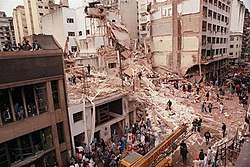
A suicide bomber drove a van loaded with explosives into the AMIA Jewish community center in Once, killing 85 people and wounding hundreds. It remains the deadliest terrorist attack in Argentine history and its investigation has been mired in controversy for decades.
Image source: AMIA bombing
Dec 19, 2001 - Dec 20, 2001
% complete
Amid economic collapse and corralito bank freezes, protesters clashed with police in downtown Buenos Aires, leaving dozens dead. Fernando de la Rúa fled Casa Rosada by helicopter, and Argentina cycled through five presidents in less than two weeks.
Image source: December 2001 riots in Argentina
2003 - 2015
% complete
Beginning with Néstor Kirchner and continuing under Cristina Fernández de Kirchner, Buenos Aires saw recovery from the 2001 crisis, expansion of social programs, legalization of same-sex marriage in 2010, and major urban projects like the Puerto Madero waterfront development.
Image source: Néstor Kirchner
Oct 6, 2018 - Oct 18, 2018
% complete
The third Summer Youth Olympic Games brought thousands of young athletes from more than 200 nations to venues across Buenos Aires, including the iconic Obelisco area, showcasing the city's capacity to host major international sporting events.
Image source: 2018 Summer Youth Olympics
Or browse the full history timeline directory, with more than 2,000 topics.
This History of Buenos Aires timeline was generated with the help of AI, using information found on the internet.
We work hard to keep these timelines accurate, but mistakes do get through. If you spot one, email us at [email protected] and we'll fix it for future visitors.
Generate yours with AI or build it from scratch, for free.
Export your timeline, add your own events, edit or remove AI-generated events, and much more
No credit card required.
Cancel anytime.
Cancel anytime.
You can create an unlimited number of timelines with up to 10 events on each one, customize how they look, export them to PDF, PNG, PowerPoint, CSV, and Excel, and share them with a link. Paid plans raise the event limit and add features like spreadsheet imports and collaborators.
Yes. You can cancel your subscription from your account page at any time, and you will not be charged again. Your subscription stays active for the rest of the period you already paid for.
Yes. We will email you a reminder before the annual renewal, and we will also email you a receipt.
Yes. You can email us within 15 days of any payment, and we will issue you a full refund.
Check out our pricing docs or send us an email anytime: [email protected].