-
Resources
-
Pricing
The history of roller coasters traces the evolution of thrill rides from ice-covered slides in 17th-century Russia to today’s sophisticated steel and wooden designs. More Less
Build a timeline like this one in minutes, for free. Start Yours →
1813
Russian engineers adapted the winter sliding tradition by adding wheeled sleds and grooved tracks. The change allowed the attraction to operate without ice and helped establish the basic idea of a guided vehicle traveling over a shaped course.
1817
The Les Montagnes Russes attraction opened in Paris, bringing the Russian Mountains concept to France. Its wheeled cars and fixed track helped popularize the form among European pleasure seekers.
Image source: Roller coaster
1827
The Mauch Chunk Switchback Gravity Railroad opened in Pennsylvania to transport coal downhill. After its commercial use declined, the line became a paid sightseeing attraction and demonstrated how gravity railways could provide thrilling recreational rides.
Image source: Mauch Chunk Switchback Railway
1848
LaMarcus Adna Thompson, later called the father of the gravity ride, was born in Ohio. His mechanical innovations and business model would turn the roller coaster into a major amusement-park attraction.
Image source: LaMarcus Adna Thompson
Jun 16, 1884
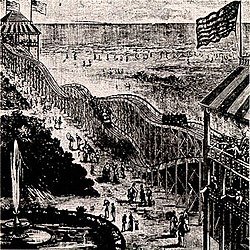
LaMarcus Adna Thompson opened the Switchback Railway at Coney Island in Brooklyn. Passengers climbed a tower, boarded a car, and coasted down a parallel undulating track, establishing the first commercially successful American roller coaster.
Image source: Switchback Railway
Jan 20, 1885
Thompson received a United States patent for an inclined railway designed for amusement. The patent helped him license and reproduce gravity rides across the country, accelerating the spread of roller coasters.
Apr 20, 1886
The United States granted a patent covering Thompson's Switchback Railway. The formal protection supported the licensing of similar installations at amusement grounds throughout the United States.
1887
Coney Island's expanding amusement district began adding competing gravity rides and mechanical attractions. The intense competition helped make Brooklyn a testing ground for new roller-coaster designs and operating practices.
Image source: Coney Island
1887
Thompson developed improved gravity rides marketed as scenic or pleasure railways. These installations combined controlled descents with themed scenery, helping shift the roller coaster from a novelty into a repeatable amusement-park business.
1902
The Gravity Pleasure Switchback Railway opened at Coney Island using Prescott's improved wheel technology. It is widely regarded as one of the first modern roller coasters because its cars were securely guided through a continuous, more forceful course.
1902
Leap-The-Dips opened at Lakemont Park in Altoona, Pennsylvania. The side-friction wooden coaster operated without modern upstop wheels and is now recognized as the world's oldest operating roller coaster after restoration.
1903
Luna Park opened at Coney Island and helped define the modern amusement park. Its spectacular architecture, electric lighting, and collection of rides created a highly competitive environment for roller-coaster innovation.
1904
Kennywood in Pennsylvania opened Jack Rabbit, a major early wooden coaster. Its large drops and innovative terrain-following design helped establish the park as an important center of roller-coaster development.
Jun 26, 1927
The Cyclone opened at Coney Island and quickly became one of the most influential wooden coasters ever built. Its compact layout, steep drops, rapid turns, and intense lateral forces made it a model for later thrill rides.
Image source: Coney Island Cyclone
1929 - 1933
The Great Depression severely reduced discretionary spending and forced many amusement parks and roller coasters to close or fall into disrepair. The industry contracted sharply, though a few established parks continued operating.
Image source: Great Depression
1933 - 1939
Economic recovery during the New Deal era gradually restored leisure spending and public-works employment. Some amusement parks repaired or expanded their attractions, helping roller coasters recover after the Depression.
Image source: New Deal
1939 - 1945
World War II redirected materials, labor, and consumer spending toward the war effort. Roller-coaster construction slowed substantially, and many parks struggled with shortages and reduced attendance.
Image source: World War II
Jul 17, 1955
Disneyland opened in Anaheim, California, introducing a highly themed and controlled amusement-park model. Although it initially emphasized dark rides and family attractions, its design standards strongly influenced the future of roller-coaster presentation.
Image source: Disneyland
Aug 5, 1961
Six Flags Over Texas opened in Arlington as a large, themed regional amusement park. Its success encouraged the development of destination parks that used roller coasters as signature attractions.
Image source: Six Flags Over Texas
1964
Cedar Point opened Blue Streak, beginning the park's transformation into a major roller-coaster destination. The park would later become known for repeatedly pursuing height, speed, and technological records.
Apr 14, 1979
Kings Island opened The Beast, a huge terrain-hugging wooden coaster in Ohio. Its long length, remote wooded setting, and multiple tunnels showed that wooden coasters could still deliver record-scale experiences in the steel-coaster era.
1885
British engineer Philip Hinkler developed the scenic railway, which used a continuous circuit rather than requiring passengers to reverse direction manually. The design became a foundation for later roller-coaster layouts.
1895
The Loop the Loop, an early looping ride, opened at Coney Island. Its circular inversion was technically demanding and produced severe lateral forces, but it proved that controlled upside-down motion could be sold as an amusement experience.
1901
Edwin Prescott patented the upstop wheel, which ran beneath the track and helped keep a coaster car attached during dips and sharper changes in elevation. This innovation made more aggressive layouts practical.
1950 - 1969
John Allen designed and promoted a new generation of wooden roller coasters for Philadelphia Toboggan Coasters and other parks. His layouts combined dramatic drops, efficient operation, and family accessibility during a major postwar revival.
Jun 14, 1959
Disneyland opened the Matterhorn Bobsleds, widely considered the first tubular-steel continuous-track roller coaster. Its steel track, enclosed mountain setting, and independently operating bobsled vehicles transformed coaster engineering and theming.
Image source: Matterhorn Bobsleds
1975
Knott's Berry Farm opened Corkscrew, the first modern roller coaster to invert riders twice in a full 360-degree series. Its compact steel layout helped popularize inversions as a standard feature.
Apr 8, 1976
Six Flags Magic Mountain opened Revolution, the world's first modern looping roller coaster with a complete vertical loop. Its clothoid-shaped loop reduced abrupt forces and demonstrated the potential of modern steel-track design.
May 6, 1989
Cedar Point opened Magnum XL-200, the first roller coaster to exceed 200 feet in height. Its opening began the modern height wars, as parks competed to build taller and faster hypercoasters.
Image source: Magnum XL-200
May 26, 1992
Six Flags Great America opened Batman: The Ride, a suspended inverted coaster designed by Bolliger & Mabillard. Riders hung beneath the track while passing through multiple inversions, making the format a major commercial success.
May 1998
Cedar Point opened Millennium Force, generally recognized as the first giga coaster, with a drop exceeding 300 feet. Its cable lift, smooth steel track, and high-speed course established a new benchmark for large-scale coaster design.
May 4, 2003
Cedar Point opened Top Thrill Dragster, the first strata coaster, reaching more than 400 feet. A hydraulic launch accelerated trains from 0 to 120 miles per hour before sending them over a towering top-hat element.
Image source: Top Thrill 2
May 21, 2005
Six Flags Great Adventure opened Kingda Ka, which became the world's tallest roller coaster and one of its fastest. Its hydraulic launch and 456-foot top-hat tower epitomized the era's emphasis on extreme height and acceleration.
Image source: Kingda Ka
Apr 25, 2015
Holiday World opened Thunderbird, Bolliger & Mabillard's first launched wing coaster. Riders sit beside the track while a magnetic launch propels the train into a course combining inversions, near-ground elements, and winged seating.
May 25, 2016
The success of Rocky Mountain Construction's steel I-box track, first showcased on New Texas Giant, demonstrated how aging wooden coasters could be rebuilt with steel rails. The technology enabled smoother rides, steeper drops, and inversions on wooden structures.
Jul 1996
Fuji-Q Highland in Japan opened Fujiyama, which became one of the world's tallest and fastest roller coasters. Its success reflected the increasingly global competition to build record-setting attractions.
Aug 1, 2000
Steel Dragon 2000 opened at Nagashima Spa Land in Japan. Its enormous length and high-speed layout made it a landmark of Japanese coaster engineering and a leading example of the international record race.
May 31, 2013
Alton Towers opened The Smiler, a steel coaster featuring 14 inversions, then the most on any roller coaster. Its tightly interwoven layout demonstrated how modern computer-aided design could pack numerous elements into a compact footprint.
May 27, 2022
EPCOT opened Guardians of the Galaxy: Cosmic Rewind, a major enclosed Disney coaster with rotating ride vehicles and a backward launch. Its combination of storytelling, controlled orientation, and indoor engineering illustrated the continuing convergence of roller coasters and dark rides.
Build a timeline like this one in minutes, for free. Start Yours →
Or browse the full history timeline directory, with more than 2,500 topics.
This History of Roller Coasters timeline was generated with the help of AI, using information found on the internet.
We work hard to keep these timelines accurate, but mistakes do get through. If you spot one, email us at [email protected] and we'll fix it for future visitors.
Generate yours with AI or build it from scratch, for free.
Export your timeline, add your own events, edit or remove AI-generated events, and much more
No credit card required.
15-day money-back guarantee.
You can create an unlimited number of timelines with up to 10 events on each one, customize how they look, export them to PDF, PNG, PowerPoint, CSV, and Excel, and share them with a link. Timelines made with Timeline Maker AI keep every event the generator created, and you can add up to 5 events of your own. Paid plans remove the event limit, add spreadsheet imports and hide Preceden's branding, and the higher-priced plan also adds collaborators, a custom logo and a custom domain.
Yes. You can cancel your subscription from your account page at any time, and you will not be charged again. Your subscription stays active for the rest of the period you already paid for.
Yes. We email you a reminder 15 days before your annual renewal, and we email you a receipt after every payment.
Yes. You can email us within 15 days of any payment, and we will issue you a full refund.
Check out our pricing docs or send us an email anytime: [email protected].