-
Use Cases
-
Resources
-
Pricing
The History of Rome spans over two millennia, beginning with the legendary founding of the city of Rome in 753 BC and evolving through three major periods: the Roman Kingdom, the Roman Republic, and the Roman Empire. Rome grew from a small settlement on the Italian peninsula into one of the greatest civilizations in human history, shaping law, government, language, architecture, and culture across Europe, North Africa, and the Middle East. Its legacy continues to influence modern Western civilization. More Less
753 BC - 509 BC
% complete
Rome was ruled by a succession of seven kings, beginning with Romulus and ending with Tarquin the Proud. During this era, Rome developed its early institutions, religious practices, and infrastructure, including the Cloaca Maxima sewer and the first temples in the Forum.
Image source: Roman Kingdom
Apr 21, 753 BC
% complete
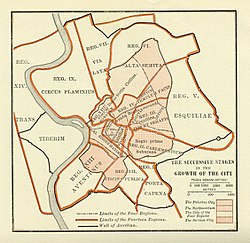
According to Roman legend, Romulus founded the city of Rome on the Palatine Hill after killing his twin brother Remus. This traditional founding date of April 21, 753 BC became central to Roman identity, celebrated annually as the birthday of the Eternal City.
Image source: Founding of Rome
509 BC
% complete
Romans expelled their last king, Lucius Tarquinius Superbus, after the rape of Lucretia by his son. The republic was established with two annually elected consuls sharing power, creating a system designed to prevent any single man from ruling again.
Image source: Roman Republic
451 BC - 450 BC
% complete
The first written code of Roman law, the Twelve Tables, was inscribed on bronze tablets following plebeian pressure for legal transparency. These laws formed the foundation of all subsequent Roman law and remained influential for a millennium.
Image source: Twelve Tables
390 BC
% complete
A Gallic warband led by Brennus defeated the Romans at the Allia River and occupied and burned most of Rome. According to legend, geese sacred to Juno alerted defenders on the Capitoline Hill, and the city eventually bought off the invaders with gold.
Image source: Battle of the Allia
343 BC - 290 BC
% complete
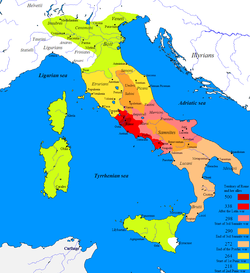
Rome fought three wars against the Samnites, fierce highland peoples of southern Italy. The conflicts, including the famous humiliation at the Caudine Forks, ultimately ended in Roman victory and established Rome as the dominant power in central Italy.
Image source: Samnite Wars
280 BC - 275 BC
% complete
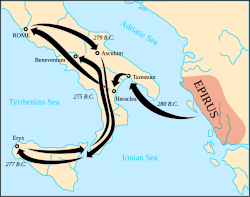
The Greek king Pyrrhus of Epirus came to the aid of Tarentum against Rome, winning costly victories that gave rise to the term 'Pyrrhic victory.' His eventual withdrawal left Rome master of southern Italy and demonstrated its ability to challenge Hellenistic powers.
Image source: Pyrrhic War
264 BC - 241 BC
% complete
Rome and Carthage fought primarily over Sicily in the first of three Punic Wars. Rome built its first substantial navy, won decisive naval battles using the boarding bridge called the corvus, and gained Sicily, Sardinia, and Corsica as its first provinces.
Image source: First Punic War
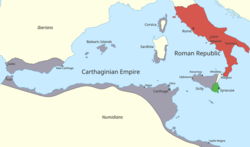
218 BC - 201 BC
% complete
Hannibal Barca famously crossed the Alps with war elephants and devastated Italy, crushing Rome at Trebia, Trasimene, and Cannae. Despite these disasters, Rome refused to surrender, and Scipio Africanus finally defeated Hannibal at Zama in 202 BC.
Image source: Second Punic War
Aug 2, 216 BC
% complete
Hannibal's masterpiece of tactical encirclement annihilated a Roman army nearly twice his size, killing perhaps 50,000 men including both consuls. One of the deadliest single days of battle in history, it remains studied by military commanders to this day.
Image source: Battle of Cannae
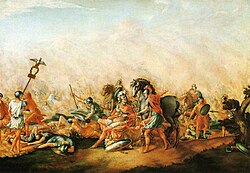
149 BC - 146 BC
% complete
Cato the Elder's repeated demand that 'Carthage must be destroyed' was fulfilled when Rome besieged and razed Carthage after a three-year siege under Scipio Aemilianus. Its territory became the province of Africa, eliminating Rome's great rival forever.
Image source: Third Punic War
133 BC - 121 BC
% complete
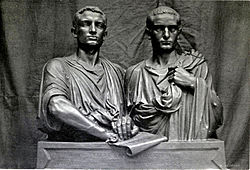
The tribunes Tiberius and Gaius Gracchus attempted sweeping land reforms to aid poor citizens, and both were killed by political opponents. Their murders marked the beginning of a century of political violence that would unravel republican norms.
Image source: Gracchi brothers
91 BC - 88 BC
% complete
Rome's Italian allies revolted demanding citizenship, fighting a bitter war across the peninsula. Though Rome prevailed militarily, it granted citizenship to all Italians south of the Po, unifying Italy under Roman identity.
Image source: Social War (91–87 BC)
73 BC - 71 BC
% complete
Spartacus, a gladiator from Capua, led one of the largest slave revolts in history, defeating several Roman armies and threatening the peninsula itself. Marcus Licinius Crassus finally crushed the uprising, crucifying thousands of rebels along the Appian Way.
Image source: Third Servile War
60 BC
% complete
Julius Caesar, Pompey the Great, and Crassus formed an informal political alliance that dominated Roman politics. The arrangement allowed Caesar to launch his conquest of Gaul, but collapsed after Crassus died at Carrhae and rivalry grew between the remaining two.
Image source: First Triumvirate
58 BC - 50 BC
% complete
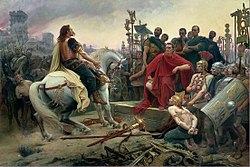
Julius Caesar waged a brutal eight-year campaign conquering Gaul, culminating in the siege of Alesia against Vercingetorix. The conquest brought vast wealth, glory, and a veteran army loyal to Caesar personally, setting the stage for civil war.
Image source: Gallic Wars
Jan 49 BC
% complete
By leading his army across the Rubicon river into Italy proper, Caesar committed treason and triggered civil war against Pompey and the Senate. His declaration 'the die is cast' became proverbial for an irreversible decision.
Image source: Crossing the Rubicon
Mar 15, 44 BC
% complete
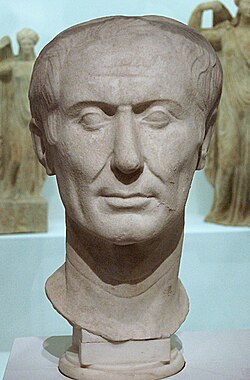
Caesar, recently named dictator perpetuo, was stabbed to death by some sixty senators led by Brutus and Cassius in the Theater of Pompey. Far from saving the republic, his murder plunged Rome into renewed civil war.
Image source: Assassination of Julius Caesar
Sep 2, 31 BC
% complete
Octavian's fleet under Agrippa decisively defeated the combined forces of Mark Antony and Cleopatra off western Greece. The victory left Octavian sole ruler of the Roman world; Antony and Cleopatra fled to Egypt and soon took their own lives.
Image source: Battle of Actium
235 AD - 284 AD
% complete
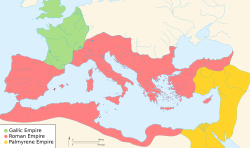
Nearly fifty years of chaos saw dozens of emperors rise and fall through assassination, barbarian invasions, plague, economic collapse, and breakaway states like the Gallic Empire. Diocletian's accession in 284 finally ended the crisis and restored imperial authority.
Image source: Crisis of the Third Century
Feb 313 AD
% complete
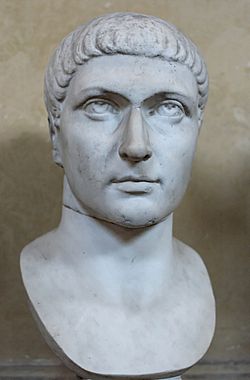
Constantine and Licinius proclaimed religious tolerance throughout the empire, legalizing Christianity after Constantine's victory at the Milvian Bridge. This pivotal act set Christianity on the path to becoming the dominant religion of Europe.
Image source: Edict of Milan
May 11, 330 AD
% complete
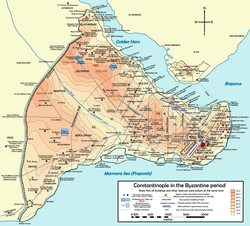
Constantine dedicated his new capital on the site of Byzantium, strategically positioned between Europe and Asia. Constantinople would flourish for over a thousand years as the heart of the Eastern Roman, or Byzantine, Empire.
Image source: Constantinople
395 AD
% complete
After Theodosius I died, the empire was permanently split between his sons Honorius in the West and Arcadius in the East. The division proved irreversible, with the wealthy Greek East increasingly diverging from the Latin West.
Image source: Western Roman Empire
Aug 24, 410 AD
% complete
Alaric's Visigoths stormed Rome and plundered it for three days, the first time the city had fallen to a foreign enemy in eight centuries. The shock reverberated across the Mediterranean and inspired Augustine to write The City of God.
Image source: Sack of Rome (410)
Sep 4, 476 AD
% complete
The Germanic general Odoacer deposed the boy-emperor Romulus Augustulus and declared himself King of Italy, sending the imperial regalia to Constantinople. This event traditionally marks the end of the Western Roman Empire and the beginning of the Middle Ages.
Image source: Fall of the Western Roman Empire
27 BC
% complete
Octavian received the title Augustus from the Senate and carefully consolidated supreme power while preserving republican forms. He reigned for over four decades, establishing the Principate, expanding the empire, and ushering in the long era of peace known as the Pax Romana.
Image source: Augustus
27 BC - 180 AD
% complete
For roughly two centuries, the empire enjoyed relative internal peace, stability, and unprecedented prosperity. Trade flourished along roads and sea lanes, cities grew, and Roman law and culture spread across the Mediterranean world and beyond.
Image source: Pax Romana
Jul 64 AD
% complete
A devastating fire destroyed much of Rome during Nero's reign. Rumors accused the emperor of playing the lyre while the city burned, and Nero deflected blame onto Christians, initiating the first major persecution of the new faith while rebuilding the city grandly.
Image source: Great Fire of Rome
69 AD
% complete
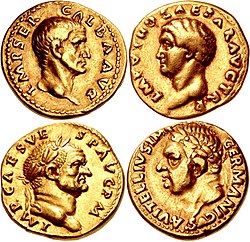
After Nero's suicide, four emperors—Galba, Otho, Vitellius, and Vespasian—claimed power in rapid succession amid civil war. Vespasian emerged victorious, founding the Flavian dynasty and restoring stability to the empire.
Image source: Year of the Four Emperors
79 AD
% complete
Vesuvius erupted catastrophically, burying the towns of Pompeii and Herculaneum under ash and pyroclastic flows. Pliny the Younger's eyewitness account preserved the disaster, and the remarkably intact ruins later became the world's finest window into daily Roman life.
Image source: Eruption of Mount Vesuvius in 79 AD
80 AD
% complete
Begun by Vespasian on the site of Nero's Golden House, the Colosseum opened under Titus with one hundred days of games. It could hold up to 50,000 spectators watching gladiatorial combat, animal hunts, and even naumachiae, becoming the enduring symbol of Rome.
Image source: Colosseum
98 AD - 117 AD
% complete
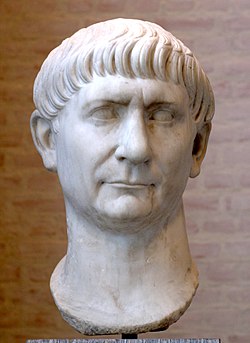
The emperor Trajan conquered Dacia and Mesopotamia, bringing the Roman Empire to its maximum territorial extent. His reign marked the height of imperial power, celebrated by Trajan's Column and Forum in Rome and remembered as the era of the Five Good Emperors.
Image source: Trajan
122 AD - 128 AD
% complete
Emperor Hadrian ordered a 73-mile fortified wall across northern Britain to mark and defend the empire's frontier. Garrisoned by auxiliary troops, it stood as the northwestern edge of Roman power and remains one of Rome's greatest surviving engineering works.
Image source: Hadrian's Wall
165 AD - 180 AD
% complete
An epidemic, likely smallpox, brought back by troops from the East killed millions across the empire, possibly including Emperor Marcus Aurelius. The plague weakened armies, disrupted economies, and foreshadowed the crises of later centuries.
Image source: Antonine Plague
212 AD
% complete
Caracalla's edict extended Roman citizenship to virtually all free inhabitants of the empire, transforming a civic privilege into an imperial identity. The move broadened the tax base but diluted the traditional distinction between Romans and provincials.
Image source: Constitutio Antoniniana
Or browse the full history timeline directory, with more than 2,000 topics.
This History of Rome timeline was generated with the help of AI, using information found on the internet.
We work hard to keep these timelines accurate, but mistakes do get through. If you spot one, email us at [email protected] and we'll fix it for future visitors.
Generate yours with AI or build it from scratch, for free.
Export your timeline, add your own events, edit or remove AI-generated events, and much more
No credit card required.
Cancel anytime.
Cancel anytime.
You can create an unlimited number of timelines with up to 10 events on each one, customize how they look, export them to PDF, PNG, PowerPoint, CSV, and Excel, and share them with a link. Paid plans raise the event limit and add features like spreadsheet imports and collaborators.
Yes. You can cancel your subscription from your account page at any time, and you will not be charged again. Your subscription stays active for the rest of the period you already paid for.
Yes. We will email you a reminder before the annual renewal, and we will also email you a receipt.
Yes. You can email us within 15 days of any payment, and we will issue you a full refund.
Check out our pricing docs or send us an email anytime: [email protected].