-
Use Cases
-
Resources
-
Pricing
Star Trek is a science fiction franchise created by Gene Roddenberry that began with the original television series in 1966 and has since expanded into multiple TV series, films, books, and games. The franchise depicts a hopeful future where humanity explores the galaxy aboard starships like the USS Enterprise, promoting themes of diversity, diplomacy, and scientific discovery. More Less
Mar 11, 1964
% complete
Former pilot Gene Roddenberry wrote a proposal for a science fiction television series about a starship crew exploring the galaxy. He pitched it to Desilu Productions, which optioned the idea, setting in motion the creation of what would become Star Trek.
Image source: Star Trek: The Original Series

Nov 27, 1964
% complete
NBC commissioned a pilot episode starring Jeffrey Hunter as Captain Christopher Pike. Though rejected by NBC executives as 'too cerebral,' the network made the unusual request of a second pilot, and footage from 'The Cage' was later reused in the two-part episode 'The Menagerie.'
Sep 8, 1966
% complete
The first regular episode, 'The Man Trap,' aired on September 8, 1966. Set aboard the USS Enterprise NCC-1701, the series followed Kirk, Spock, and Dr. McCoy on five-year missions of exploration, blending action with social commentary.
Sep 22, 1966
% complete
With William Shatner cast as Captain James T. Kirk alongside Leonard Nimoy's Mr. Spock, the second pilot convinced NBC to greenlight the series. It aired as the third broadcast episode but established the show's tone and central characters.
Image source: Where No Man Has Gone Before
Nov 22, 1968
% complete
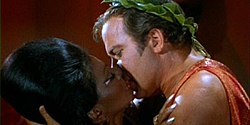
In the episode 'Plato's Stepchildren,' Captain Kirk and Lieutenant Uhura shared what is widely recognized as one of American television's first scripted interracial kisses, a landmark moment during the civil rights era.
Image source: Plato's Stepchildren
Jun 3, 1969
% complete
After struggling with low ratings and being moved to a Friday night death slot, Star Trek was canceled by NBC following its third season. The final original episode, 'Turnabout Intruder,' aired on June 3, 1969.
Sep 8, 1969
% complete
Reruns in syndication found a massive new audience, turning Star Trek into a cultural phenomenon. Fans organized conventions, wrote letters demanding a revival, and created fan fiction, demonstrating unprecedented grassroots support that eventually led to new productions.
Image source: Trekkie
Sep 8, 1973
% complete
Filmation produced an animated continuation featuring the voices of most of the original cast. Running two seasons, it won the franchise's first Emmy Award and allowed stories impossible within live-action budgets, though its canon status was debated for decades.
Image source: Star Trek: The Animated Series
Jan 1, 1977
% complete
Paramount planned a new live-action series starring most of the original cast, with scripts written and sets built. After the success of Close Encounters of the Third Kind demonstrated the box office power of science fiction films, Paramount converted the project into a feature film instead.
Image source: Star Trek: Phase II
Dec 7, 1979
% complete
Directed by Robert Wise, the first Star Trek film reunited the original cast aboard a refitted Enterprise confronting the mysterious V'Ger entity. Despite mixed reviews for its slow pacing, it grossed over $80 million and proved the franchise could thrive on the big screen.
Image source: Star Trek: The Motion Picture
Jun 4, 1982
% complete
Widely regarded as the best of the original-cast films, Nicholas Meyer's sequel pitted Kirk against his old nemesis Khan Noonien Singh. Featuring Ricardo Montalbán's acclaimed performance and Spock's iconic sacrificial death, it revitalized the franchise critically and commercially.
Image source: Star Trek II: The Wrath of Khan
Jun 1, 1984 - Nov 26, 1986
% complete
Nimoy directed The Search for Spock (1984), which resurrected the beloved character, and The Voyage Home (1986), a comedic time-travel tale about saving whales that became the highest-grossing film of the original cast era and earned four Academy Award nominations.
Image source: Star Trek IV: The Voyage Home
Nov 22, 1996
% complete
Jonathan Frakes directed this acclaimed TNG film in which Picard battles the Borg while Zefram Cochrane makes humanity's first warp flight. Grossing $146 million worldwide, it became the highest-grossing Star Trek film at the time and a critical success.
Image source: Star Trek: First Contact
Dec 11, 1998
% complete
The ninth Star Trek film saw Picard defy Starfleet orders to protect the Ba'ku people from forced relocation. Directed by Jonathan Frakes, it received mixed reviews and modest box office returns amid growing franchise fatigue.
Image source: Star Trek: Insurrection
Dec 13, 2002
% complete
The tenth film featured Tom Hardy as Shinzon, a clone of Picard. Plagued by poor marketing and competition from The Lord of the Rings, it became the lowest-grossing Star Trek film, leading Paramount to shelve the film franchise for years.
Image source: Star Trek: Nemesis
Sep 28, 1987
% complete
Set nearly a century after the original series, TNG followed Captain Jean-Luc Picard (Patrick Stewart) and the crew of the USS Enterprise-D. After a rocky first season, it grew into a critical and ratings success, running seven seasons and anchoring the franchise's expansion.
Image source: Star Trek: The Next Generation
Jan 3, 1993
% complete
Breaking from the exploration format, DS9 centered on Commander Benjamin Sisko managing the space station Terok Nor near Bajor. Its serialized storytelling, morally complex arcs like the Dominion War, and diverse cast made it a fan favorite across seven seasons.
Image source: Star Trek: Deep Space Nine
May 23, 1994
% complete
TNG concluded with a two-hour finale that sent Picard jumping through time to save humanity from an anomaly. The Emmy-winning episode provided a satisfying sendoff for the crew, who would continue their adventures in feature films.
Jan 16, 1995
% complete
Voyager followed Captain Kathryn Janeway, Starfleet's first female series lead, and her crew stranded 70,000 light-years from home in the Delta Quadrant. Running seven seasons, it introduced characters like Seven of Nine and continued the franchise's 1990s dominance.
Image source: Star Trek: Voyager
Sep 26, 2001
% complete
A prequel set before the founding of the Federation, Enterprise followed Captain Jonathan Archer exploring space aboard humanity's first warp-five ship. Despite improving creatively in later seasons, declining ratings led to cancellation after four seasons, ending an 18-year run of continuous new Star Trek on television.
Image source: Star Trek: Enterprise
May 8, 2009
% complete
Directed by J.J. Abrams, the reboot recast Kirk, Spock, and the original crew in an alternate timeline created by time travel. A critical and commercial hit grossing $385 million, it introduced Star Trek to a new generation and won an Academy Award for makeup.
Image source: Star Trek (film)
May 16, 2013
% complete
The sequel featured Benedict Cumberbatch as Khan in a controversial retelling of The Wrath of Khan elements. It grossed $467 million worldwide, becoming the highest-grossing Star Trek film ever, though some fans criticized its plot choices.
Image source: Star Trek Into Darkness
Jul 22, 2016
% complete
Directed by Justin Lin for the franchise's 50th anniversary, Beyond emphasized exploration and ensemble teamwork. Well reviewed but earning less than its predecessor, it left the Kelvin timeline film series in limbo.
Image source: Star Trek Beyond
Sep 8, 2016
% complete
Fifty years after the premiere of The Original Series, the franchise marked its golden anniversary with conventions, documentaries, merchandise, and celebrations worldwide, honoring its enduring legacy of optimism, diversity, and scientific curiosity.
Sep 24, 2017
% complete
The first new Star Trek series in 12 years launched the streaming era of the franchise. Starring Sonequa Martin-Green as Michael Burnham, Discovery ran five seasons, evolving from the Klingon War through future-set storylines and helping establish CBS All Access (later Paramount+) as the franchise's home.
Image source: Star Trek: Discovery
Oct 4, 2018
% complete
This anthology series of roughly ten-minute episodes expanded the streaming universe between Discovery seasons, experimenting with animation, standalone character stories, and connections to upcoming series like Picard and Strange New Worlds.
Image source: Star Trek: Short Treks
Jan 23, 2020
% complete
Sir Patrick Stewart reprised Jean-Luc Picard twenty years after Nemesis in a more melancholy, serialized story about the admiral's later life. The series ran three seasons, with its final season reuniting the full Next Generation cast to widespread acclaim.
Image source: Star Trek: Picard
Aug 6, 2020
% complete
Created by Mike McMahan, this animated comedy focused on junior officers aboard the USS Cerritos, lovingly parodying and celebrating franchise lore. It ran five seasons and proved animation could be a vital part of modern Star Trek storytelling.
Image source: Star Trek: Lower Decks
Oct 28, 2021
% complete
This CG-animated series aimed at younger audiences followed a group of alien teens who escape using a derelict Starfleet ship, guided by a hologram of Admiral Janeway voiced by Kate Mulgrew. It later moved to Netflix after being removed from Paramount+.
Image source: Star Trek: Prodigy
May 5, 2022
% complete
Spun off from Discovery, Strange New Worlds returned to the episodic exploration format, following Captain Christopher Pike, young Spock, and Uhura aboard the Enterprise a decade before Kirk. Critically praised for recapturing classic Star Trek's spirit, it quickly became a flagship of the modern franchise.
Image source: Star Trek: Strange New Worlds
Or browse the full history timeline directory, with more than 2,000 topics.
This History of Star Trek timeline was generated with the help of AI, using information found on the internet.
We work hard to keep these timelines accurate, but mistakes do get through. If you spot one, email us at [email protected] and we'll fix it for future visitors.
Generate yours with AI or build it from scratch, for free.
Export your timeline, add your own events, edit or remove AI-generated events, and much more
No credit card required.
Cancel anytime.
Cancel anytime.
You can create an unlimited number of timelines with up to 10 events on each one, customize how they look, export them to PDF, PNG, PowerPoint, CSV, and Excel, and share them with a link. Paid plans raise the event limit and add features like spreadsheet imports and collaborators.
Yes. You can cancel your subscription from your account page at any time, and you will not be charged again. Your subscription stays active for the rest of the period you already paid for.
Yes. We will email you a reminder before the annual renewal, and we will also email you a receipt.
Yes. You can email us within 15 days of any payment, and we will issue you a full refund.
Check out our pricing docs or send us an email anytime: [email protected].