-
Use Cases
-
Resources
-
Pricing
The history of Sydney traces back tens of thousands of years to the Aboriginal peoples of the Eora Nation, whose connection to the land long predates European arrival. In 1788, the First Fleet established a British penal colony at Port Jackson, making Sydney the site of Australia's first European settlement. Over the 19th and 20th centuries, Sydney grew from a colonial outpost into Australia's largest city and economic hub, marked by milestones such as the gold rushes, federation in 1901, the opening of the Sydney Harbour Bridge in 1932, the iconic Opera House in 1973, and hosting the 2000 Olympic Games. More Less
Apr 29, 1770
% complete
Lieutenant James Cook aboard the Endeavour anchored in Botany Bay, making the first recorded European observation of the east coast of Australia. He named it after the bay and claimed the land for Britain, paving the way for later colonization.
Image source: Botany Bay
Jan 26, 1788
% complete
Governor Arthur Phillip led eleven ships carrying convicts, marines and settlers into Port Jackson. He established the first permanent British penal colony at Sydney Cove, founding what would become the city of Sydney.
Image source: First Fleet
Mar 5, 1803
% complete
Australia's first newspaper, The Sydney Gazette and New South Wales Advertiser, began publication under government control, becoming a vital source of news, shipping information and official notices for the young colony.
Image source: The Sydney Gazette
Mar 4, 1804
% complete
Irish convicts at Castle Hill staged one of the earliest uprisings against colonial authority in Australia. The rebellion was quickly crushed by government troops at Vinegar Hill near Rouse Hill, and its leaders were executed or flogged.
Image source: Castle Hill convict rebellion
Jan 26, 1808
% complete
Officers of the New South Wales Corps, backed by wealthy colonists including John Macarthur, arrested Governor William Bligh in a successful military coup. It remains the only armed overthrow of a government in Australian history.
Image source: Rum Rebellion
Apr 1789
% complete
A devastating smallpox epidemic swept through the Aboriginal population around Sydney, killing a large proportion of the Eora people and drastically altering the demographic balance of the region within a year of colonization.
Jan 1, 1810 - Dec 1, 1821
% complete
Governor Lachlan Macquarie transformed Sydney from a penal outpost into a planned town, commissioning major public works such as the Hyde Park Barracks, St James' Church and the first bank, earning him recognition as a founder of modern Sydney.
Image source: Lachlan Macquarie
May 1813 - Nov 1813
% complete
Gregory Blaxland, William Lawson and William Charles Wentworth found a route across the Blue Mountains west of Sydney, unlocking vast grazing lands beyond the coastal plain and fueling the colony's expansion.
Image source: 1813 crossing of the Blue Mountains
Jun 1819
% complete
Designed by architect Francis Greenway, the Hyde Park Barracks provided accommodation for male convicts working for the government. Today it stands as a UNESCO World Heritage site testifying to Australia's convict history.
Image source: Hyde Park Barracks, Sydney
Oct 1, 1840
% complete
Following sustained protest from free settlers, Britain ended the transportation of convicts to New South Wales. This marked Sydney's transition from a penal settlement toward a free commercial city.
Image source: Convicts in Australia
Jul 20, 1842
% complete
The City of Sydney was formally incorporated as an autonomous municipality with an elected council, giving residents local self-government and establishing the office of mayor for the growing town.
Image source: City of Sydney
Oct 1, 1850
% complete
The University of Sydney opened as Australia's first university, modeled on Oxford and Cambridge. It admitted students regardless of religion or class, becoming an intellectual cornerstone of the colony.
Image source: University of Sydney
May 1851 - 1860
% complete
Discoveries of gold in New South Wales triggered a rush that brought enormous wealth, new immigrants and rapid economic growth, transforming Sydney into a booming port and financial hub despite Melbourne capturing much of the trade.
Image source: Australian gold rushes
Sep 26, 1855
% complete
The Sydney Railway Company opened the first railway line in New South Wales, running from Sydney Terminus to Parramatta Junction, beginning the rail network that would shape suburban growth for over a century.
Image source: Railways in Sydney
Jan 1, 1856
% complete
New South Wales gained responsible government under its own constitution, with a bicameral parliament elected largely by popular vote. Sydney became the seat of a self-governing colonial democracy.
Feb 1857
% complete
Severe storms and flooding battered the city in 1857, damaging ships in the harbor and low-lying suburbs, reminding residents of the vulnerability of the rapidly expanding settlement to natural disasters.
Image source: History of Sydney
Sep 17, 1879 - Apr 1880
% complete
Housed in the ornate Garden Palace building, the exhibition showcased international arts, industry and technology, announcing Sydney's ambitions as a global city. The Garden Palace tragically burned down in 1882.
Image source: Sydney International Exhibition
Jan 1900 - Aug 1900
% complete
Bubonic plague broke out in the wharves and slums of central Sydney, killing about 100 people. Authorities demolished hundreds of buildings in The Rocks, reshaping the historic district in the name of public health.
Jan 1, 1901
% complete
Six colonies united to form the Commonwealth of Australia. Although Canberra was later chosen as the national capital, Sydney became a state capital within the federation and celebrated the new nation with grand festivities.
Image source: Federation of Australia
Aug 1914 - Nov 11, 1918
% complete
Tens of thousands of Sydneysiders enlisted for service overseas. The landing at Gallipoli in 1915 forged the Anzac legend, commemorated ever since at the Anzac Memorial in Hyde Park and dawn services across the city.
Image source: Australia in World War I
Mar 19, 1932
% complete
After nine years of construction, the Sydney Harbour Bridge officially opened, connecting the CBD to the North Shore. Nicknamed the 'Coathanger', it became one of the world's most iconic steel arch bridges.
Image source: Sydney Harbour Bridge
Mar 2, 1959
% complete
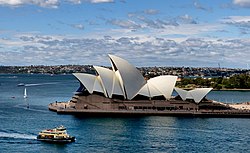
Work started on Jørn Utzon's radical sail-shaped design at Bennelong Point. Plagued by engineering challenges, cost blowouts and political disputes that saw Utzon resign in 1966, the project redefined Sydney's image worldwide.
Image source: Sydney Opera House
Oct 20, 1973
% complete
Queen Elizabeth II inaugurated the completed Sydney Opera House. Its distinctive shells became a global symbol of the city and, in 2007, a UNESCO World Heritage Site recognized as a masterpiece of 20th-century architecture.
Jan 18, 1977
% complete
A crowded commuter train derailed at Granville and struck a bridge support, which collapsed onto carriages, killing 83 people. It remains Australia's deadliest rail disaster and prompted sweeping safety reforms.
Image source: Granville rail disaster
Feb 1978
% complete
Sydney hosted major international gatherings through the late 20th century, cementing its role as Australia's diplomatic and cultural gateway while street demonstrations highlighted social tensions of the era.
Sep 24, 1993
% complete
The IOC selected Sydney ahead of Beijing to host the 2000 Summer Olympics, sparking massive redevelopment of Homebush Bay and Darling Harbour and launching a decade-long transformation of the city.
Image source: Bids for the 2000 Summer Olympics
Sep 15, 2000 - Oct 1, 2000
% complete
The 'best Games ever', as declared by IOC president Juan Antonio Samaranch, drew record television audiences. Cathy Freeman's 400m victory lit up Stadium Australia, and the Games showcased multicultural Sydney to the world.
Image source: 2000 Summer Olympics
Dec 11, 2005
% complete
Violent clashes between crowds of predominantly white youths and people of Middle Eastern appearance erupted at Cronulla Beach, exposing racial tensions and prompting nationwide reflection on multiculturalism and community relations.
Image source: 2005 Cronulla riots
May 2017
% complete
Sydney Metro, light rail extensions and the new ferry fleet modernized the city's transport system, including driverless metro trains — the first in Australia — linking Chatswood, the CBD and the growing western suburbs.
Image source: Transport in Sydney
Dec 2019 - Mar 2020
% complete
Catastrophic bushfires across New South Wales produced hazardous smoke that repeatedly blanketed Sydney, at times recording the world's worst air quality, highlighting the escalating threat of climate change to the city.
Image source: 2019–20 Australian bushfire season
Jun 26, 2021 - Oct 11, 2021
% complete
Greater Sydney endured months of strict stay-at-home orders during the Delta variant outbreak, profoundly affecting business, schooling and social life before vaccination rates allowed restrictions to ease in October 2021.
Or browse the full history timeline directory, with more than 2,000 topics.
This History of Sydney timeline was generated with the help of AI, using information found on the internet.
We work hard to keep these timelines accurate, but mistakes do get through. If you spot one, email us at [email protected] and we'll fix it for future visitors.
Generate yours with AI or build it from scratch, for free.
Export your timeline, add your own events, edit or remove AI-generated events, and much more
No credit card required.
Cancel anytime.
Cancel anytime.
You can create an unlimited number of timelines with up to 10 events on each one, customize how they look, export them to PDF, PNG, PowerPoint, CSV, and Excel, and share them with a link. Paid plans raise the event limit and add features like spreadsheet imports and collaborators.
Yes. You can cancel your subscription from your account page at any time, and you will not be charged again. Your subscription stays active for the rest of the period you already paid for.
Yes. We will email you a reminder before the annual renewal, and we will also email you a receipt.
Yes. You can email us within 15 days of any payment, and we will issue you a full refund.
Check out our pricing docs or send us an email anytime: [email protected].