
-
Use Cases
-
Resources
-
Pricing
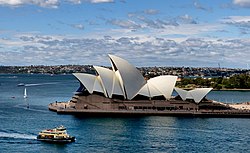
The Sydney Opera House is one of the world's most iconic performing arts venues, located on Bennelong Point in Sydney Harbour, Australia. Designed by Danish architect Jørn Utzon, its distinctive sail-shaped shells took 14 years to build and became a UNESCO World Heritage Site in 2007, recognized as a masterpiece of 20th-century architecture. More Less
1954
% complete
By 1954, conductor Eugene Goossens succeeded in gaining the support of New South Wales Premier Joseph Cahill, who called for designs for a dedicated opera house in Sydney.
Image source: Sydney Opera House
Sep 13, 1955
% complete
Premier Joseph Cahill launched an international design competition with a grand prize of 5,000 Australian pounds. It received 233 entries representing architects from 32 countries.
1956
% complete
Danish architect Jørn Utzon submitted his drawings to the Opera House Committee as part of the international competition, among 233 entries from around the world.
Jan 29, 1957
% complete
The winner was announced in Sydney on 29 January 1957: Danish architect Jørn Utzon. The jury included Professor Henry Ashworth, Cobden Parkes, Professor Leslie Martin and Eero Saarinen. Original estimates projected a cost of £3,500,000 ($7 million) and completion by 26 January 1963 (Australia Day).
Jul 29, 1957
% complete
Utzon first visited Sydney on 29 July 1957 along with Erik Andersson, who had worked on the competition scheme, to help establish and supervise the developing project.
Aug 7, 1957
% complete
Utzon and Andersson arrived with a new model of the scheme that was presented at a public meeting at Sydney Town Hall on 7 August 1957.
Aug 22, 1957
% complete
Utzon and Andersson departed Sydney on August 22 headed for Tokyo, planning to return to Sydney in March 1958.
1958
% complete
The Government of New South Wales, led by Premier Joseph Cahill, authorised work to begin in 1958 with Jørn Utzon directing construction.
1958
% complete
The Fort Macquarie Tram Depot, occupying the site on the original Fort Macquarie at the time of these plans, was demolished in 1958 to clear the way for the Opera House.
Mar 2, 1959
% complete
Stage I started on 2 March 1959 with the construction firm Civil & Civic, monitored by the engineers Ove Arup & Partners. The Opera House was built in four stages spanning 1957 to 1973.
Jan 23, 1961
% complete
By 23 January 1961, work was running 47 weeks behind, mainly because of unexpected difficulties including inclement weather, stormwater diversion issues, construction beginning before proper drawings were prepared, and contract changes.
Jun 1, 1961
% complete
In mid-1961, after at least 12 iterations of the form of the shells since 1957, the design team found a workable economic solution: the shells would all be created as sections from a sphere.
1962
% complete
Hornibrook manufactured the 2400 precast ribs and 4000 roof panels in an on-site factory and also developed the construction processes for the iconic shells.
Apr 6, 1962
% complete
On 6 April 1962, it was estimated that the Opera House would be completed between August 1964 and March 1965, already well beyond the original 1963 target.
Feb 1, 1963
% complete
Utzon's office moved to Palm Beach, Sydney in February 1963, and Stage III – the interiors – started with Utzon moving his entire office to Sydney that same month. Work on the podium was completed in February 1963, marking the end of stage II.
1965
% complete
In 1965 Utzon worked closely with Ralph Symonds, a Sydney plywood manufacturer, despite an Arup engineer warning that Symonds's knowledge of plywood design stresses was extremely sketchy and his technical advice useless for their purposes.
1965
% complete
After the 1965 election of the Liberal Party, with Robert Askin becoming Premier, the new government declared the project under the jurisdiction of the Ministry of Public Works. Its criticism of costs and time, and its view that Utzon's designs were impractical, ultimately led to his resignation.
Feb 28, 1966
% complete
By February 1966, Utzon was owed more than $100,000 in fees, and he left the project on 28 February 1966. In March, Davis Hughes offered him a subordinate role without supervisory powers, but Utzon rejected it.
Apr 1, 1966 - 1973
% complete
When Hall agreed to the design role and was appointed in April 1966, he imagined he would find the Stage III documentation well advanced. He resigned from the Government Architects office in early 1966 to pursue his own practice, having won the Sir John Sulman Medal in 1964 for Goldstein Hall at UNSW.
Jan 1, 1967
% complete
In consultation with all potential building users, the first Review of Program was completed in January 1967 under Peter Hall's leadership.
1968
% complete
The interior layout was changed and the stage machinery already fitted inside the major hall was pulled out and largely discarded, as detailed in the 1968 BBC TV documentary Autopsy on a Dream. Hall's design for the Concert Hall was rejected as it only seated 2000, considered insufficient.
1972
% complete
In 1972, a construction worker was fired, leading BLF-affiliated workers to demand his rehiring and a 25% wage increase.
1973
% complete
The Opera House was formally completed in 1973, having cost $102 million – far exceeding the original 1957 estimate of $7 million. Even in October 1966, the cost so far had been only A$22.9 million.
1960
% complete
The first person to perform at the Sydney Opera House was American vocalist Paul Robeson – he sang 'Ol' Man River' to construction workers as they ate lunch during lunchtime performances arranged on site.
Apr 10, 1973
% complete
The first solo piano recital took place in the Concert Hall on 10 April 1973, played by Romola Costantino to an invited audience.
Jul 25, 1973
% complete
The first performance of an opera was Larry Sitsky's The Fall of the House of Usher, to a libretto by Mary Durack, in a double-bill with James Penberthy's Dalgerie, conducted by Rex Hobcroft on 25 July 1973.
Sep 5, 1973
% complete
The first public concert in the Concert Hall took place on 5 September 1973.
Sep 28, 1973
% complete
The first opera performed in what was then known as the Opera Theatre was Sergei Prokofiev's War and Peace, on 28 September 1973, conducted by Edward Downes and produced by Sam Wanamaker.
Oct 20, 1973
% complete
The Sydney Opera House was formally opened by Queen Elizabeth II on 20 October 1973, sixteen years after Utzon's selection as winner of the international design competition.
1974
% complete
In 1974, Australian opera singer Joan Sutherland performed for the first time in the theatre that would later be named in her honour.
Sep 27, 1974
% complete
Rites of Passage premiered at the Sydney Opera House on 27 September 1974, a year after the venue's opening.
1990
% complete
In 1990, Nelson Mandela addressed a crowd of 40,000 at the Sydney Opera House and attended a choral performance of Nkosi Sikelel' iAfrica ('God Bless Africa').
1996
% complete
In 1996, Crowded House played their record-breaking Farewell to the World concert on the steps of the Sydney Opera House.
2000
% complete
During the 2000 Summer Olympics, the Opera House served as the focal point for the triathlon events. Swimmer Samantha Riley stood atop one of the Concert Hall's shells with the Olympic Torch before sending the flame on its final journey to Stadium Australia.
Oct 5, 2013 - Dec 31, 2013
% complete
On 5 October 2013, the sails formed a graphic projection-screen for a lightshow connected with the International Fleet Review. On 31 December 2013, the venue's 40th anniversary year ended with a New Year fireworks display mounted for the first time in a decade.
Feb 21, 2014
% complete
The Sydney Opera House hosted an event, 'the biggest blind date', on Friday 21 February 2014, which won a historic Guinness World Record.
Jun 14, 2019
% complete
On 14 June 2019, a state memorial service for former Australian Prime Minister Bob Hawke was held at the Sydney Opera House.
Image source: Bob Hawke
Dec 1, 2024
% complete
In December 2024, after five years of absence, The Nutcracker returned to the Sydney Opera House.
1999
% complete
In 1999, Jørn Utzon was appointed by the Sydney Opera House Trust as a design consultant for future work, re-engaging him with the building he had left in 1966.
2003
% complete
Utzon received the Pritzker Architecture Prize, architecture's highest honour, in 2003, recognising his masterpiece on Sydney Harbour.
Mar 18, 2003
% complete
In 2003, the Opera House was vandalised by Dave Burgess and Will Saunders with red paint saying 'No War', in an act of protest against the Iraq War.
2004
% complete
In 2004, the first interior space rebuilt to an Utzon design was opened and renamed 'The Utzon Room' in his honour.
2007
% complete
In 2007, the Sydney Opera House became a UNESCO World Heritage Site, having been listed on the Register of the National Estate since 1980, National Trust register since 1983, City of Sydney Heritage Inventory since 2000, NSW State Heritage Register since 2003, and Australian National Heritage List since 2005.
Nov 29, 2008
% complete
Jørn Utzon died on 29 November 2008, having never returned to Australia to see the completed Opera House.
Image source: Jørn Utzon
Mar 25, 2009
% complete
A state memorial service, attended by Utzon's son Jan and daughter Lin, was held in the Concert Hall on 25 March 2009, featuring performances, readings and recollections from prominent figures in the Australian performing arts scene.
Nov 17, 2009
% complete
Refurbished Western Foyer and accessibility improvements were commissioned on 17 November 2009, the largest building project completed since Utzon was re-engaged in 1999.
2013
% complete
In 2013, a 60-metre long artwork by artist Reg Mombassa was unveiled at the Sydney Opera House.
Mar 29, 2016
% complete
An original 1959 tapestry by Le Corbusier, commissioned by Utzon to hang in the Opera House and called Les Dés Sont Jetés (The Dice Are Cast), was finally unveiled in situ after being held by the Utzon family in Denmark for over 50 years. The Opera House bought it at auction in June 2015.
Feb 1, 2017
% complete
Since 2013, residents calling themselves the Sydney Opera House Concerned Citizens Group campaigned against Forecourt Concerts exceeding approved noise levels. In February 2017 the Department of Planning handed down a $15,000 fine for breach of allowed noise levels at a November 2015 concert; the DA was amended in 2016 to allow a 5 decibel increase.
Jun 27, 2018
% complete
The longest continuous serving employee of the Sydney Opera House was commemorated on 27 June 2018, for 50 years of service.
Oct 5, 2018 - Oct 9, 2018
% complete
Opera House chief executive Louise Herron clashed with radio commentator Alan Jones on 5 October 2018 over advertising on the sails. The political view lacked significant public support, with a petition against the advertising collecting over 298,000 names by 9 October 2018.
2023
% complete
In 2023, the New South Wales Government scrapped plans to light the sails of the Sydney Opera House in honour of the coronation of King Charles III.
Oct 20, 2023
% complete
On 20 October 2023, fifty years after Queen Elizabeth II formally opened the building, the Sydney Opera House turned 50 years old.
Or browse the full history timeline directory, with more than 2,000 topics.
This Sydney Opera House timeline was generated with the help of AI, using information found on the internet.
We work hard to keep these timelines accurate, but mistakes do get through. If you spot one, email us at [email protected] and we'll fix it for future visitors.
Generate yours with AI or build it from scratch, for free.
Export your timeline, add your own events, edit or remove AI-generated events, and much more
No credit card required.
Cancel anytime.
Cancel anytime.
You can create an unlimited number of timelines with up to 10 events on each one, customize how they look, export them to PDF, PNG, PowerPoint, CSV, and Excel, and share them with a link. Paid plans raise the event limit and add features like spreadsheet imports and collaborators.
Yes. You can cancel your subscription from your account page at any time, and you will not be charged again. Your subscription stays active for the rest of the period you already paid for.
Yes. We will email you a reminder before the annual renewal, and we will also email you a receipt.
Yes. You can email us within 15 days of any payment, and we will issue you a full refund.
Check out our pricing docs or send us an email anytime: [email protected].