-
Use Cases
-
Resources
-
Pricing
The House of Representatives is the lower chamber of the United States Congress, established by the Constitution in 1787 and first convened in 1789. Designed to represent the people directly, it has grown from 65 members to 435, playing a central role in American lawmaking, impeachment proceedings, and budget authority. More Less
Sep 1774 - Oct 1774
% complete
The First Continental Congress was a meeting of representatives of twelve of Great Britain's seventeen North American colonies, held in the autumn of 1774. It marked the colonies' first coordinated response to British policies and laid groundwork for unified colonial governance.
Image source: Continental Congress

Apr 1775
% complete
When King George III failed to respond to colonial grievances and the American Revolutionary War began in April 1775, the Second Continental Congress was convened, this time with thirteen colonies in attendance.
Image source: Second Continental Congress
Jul 4, 1776
% complete
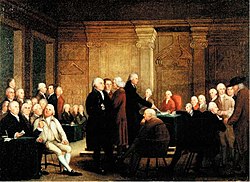
On July 4, 1776, the Continental Congress declared the thirteen colonies free and independent states, referring to them as the 'united States of America.' This was not a formal name, so 'united' was not capitalized, with 'States' capitalized only because all nouns were capitalized in English before the Industrial Revolution.
Image source: United States Declaration of Independence
1777
% complete
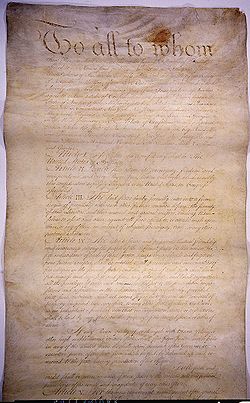
The Second Continental Congress continued in office while the War for Independence continued, producing the Articles of Confederation—the country's first constitution—in 1777, which was ratified by all of the states by 1781.
Image source: Articles of Confederation
1787
% complete
The ineffectiveness of the federal government under the Articles of Confederation led Congress to summon the Convention of 1787, which would ultimately draft a new constitution establishing a stronger federal government with a bicameral legislature.
Image source: Constitutional Convention (United States)
1788 - Dec 31, 1788
% complete
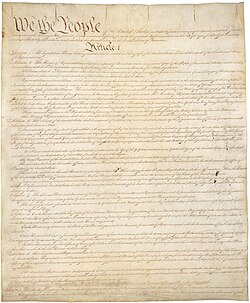
The Constitution was ratified by the end of 1788, and its full implementation was set for March 4, 1789, creating the framework for a new national government that included a directly elected House of Representatives.
Image source: Constitution of the United States
1789
% complete
Since its inception in 1789, all representatives have been directly elected by the people, distinguishing the House as the chamber most immediately accountable to voters from its very beginning.
Image source: United States House of Representatives
Mar 4, 1789
% complete
Like its counterpart, the Senate, the House was established by the United States Constitution and convened for its first meeting on March 4, 1789, at Federal Hall in New York City, marking the birth of the lower chamber of Congress.
Apr 1, 1789
% complete
The House of Representatives began work on April 1, 1789, when it achieved a quorum for the first time, with 59 members elected from 11 states ready to begin the business of the new government.
1790
% complete
In 1790, North Carolina and Rhode Island elected representatives, bringing the total count of representatives to 65 and expanding representation in the young House.
1800 - 1850
% complete
For most of the first half of the 19th century, a balance between the free North and the slaveholding South existed in the Senate, as the numbers of free and slave states were equal, shaping sectional politics in the era leading up to the Civil War.
Image source: History of the United States Congress
1809
% complete
The early 19th century was marked by the assertion of Congress' gradual independence from the Presidency, starting from the presidency of James Madison and onward, as the legislative branch developed its own institutional identity and power.
1825
% complete
In 1825, new Speaker of the House Henry Clay officially announced that he and his followers would separate from Andrew Jackson and form the National Republican Party, reshaping American partisan alignments.
1832
% complete
Clay lost to Jackson in the 1832 presidential election and subsequently moved to the Senate, ending his tenure as Speaker of the House and marking a transition in his long political career.
Image source: Henry Clay
1861 - 1874
% complete
The Democrats were a weak minority in the House from 1861 to 1874, a period dominated by the Republican Party during the Civil War and early Reconstruction eras.
Image source: History of the Democratic Party (United States)
1865 - Aug 11, 1868
% complete
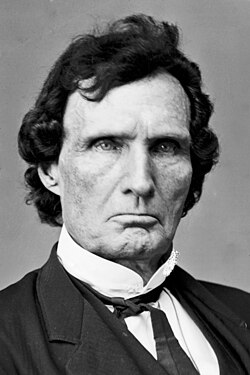
Stevens was one of the major policymakers regarding Reconstruction, and obtained a House vote of impeachment against President Andrew Johnson, who was acquitted by the Senate in 1868. Stevens dominated the House with his wit, knowledge of parliamentary law, and sheer willpower, even though he was often unable to prevail.
Image source: Thaddeus Stevens
1874
% complete
The Democrats made a major comeback in 1874 by winning 93 seats held by the GOP and becoming the majority party in the House of Representatives.
Image source: 1874–75 United States House of Representatives elections
1860 - 1920
% complete
Between 1860 and 1920 the average tenure of House members doubled from four to eight years, reflecting growing careerism and institutional stability within Congress.
1896
% complete
The increasing importance of the federal government, an increasing acceptance of lengthy congressional service, and (after 1896) a decline in the partisan competitiveness of congressional districts all contributed to the growing length of the average term of House members.
1900
% complete
Historiographical views of Stevens have dramatically shifted over the years, from the early 20th-century view of Stevens and the Radical Republicans as tools of big business motivated by hatred of the white South, to the perspective of the neoabolitionists of the 1950s and afterwards, who applauded their efforts to give equal rights to the freed slaves.
1900
% complete
The early 20th century witnessed the rise of party leadership in both houses of Congress, formalizing the roles of Speakers, majority leaders, and minority leaders as central figures in legislative operations.
Image source: Party leaders of the United States House of Representatives
1911
% complete
In 1911, Congress passed the Apportionment Act of 1911, also known as 'Public Law 62-5', which capped the size of the United States House of Representatives at 435 seats, a limit that persists today.
Image source: Apportionment Act of 1911
Nov 7, 1916
% complete
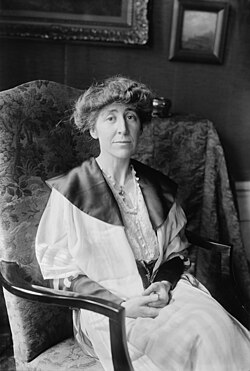
On November 7, 1916, Jeannette Rankin was elected to Montana's at-large seat in the House of Representatives, becoming the first female member of Congress, four years before women gained the right to vote nationwide.
Image source: Jeannette Rankin
1931 - 1994
% complete
After the beginning of the Great Depression and the New Deal, the Democrats controlled the House from 1931 to 1994, with two exceptions (1946 and 1952), as the New Deal Coalition proved remarkably successful and durable.
Image source: New Deal coalition
1937 - 1965
% complete
In terms of legislation, the Conservative coalition usually blocked liberal legislative proposals, except in 1964–65 when President Lyndon Johnson had the majorities needed to pass his Great Society proposals.
Image source: Conservative coalition
1973
% complete
In 1973, Speaker of the House Carl Albert appointed Felda Looper as the first female page in the House of Representatives, opening the page program to women for the first time.
1990
% complete
Population had more than tripled since the 1911 expansion of the House to its current 435 seats; accordingly, proposals began to be made by commentators such as George F. Will. One such proposal, the Wyoming Rule, calls for adding enough members to reduce the population of the average Congressional district to that of the least populous state's smallest district; in 1990, this would have resulted in a total House size of 547.
Nov 1994
% complete
The Republicans under Newt Gingrich returned to a majority in the election of 1994, as part of the Republican Revolution that gave the party both houses of Congress and a majority of governorships that year, ending decades of Democratic House control.
Nov 2006 - Jan 2007
% complete
The Democrats gained 30 seats in the 2006 elections, regaining control of the House and electing Nancy Pelosi as the first female Speaker of the House of Representatives.
Image source: Nancy Pelosi
Nov 2008
% complete
They strengthened their control during the 2008 elections, gaining an additional 21 seats alongside Barack Obama's presidential victory, giving Democrats a commanding majority in the House.
Image source: 2008 United States House of Representatives elections
Nov 2010
% complete
However, the Republicans soon erased those gains after gaining 63 seats in the 2010 elections, the largest seat change for any election since 1948, returning the GOP to power in the House.
Image source: 2010 United States House of Representatives elections
2011 - 2018
% complete
Republican control of the House remained until the 2018 elections, spanning the Trump administration years before Democrats regained the chamber majority in the 2018 midterm elections.
Image source: Party divisions of United States Congresses
Or browse the full history timeline directory, with more than 2,000 topics.
This History of the House of Representatives timeline was generated with the help of AI, using information found on the internet.
We work hard to keep these timelines accurate, but mistakes do get through. If you spot one, email us at [email protected] and we'll fix it for future visitors.
Generate yours with AI or build it from scratch, for free.
Export your timeline, add your own events, edit or remove AI-generated events, and much more
No credit card required.
Cancel anytime.
Cancel anytime.
You can create an unlimited number of timelines with up to 10 events on each one, customize how they look, export them to PDF, PNG, PowerPoint, CSV, and Excel, and share them with a link. Paid plans raise the event limit and add features like spreadsheet imports and collaborators.
Yes. You can cancel your subscription from your account page at any time, and you will not be charged again. Your subscription stays active for the rest of the period you already paid for.
Yes. We will email you a reminder before the annual renewal, and we will also email you a receipt.
Yes. You can email us within 15 days of any payment, and we will issue you a full refund.
Check out our pricing docs or send us an email anytime: [email protected].