-
Use Cases
-
Resources
-
Pricing
The White House, located at 1600 Pennsylvania Avenue in Washington, D.C., is the official residence and workplace of the President of the United States. Designed by James Hoban, it was built between 1792 and 1800 and has served as home to every U.S. president since John Adams. The building has undergone major reconstructions after being burned by British forces in 1814, as well as significant renovations under Harry Truman. It stands as an iconic symbol of American democracy and executive power. More Less
Jul 16, 1790
% complete
The Residence Act established a federal district along the Potomac River as the new national capital, with Pierre Charles L'Enfant's plan designating a grand site for the president's residence. The location chosen would become home to the White House for more than two centuries.
Image source: White House
Oct 13, 1792
% complete
Irish-American architect James Hoban won the public competition to design the President's House, drawing inspiration from neoclassical architecture and Dublin's Leinster House. His Palladian-style design was approved by George Washington, who never lived in the completed building.
Image source: James Hoban
Oct 13, 1792
% complete
The cornerstone of the Executive Mansion was laid in a Masonic ceremony in Washington, D.C., beginning construction of what would take eight years to complete using laborers including enslaved African Americans and skilled immigrant craftsmen.
Nov 1, 1800
% complete
President John Adams moved into the unfinished Executive Mansion on November 1, 1800, becoming the first president to live there. He famously wrote a letter wishing the house be inhabited by 'honest and wise' leaders, and only stayed a few months before his term ended.
Mar 12, 1933 - Jun 1944
% complete
From the White House, Franklin D. Roosevelt delivered thirty radio addresses known as fireside chats, speaking directly to Americans during the Great Depression and World War II and transforming presidential communication.
Image source: Fireside chats
Oct 16, 1962 - Oct 28, 1962
% complete
For thirteen tense days, President John F. Kennedy convened his ExComm advisors at the White House to respond to Soviet missiles in Cuba. The crisis brought the world to the brink of nuclear war before a diplomatic resolution was reached.
Image source: Cuban Missile Crisis
Feb 21, 1972 - Feb 28, 1972
% complete
Richard Nixon made a groundbreaking trip to the People's Republic of China, orchestrated from the White House, ending decades of diplomatic isolation and reshaping Cold War geopolitics.
Image source: 1972 visit by Richard Nixon to China
Aug 9, 1974
% complete
Facing certain impeachment over the Watergate scandal, Richard Nixon became the first U.S. president to resign, announcing his decision from the Oval Office in a televised address before departing the White House by helicopter.
Image source: Presidency of Richard Nixon
Sep 17, 1978
% complete
President Jimmy Carter hosted Egyptian President Anwar Sadat and Israeli Prime Minister Menachem Begin at the presidential retreat, brokered through intense negotiations tied closely to the White House, resulting in landmark peace agreements between Egypt and Israel.
Image source: Camp David Accords
Jan 20, 1981
% complete
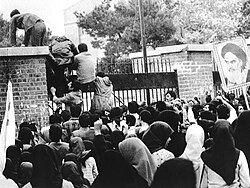
Fifty-two Americans held hostage at the U.S. embassy in Tehran were released minutes after Ronald Reagan was inaugurated as president, ending a crisis that had dominated Carter's final year in the White House.
Image source: Iran hostage crisis
Jun 12, 1987
% complete
Standing at the Brandenburg Gate, President Ronald Reagan issued his famous challenge to Soviet leader Mikhail Gorbachev, a defining moment of Cold War rhetoric delivered during his tenure in the White House.
Image source: Tear down this wall!
Jan 1998
% complete
News broke of a relationship between President Bill Clinton and White House intern Monica Lewinsky, leading to investigations, Clinton's impeachment by the House of Representatives, and eventual Senate acquittal—all centered on events within the White House.
Image source: Impeachment of Bill Clinton
Nov 4, 2008
% complete
Barack Obama's election marked a historic milestone as he became the first African American president to occupy the White House, serving two terms from 2009 to 2017.
Image source: Presidency of Barack Obama
Apr 22, 2016
% complete
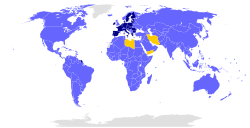
The United States, under President Barack Obama, joined 195 other nations in signing the Paris Agreement on climate change, a major environmental commitment championed from the White House.
Image source: Paris Agreement
Jan 20, 2017
% complete
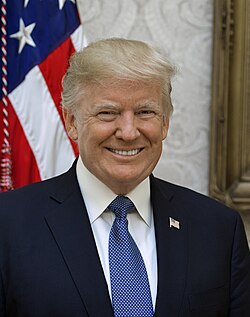
Real estate developer and television personality Donald Trump was inaugurated as the 45th President of the United States, beginning a tumultuous four-year term in the White House marked by significant policy shifts and political controversy.
Image source: Presidency of Donald Trump
Jan 20, 2021
% complete
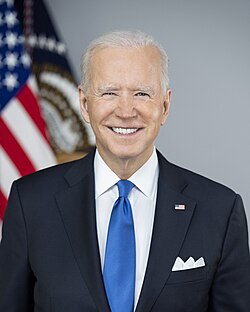
Joe Biden was sworn in as the 46th president during the COVID-19 pandemic, with the inauguration held with limited attendance and heightened security following the January 6 Capitol riot weeks earlier.
Image source: Presidency of Joe Biden
Aug 24, 1814
% complete
During the War of 1812, British troops captured Washington, D.C. and set fire to the White House, destroying much of its interior. First Lady Dolley Madison famously rescued Gilbert Stuart's portrait of George Washington before fleeing.
Image source: Burning of Washington
Sep 1817
% complete
After three years of reconstruction led by James Hoban, the rebuilt mansion welcomed President James Monroe. The rebuilding added the distinctive south portico, and smoke damage prompted the exterior to be painted white, giving rise to the name 'White House.'
1829
% complete
The iconic north portico with its grand columns was completed during Andrew Jackson's presidency, finishing the principal facade of the White House that remains one of the most recognizable building fronts in the world.
1901 - 1902
% complete
Under Theodore Roosevelt, architect Charles Follen McKim designed the West Wing to provide additional office space, separating presidential work from the family residence. Roosevelt also officially renamed the building 'The White House' in 1901.
1909
% complete
President William Howard Taft expanded the West Wing and created the Oval Office, an oval-shaped room inspired by the Blue Room, which became the president's formal workspace and an enduring symbol of the American presidency.
Image source: Oval Office
1942
% complete
Constructed during Franklin D. Roosevelt's presidency partly to conceal construction of an underground bomb shelter, the East Wing became the primary entrance for visitors and headquarters of the First Lady's staff.
Image source: East Wing
Dec 1948 - Mar 1952
% complete
Engineers discovered the White House was structurally unsound, with floors sagging and beams weakened by decades of patchwork repairs. Harry Truman and his family moved across the street to Blair House while the entire interior was gutted and rebuilt with a steel frame.
Image source: White House Reconstruction
1961 - 1963
% complete
First Lady Jacqueline Kennedy led a celebrated restoration of the White House, furnishing rooms with authentic historical pieces and founding the White House Historical Association. Her televised tour of the restored mansion in 1962 drew millions of viewers.
Image source: Jacqueline Kennedy Onassis
Nov 1, 1950
% complete
While the White House was being renovated, Puerto Rican nationalists Oscar Collazo and Griselio Torresola attempted to assassinate President Truman at nearby Blair House. A Secret Service officer was killed before the attackers were stopped.
Image source: Attempted assassination of Harry S. Truman
1961
% complete
After the Bay of Pigs failure exposed communication gaps, John F. Kennedy ordered creation of the White House Situation Room, a secure intelligence and crisis management center beneath the West Wing used by presidents ever since.
Image source: Situation Room
Sep 11, 2001
% complete
On the day of the September 11 terrorist attacks, the White House was evacuated amid fears it was a target, and United Airlines Flight 93 is believed to have been headed toward Washington before passengers fought back. Security protocols were permanently transformed afterward.
Image source: September 11 attacks
May 2, 2011
% complete
President Obama and his national security team watched live from the White House Situation Room as Navy SEALs conducted the raid that killed al-Qaeda leader Osama bin Laden in Abbottabad, Pakistan.
Image source: Killing of Osama bin Laden
Or browse the full history timeline directory, with more than 2,000 topics.
This White House timeline was generated with the help of AI, using information found on the internet.
We work hard to keep these timelines accurate, but mistakes do get through. If you spot one, email us at [email protected] and we'll fix it for future visitors.
Generate yours with AI or build it from scratch, for free.
Export your timeline, add your own events, edit or remove AI-generated events, and much more
No credit card required.
Cancel anytime.
Cancel anytime.
You can create an unlimited number of timelines with up to 10 events on each one, customize how they look, export them to PDF, PNG, PowerPoint, CSV, and Excel, and share them with a link. Paid plans raise the event limit and add features like spreadsheet imports and collaborators.
Yes. You can cancel your subscription from your account page at any time, and you will not be charged again. Your subscription stays active for the rest of the period you already paid for.
Yes. We will email you a reminder before the annual renewal, and we will also email you a receipt.
Yes. You can email us within 15 days of any payment, and we will issue you a full refund.
Check out our pricing docs or send us an email anytime: [email protected].