
-
Use Cases
-
Resources
-
Pricing
Tennis evolved from a medieval French handball game called 'jeu de paume' into the modern racket sport played worldwide today. Major Walter Clopton Wingfield patented lawn tennis in 1873, the first Wimbledon Championship was held in 1877, and the sport grew through the Open Era beginning in 1968, when professionals were allowed to compete in Grand Slam tournaments alongside amateurs. More Less
1500
% complete
Players began using strung racquets instead of their hands to hit the ball in jeu de paume. This innovation allowed for greater power and control, transforming the game and making it faster and more competitive across European courts.
Image source: List of racket sports
Feb 23, 1874
% complete
British army officer Major Walter Clopton Wingfield patented his outdoor lawn tennis game, which he called sphairistikè (Greek for 'ball playing'). His hourglass-shaped court and boxed equipment sets sold widely, popularizing lawn tennis as a fashionable pastime.
Image source: Walter Clopton Wingfield
Jul 9, 1877 - Jul 19, 1877
% complete
The All England Croquet Club hosted the first Wimbledon Championships at Worple Road in London, drawing 22 male competitors. Spencer Gore won the inaugural title, and the event established standardized rules that shaped the sport worldwide.
Image source: 1877 Wimbledon Championship
Aug 31, 1881
% complete
The first U.S. National Championships were held at the Newport Casino in Rhode Island, organized by the newly formed United States National Lawn Tennis Association. Richard Sears won the first of seven consecutive men's singles titles.
Image source: US Open (tennis)
1925
% complete
The French Championships, previously restricted to members of French clubs, opened to international competitors at Stade Français. This marked the emergence of Roland Garros as a major championship on clay courts.
Image source: French Open
1927
% complete
The Australasian Championships were renamed the Australian Championships, solidifying its status alongside Wimbledon, the French Championships, and the U.S. Championships as one of tennis's four major tournaments.
Image source: Australian Open

1900
% complete
Dwight Filley Davis, a Harvard student, donated a silver trophy for an international team competition between the United States and the British Isles. The Davis Cup grew into the premier annual international team event in men's tennis.
Image source: Davis Cup
Mar 1, 1913
% complete
Twelve national associations met in Paris to establish the International Lawn Tennis Federation (ILTF), creating a governing body to standardize rules and coordinate international tennis. It later became the International Tennis Federation (ITF).
Image source: International Tennis Federation

1948
% complete
Former champion Jack Kramer launched a lucrative professional touring circuit featuring head-to-head matches between top players. His promotion of pro tennis laid groundwork for the eventual merger of amateur and professional ranks.
Image source: Jack Kramer
Apr 22, 1968
% complete
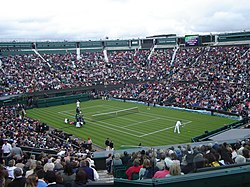
Tennis entered the Open Era when the British Hard Court Championships at Bournemouth allowed professionals to compete alongside amateurs for prize money. The decision ended the long-standing divide between amateur and professional tennis.
Image source: History of tennis
1973
% complete
The U.S. Open became the first Grand Slam tournament to award equal prize money to men and women, thanks largely to advocacy by Billie Jean King. This set a precedent that other majors would follow decades later.
Image source: United States Tennis Association
Jun 20, 1973
% complete
Billie Jean King led the formation of the Women's Tennis Association (WTA) ahead of Wimbledon, uniting female players to fight for equal prize money and better conditions. The WTA Tour gave women's professional tennis its own organizational structure.
Image source: Women's Tennis Association
1919 - 1926
% complete
French star Suzanne Lenglen revolutionized women's tennis with her athletic flair, flamboyant style, and dominant play, losing only one match from 1914 through 1926. She won six Wimbledon singles titles and helped popularize the sport globally.
Image source: Suzanne Lenglen
Sep 24, 1938
% complete
American Don Budge became the first player to win all four major singles titles in a single calendar year, capturing the Australian, French, Wimbledon, and U.S. championships in 1938, an achievement known as the Grand Slam.
Image source: Don Budge
Jul 6, 1957
% complete
Althea Gibson became the first African American player to win a Wimbledon singles title, defeating Darlene Hard in the final. She had already broken tennis's color barrier at the U.S. Nationals in 1950 and went on to win multiple majors.
Image source: Althea Gibson
1969
% complete
Australian Rod Laver completed his second calendar-year Grand Slam, having also achieved it as an amateur in 1962. He remains the only man to win all four majors in one year twice, cementing his legacy as one of the greatest players ever.
Image source: Rod Laver
Sep 12, 1970
% complete
Australia's Margaret Court won all four major singles titles in 1970, becoming the first woman in the Open Era to complete a calendar Grand Slam. She finished her career with a record 24 major singles titles.
Image source: Margaret Court
Sep 20, 1973
% complete
Billie Jean King defeated self-proclaimed male chauvinist Bobby Riggs in a nationally televised exhibition match at the Houston Astrodome before over 30,000 fans. Her straight-sets victory became a landmark moment for women's sports and gender equality.
Image source: Battle of the Sexes (tennis)
1978 - 1981
% complete
The contrasting styles and temperaments of Sweden's ice-cool Björn Borg and America's fiery John McEnroe produced some of tennis's most memorable matches, including the epic 1980 Wimbledon final. Their rivalry defined the late 1970s and early 1980s.
Image source: Borg–McEnroe rivalry
Oct 1, 1988
% complete
German star Steffi Graf won all four Grand Slam singles titles and Olympic gold in 1988, the only player to achieve the Golden Slam in a single calendar year. Her powerful forehand and athleticism made her one of the sport's all-time greats.
Image source: Steffi Graf
1999
% complete
American Andre Agassi completed a career Golden Slam by winning the French Open in 1999, adding the missing clay-court major to his collection of all four Grand Slams and an Olympic gold medal from 1996.
Image source: Andre Agassi
2000 - 2010
% complete
American sisters Venus and Serena Williams transformed women's tennis with their power and athleticism, combining for numerous Grand Slam titles, Olympic golds, and memorable sibling finals, inspiring a new generation of diverse players.
Image source: Williams sisters
Mar 2004
% complete
Roger Federer and Rafael Nadal began one of the greatest rivalries in sports history, meeting repeatedly in Grand Slam finals. Their contrasting styles—Federer's elegance versus Nadal's relentless topspin—produced legendary matches like the 2008 Wimbledon final.
Image source: Federer–Nadal rivalry
Jun 8, 2014
% complete
Rafael Nadal defeated Novak Djokovic in the 2014 French Open final to claim his ninth Roland Garros crown, extending his unprecedented dominance on clay courts and surpassing previous records for titles at a single major.
Jun 5, 2016
% complete
Serbia's Novak Djokovic won the French Open for the first time, completing a career Grand Slam and holding all four major titles simultaneously—a feat dubbed the 'Nole Slam.' He became a central figure of the Big Three era.
Image source: Novak Djokovic
Jul 11, 2021
% complete
Novak Djokovic won his sixth Wimbledon title and twentieth Grand Slam singles trophy, tying Rafael Nadal and Roger Federer atop the all-time men's list and capping a remarkable season in which he pursued a calendar Grand Slam.
Sep 20, 1988 - Oct 2, 1988
% complete
Tennis was reinstated as a full medal sport at the Seoul Olympics after being absent since 1924. Steffi Graf's gold medal completed her Golden Slam, winning all four majors plus Olympic gold in a single year.
Jan 2006
% complete
The Australian Open became the first Grand Slam to use Hawk-Eye electronic line-calling technology, allowing players to challenge umpire calls. The system reduced human error and changed officiating across professional tennis.
Image source: Hawk-Eye
2021
% complete
Wimbledon replaced human line judges with electronic line calling for the first time in its history during the 2021 Championships, due partly to pandemic-related restrictions, ending a centuries-old tradition of on-court officials.
Or browse the full history timeline directory, with more than 2,000 topics.
This History of Tennis timeline was generated with the help of AI, using information found on the internet.
We work hard to keep these timelines accurate, but mistakes do get through. If you spot one, email us at [email protected] and we'll fix it for future visitors.
Generate yours with AI or build it from scratch, for free.
Export your timeline, add your own events, edit or remove AI-generated events, and much more
No credit card required.
Cancel anytime.
Cancel anytime.
You can create an unlimited number of timelines with up to 10 events on each one, customize how they look, export them to PDF, PNG, PowerPoint, CSV, and Excel, and share them with a link. Paid plans raise the event limit and add features like spreadsheet imports and collaborators.
Yes. You can cancel your subscription from your account page at any time, and you will not be charged again. Your subscription stays active for the rest of the period you already paid for.
Yes. We will email you a reminder before the annual renewal, and we will also email you a receipt.
Yes. You can email us within 15 days of any payment, and we will issue you a full refund.
Check out our pricing docs or send us an email anytime: [email protected].