-
Use Cases
-
Resources
-
Pricing
The Boston Marathon is the world's oldest continuously run annual marathon, first held in 1897 and organized by the Boston Athletic Association. Held every Patriots' Day in April, the race follows a 26.2-mile course from Hopkinton to Boston's Back Bay. Over more than a century, it has witnessed historic moments including the inclusion of women runners, dramatic finishes like the 1982 'Duel in the Sun,' record-setting performances, the tragic 2013 bombing, and the city's resilient response. Qualifying for Boston remains one of the greatest achievements for amateur distance runners worldwide. More Less
Apr 19, 1897
% complete
The first Boston Marathon took place on April 19, 1897, organized by the Boston Athletic Association after the success of the marathon at the first modern Olympics. Fifteen runners started the race, with John J. McDermott of New York winning in 2:55:10 over a course of about 24.5 miles.
Image source: Boston Marathon
Apr 19, 1898
% complete
Canadian runner Ronald J. MacDonald won the 1898 Boston Marathon, setting a new best time for the event and establishing Canada's early prominence in American distance running.
Jan 1, 1908
% complete
Following the 1908 London Olympics, which established the now-standard 26-mile, 385-yard marathon distance, organizers gradually adjusted the Boston course. By the early 1920s the route from Ashland to Boston was extended to Hopkinton to match the official marathon distance.
Apr 19, 1924
% complete
In 1924 the starting line was moved west from Ashland to Hopkinton, lengthening the course to the official 26.2-mile Olympic distance that remains today.
Apr 20, 1930
% complete
Clarence 'Mr. DeMarathon' DeMar won his fifth and final Boston Marathon in 1930, setting a record for most victories by an individual runner that still stands as a mark of dominance across three decades.
Image source: Clarence DeMar
Apr 19, 1939
% complete
Narragansett runner Ellison 'Tarzan' Brown won the 1939 Boston Marathon in 2:28:51, breaking the two-and-a-half-hour barrier and setting a new course record.
Image source: Ellison Brown
Apr 20, 1950
% complete
Canadian Gerard Cote captured his fourth Boston Marathon victory in 1950, becoming one of the most dominant runners of the postwar era with wins spanning the 1940s and early 1950s.
Image source: Gérard Côté
Apr 19, 1957
% complete
John A. Kelley, who won Boston twice and competed in it a record 61 times over five decades, became a beloved symbol of the race, immortalized in bronze near Heartbreak Hill.
Image source: Johnny Kelley
Apr 19, 1968
% complete
Wesleyan University student Amby Burfoot won the 1968 Boston Marathon and later became a celebrated editor at Runner's World, chronicling the sport he once conquered.
Image source: Amby Burfoot
Apr 21, 1975
% complete
'Boston Billy' Rodgers won the 1975 Boston Marathon in 2:09:55, beginning an era of American dominance in which he would win four Boston titles between 1975 and 1980.
Image source: Bill Rodgers (runner)
Apr 21, 1975
% complete
American Jackie Hansen ran 2:42:24 at Boston in 1975, setting a women's world best time and highlighting the rapid improvement in women's marathon performances.
Apr 18, 1977
% complete
Rodgers captured his third straight Boston crown in 1977, cementing his status as the face of the first American running boom and a hometown favorite in New England.
Apr 16, 1979
% complete
Maine native Joan Benoit won the 1979 Boston Marathon as a college senior, then returned in 1983 to set a world best of 2:22:43 before winning the first Olympic women's marathon gold in 1984.
Image source: Joan Benoit
Apr 16, 1990
% complete
Wheelchair racer Jean Driscoll began her unmatched run of Boston victories in 1990, ultimately winning eight times, including seven consecutive titles, becoming the race's most decorated athlete.
Apr 15, 1996
% complete
Kenya's Cosmas Ndeti completed his third consecutive Boston win in 1996 during the centennial year, part of Kenya's growing stranglehold on the men's title that continues today.
Apr 17, 2000
% complete
Kenya's Catherine Ndereba, 'Catherine the Great,' won her first Boston title in 2000, eventually claiming four crowns and setting multiple world records in the marathon.
Image source: Catherine Ndereba
Apr 21, 2008
% complete
Kenyan Robert Cheruiyot secured his fourth Boston victory in 2008, joining the elite group of four-time champions and dominating the race throughout the mid-2000s.
Image source: Robert Kipkoech Cheruiyot
Apr 19, 1953
% complete
Japan's Keizo Yamada won the 1953 Boston Marathon, signaling the beginning of Japan's strong tradition in international marathoning and expanding the race's global reach.
Image source: Keizo Yamada
Apr 19, 1963
% complete
Ethiopian double Olympic marathon champion Abebe Bikila competed at Boston in 1963, drawing huge crowds and elevating the race's international profile, though he finished a surprising fifth.
Image source: Abebe Bikila
Apr 19, 1966
% complete
In 1966 Roberta 'Bobbi' Gibb jumped into the field mid-race to become the first woman to run the Boston Marathon, finishing in about 3:21 despite women being barred from official entry.
Image source: Bobbi Gibb
Apr 19, 1967
% complete
Kathrine Switzer entered the 1967 race under the name K.V. Switzer and famously was physically accosted by race official Jock Semple, who tried to remove her. Her defiant finish became an iconic moment in the fight for women's running rights.
Image source: Kathrine Switzer
Apr 17, 1972
% complete
In 1972 the Amateur Athletic Union permitted women to compete officially in the Boston Marathon, and Nina Kuscsik won the inaugural women's division title.
Apr 16, 1973
% complete
Following official inclusion, women's fields grew rapidly through the 1970s, helped by pioneers like Switzer and Kuscsik, transforming Boston into a showcase of women's distance running.
Apr 21, 1975
% complete
The 1975 race introduced an official wheelchair division, making Boston a pioneer in disability athletics; Bob Hall finished in 2:58, legitimizing wheelchair racing at major events.
Apr 19, 1982
% complete
The 1982 'Duel in the Sun' saw Alberto Salazar edge Dick Beardsley by two seconds in one of the greatest races in Boston history, both men pushing each other to extraordinary efforts down Boylston Street.
Image source: Dick Beardsley
Apr 15, 1996
% complete
The 100th running in 1996 attracted nearly 39,000 entrants, then the largest marathon field ever assembled, with festivities celebrating a century of the world's oldest annual marathon.
Apr 21, 2014
% complete
One year after the bombing, Meb Keflezighi won the 2014 Boston Marathon in an emotional triumph, becoming the first American male winner since Greg Meyer in 1983 in what was dubbed 'Boston Strong' year.
Image source: Meb Keflezighi
Apr 21, 1986
% complete
With the advent of open professionalism following the 1984 Olympic boycott issues, the Boston Marathon began awarding prize money in 1986, attracting elite international fields and raising competitive stakes.
Apr 1, 2003
% complete
As demand exploded, the Boston Athletic Association tightened qualifying times and registration processes over the 2000s, culminating in later reforms after fields sold out within hours.
Apr 15, 2013
% complete
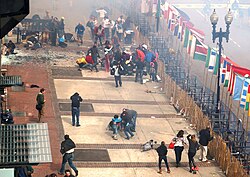
On April 15, 2013, two pressure-cooker bombs exploded near the finish line on Boylston Street, killing three people and injuring hundreds. The tragedy prompted a citywide lockdown and manhunt and profoundly shaped subsequent editions of the race.
Image source: Boston Marathon bombing
Or browse the full history timeline directory, with more than 2,000 topics.
This History of the Boston Marathon timeline was generated with the help of AI, using information found on the internet.
We work hard to keep these timelines accurate, but mistakes do get through. If you spot one, email us at [email protected] and we'll fix it for future visitors.
Generate yours with AI or build it from scratch, for free.
Export your timeline, add your own events, edit or remove AI-generated events, and much more
No credit card required.
Cancel anytime.
Cancel anytime.
You can create an unlimited number of timelines with up to 10 events on each one, customize how they look, export them to PDF, PNG, PowerPoint, CSV, and Excel, and share them with a link. Paid plans raise the event limit and add features like spreadsheet imports and collaborators.
Yes. You can cancel your subscription from your account page at any time, and you will not be charged again. Your subscription stays active for the rest of the period you already paid for.
Yes. We will email you a reminder before the annual renewal, and we will also email you a receipt.
Yes. You can email us within 15 days of any payment, and we will issue you a full refund.
Check out our pricing docs or send us an email anytime: [email protected].