-
Use Cases
-
Resources
-
Pricing
The history of theater spans over two and a half millennia, beginning with religious rituals in ancient Greece and evolving through Roman spectacles, medieval mystery plays, the Renaissance revival of classical drama, Elizabethan playhouses, and modern experimental and commercial theater. This timeline highlights the major developments, influential playwrights, architectural innovations, and cultural shifts that shaped theatrical performance into the diverse art form we know today. More Less
534 BC
% complete
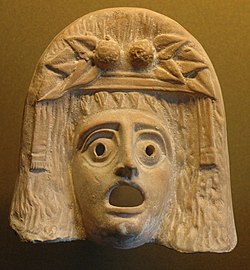
The origins of Greek tragedy are traditionally traced to Athens around 534 BC, when the poet Thespis is said to have won the first competition for tragedy at the City Dionysia festival. Thespis is credited with stepping out of the chorus to speak as an individual character, creating the role of the first actor and laying the foundation for Western drama.
Image source: Greek tragedy
471 BC
% complete
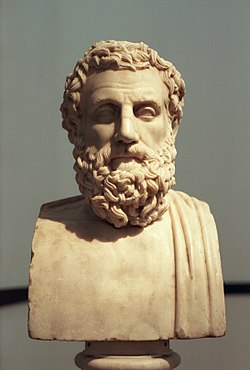
Aeschylus, often called the father of tragedy, introduced a second actor to the stage, allowing true dramatic dialogue and conflict between characters. His works, including The Persians and the Oresteia trilogy, transformed theater from choral performance into structured dramatic art.
Image source: Aeschylus
468 BC
% complete
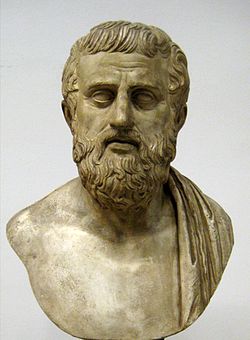
Sophocles defeated Aeschylus in the Athenian dramatic competitions in 468 BC and is credited with adding a third actor, expanding the possibilities of plot complexity. His masterpieces Oedipus Rex and Antigone became models of classical dramatic structure.
Image source: Sophocles
425 BC
% complete
Aristophanes dominated Old Comedy in Athens with biting political satire in plays like The Clouds and The Birds. His works established comedy as a powerful vehicle for social commentary and influenced comic traditions for millennia.
Image source: Aristophanes
335 BC
% complete
Aristotle's Poetics provided the first systematic theory of drama, analyzing tragedy's elements of plot, character, and catharsis. It became one of the most influential texts on dramatic theory in Western history.
Image source: Poetics (Aristotle)
205 BC - 160 BC
% complete
Roman comedy thrived through playwrights Plautus and Terence, who adapted Greek New Comedy into Latin works full of farce and wit. Their plays shaped European comedic traditions and were later imitated by Shakespeare and Molière.
Image source: Theatre of ancient Rome
55 BC
% complete
The Theatre of Pompey, completed in 55 BC, was Rome's first permanent stone theater, ending the era of temporary wooden structures. Its massive design set the architectural standard for Roman theaters across the empire.
Image source: Theatre of Pompey
970
% complete
After the fall of Rome, theatrical performance survived through the church. Around 970 AD, liturgical dramas such as the Quem Quaeritis trope began dramatizing biblical stories during mass, marking the rebirth of Western theater.
Image source: Liturgical drama
1200 - 1550
% complete
Medieval mystery cycles, performed by guilds on pageant wagons, dramatized biblical narratives for public audiences. Famous examples include the York Cycle and the Wakefield Cycle, bringing theater out of the church and into town squares.
Image source: Mystery play
1545
% complete
Commedia dell'arte arose in Italy as professional troupes performed improvised comedies featuring stock characters like Harlequin and Pantalone. Its influence spread across Europe, shaping pantomime, clowning, and modern improvisational theater.
Image source: Commedia dell'arte
1576
% complete
James Burbage built The Theatre in Shoreditch, London, the first purpose-built playhouse in England. It paved the way for the great Elizabethan playhouses and the flourishing of English Renaissance drama.
Image source: Playhouse Theatre
1585
% complete
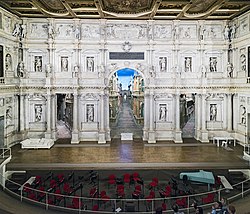
Designed by Andrea Palladio, the Teatro Olimpico in Vicenza was the first permanent indoor theater of the Renaissance, reviving classical Roman stage architecture with its famous trompe-l'œil perspective scenery.
Image source: Teatro Olimpico
1599
% complete
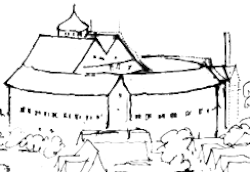
The Globe Theatre, built by Shakespeare's company the Lord Chamberlain's Men, became the iconic home of Elizabethan drama. Many of Shakespeare's greatest plays premiered there before it burned down in 1613.
Image source: Globe Theatre
1600 - 1601
% complete
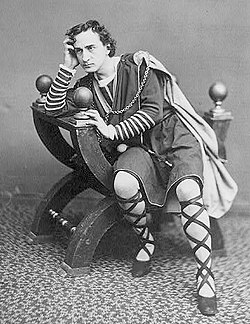
Shakespeare's Hamlet, written around 1600–1601, is widely regarded as the greatest play in the English language. Its psychological depth and exploration of revenge, mortality, and madness redefined tragic drama.
Image source: Hamlet
1603
% complete
Izumo no Okuni performed the first kabuki dances in Kyoto in 1603, founding Japan's most flamboyant theatrical form. Kabuki evolved into a highly stylized art combining music, dance, and elaborate staging.
Image source: Kabuki
1642 - 1660
% complete
With the outbreak of the English Civil War, the Puritan government banned stage plays, closing all London theaters for eighteen years. English drama was suppressed until the Restoration of Charles II in 1660.
Image source: English Civil War
1658 - 1673
% complete
Molière, France's greatest comic dramatist, wrote and starred in Tartuffe, The Misanthrope, and The Imaginary Invalid, blending farce with sharp social satire. He died shortly after performing in his final play in 1673.
Image source: Molière
1660
% complete
Charles II granted patents to reopen theaters and licensed actresses to perform female roles for the first time in England. Restoration comedy flourished with witty, satirical plays by Congreve, Wycherley, and Aphra Behn.
Image source: Restoration comedy
1790
% complete
When four great Anhui troupes came to Beijing for the Qianlong Emperor's birthday in 1790, their styles merged with local traditions to form Peking (Beijing) opera, China's dominant theatrical form known for its stylized movement and painted faces.
Image source: Peking opera
1808
% complete
Part One of Goethe's Faust appeared in 1808, becoming a cornerstone of German Romantic drama. Its retelling of the pact between Faust and Mephistopheles explored ambition, desire, and redemption on an epic scale.
Image source: Goethe's Faust
Dec 21, 1879
% complete
Henrik Ibsen's A Doll's House premiered at the Royal Theatre in Copenhagen, shocking audiences with its critique of marriage and its heroine Nora's decision to leave her family. It launched the modern realist drama movement.
Image source: A Doll's House
1898
% complete
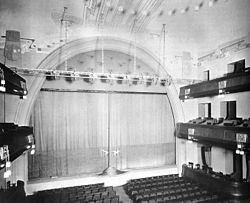
Konstantin Stanislavski and Vladimir Nemirovich-Danchenko founded the Moscow Art Theatre in 1898, revolutionizing acting with psychologically realistic ensemble work. Their productions of Chekhov's plays defined modern naturalism.
Image source: Moscow Art Theatre
Jan 17, 1904
% complete
Anton Chekhov's final play, The Cherry Orchard, premiered at the Moscow Art Theatre months before his death. Its subtle blend of comedy and melancholy about a family losing its estate became a masterpiece of modern drama.
Image source: The Cherry Orchard
1926
% complete
Bertolt Brecht pioneered epic theater, using alienation effects to make audiences think critically rather than emotionally. Works like The Threepenny Opera and Mother Courage reshaped political theater worldwide.
Image source: Epic theatre
1931 - 1941
% complete
Harold Clurman, Cheryl Crawford, and Lee Strasberg founded the Group Theatre, which brought Stanislavski's method acting to America. It nurtured talents like Elia Kazan, Stella Adler, and playwright Clifford Odets.
Dec 3, 1947
% complete
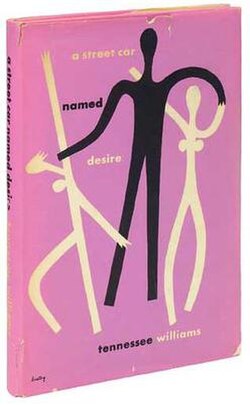
A Streetcar Named Desire opened on Broadway starring Marlon Brando and Jessica Tandy, directed by Elia Kazan. Williams's poetic Southern gothic drama about Blanche DuBois became an American classic.
Image source: A Streetcar Named Desire
Feb 10, 1949
% complete
Arthur Miller's Death of a Salesman opened at the Morosco Theatre, winning the Pulitzer Prize and Tony Award. Its portrait of Willy Loman made the common man a tragic hero and critiqued the American Dream.
Image source: Death of a Salesman
Jan 5, 1953
% complete
Samuel Beckett's Waiting for Godot premiered in Paris, becoming the defining work of the Theater of the Absurd. Its existential humor and minimalist structure revolutionized postwar drama.
Image source: Waiting for Godot
Sep 26, 1957
% complete
West Side Story, with music by Leonard Bernstein, lyrics by Stephen Sondheim, and choreography by Jerome Robbins, premiered on Broadway. Its groundbreaking fusion of dance, music, and social realism elevated the American musical.
Image source: West Side Story
Oct 17, 1967
% complete
Hair: The American Tribal Love-Rock Musical opened off-Broadway in 1967, bringing rock music, counterculture themes, and nudity to the stage. It moved to Broadway in 1968 and defined the era's rebellious spirit.
Image source: Hair (musical)
Oct 7, 1982
% complete
Cats, based on T.S. Eliot's poetry with music by Andrew Lloyd Webber, opened on Broadway and ran for eighteen years, then a record. It exemplified the mega-musical era of lavish spectacle and global branding.
Image source: Cats (musical)
Apr 29, 1993
% complete
Tony Kushner's Angels in America: Millennium Approaches opened on Broadway, winning the Pulitzer Prize and multiple Tonys. Its ambitious exploration of AIDS, politics, and spirituality marked a high point of late twentieth-century drama.
Image source: Angels in America
Nov 13, 1997
% complete
Julie Taymor's visionary staging of Disney's The Lion King opened on Broadway, dazzling audiences with puppetry and masks. It became one of the highest-grossing entertainment productions of all time.
Image source: The Lion King (musical)
Feb 17, 2015
% complete
Lin-Manuel Miranda's Hamilton, blending hip-hop with the story of Alexander Hamilton, premiered at the Public Theater before transferring to Broadway. It became a cultural phenomenon that redefined the American musical.
Image source: Hamilton (musical)
Or browse the full history timeline directory, with more than 2,000 topics.
This History of Theater timeline was generated with the help of AI, using information found on the internet.
We work hard to keep these timelines accurate, but mistakes do get through. If you spot one, email us at [email protected] and we'll fix it for future visitors.
Generate yours with AI or build it from scratch, for free.
Export your timeline, add your own events, edit or remove AI-generated events, and much more
No credit card required.
Cancel anytime.
Cancel anytime.
You can create an unlimited number of timelines with up to 10 events on each one, customize how they look, export them to PDF, PNG, PowerPoint, CSV, and Excel, and share them with a link. Paid plans raise the event limit and add features like spreadsheet imports and collaborators.
Yes. You can cancel your subscription from your account page at any time, and you will not be charged again. Your subscription stays active for the rest of the period you already paid for.
Yes. We will email you a reminder before the annual renewal, and we will also email you a receipt.
Yes. You can email us within 15 days of any payment, and we will issue you a full refund.
Check out our pricing docs or send us an email anytime: [email protected].