-
Resources
-
Pricing
The history of tunnels traces human efforts to create underground routes for water, transport, mining, defense, and shelter. From ancient hand-cut passages to massive modern rail and road tunnels, technological advances have expanded their scale, safety, and purpose. More Less
Build a timeline like this one in minutes, for free. Start Yours →
Part of our collection of invention and technology timelines.
701 BC
Workers in Jerusalem completed a 533-meter rock-cut water tunnel that carried the Gihon Spring's water to the Pool of Siloam. Its inscription records excavation from both ends, an early example of accurately coordinated underground construction.
530 BC
On Samos, engineers built the Eupalinos Tunnel through Mount Kastro to supply the ancient city with water. The roughly kilometer-long tunnel was driven from opposite ends and demonstrates sophisticated surveying and geometry.
500 BC
Persian engineers developed and expanded qanats, gently sloping underground channels that transported groundwater over long distances. Vertical access shafts enabled excavation, maintenance, ventilation, and water lifting.
Image source: Qanat
312 BC
The Aqua Appia, begun in 312 BC, helped establish Roman practice in water engineering, including underground channels and tunnels. Roman aqueduct builders later used tunnels extensively where terrain made surface arcades impractical.
Image source: Roman aqueduct
100 BC - 1 BC
Roman military and commercial roads increasingly crossed difficult terrain using cuttings and rock tunnels. These works connected provinces and established construction practices later adapted for mines, canals, and railways.
Image source: Roman roads
100 BC - 1 BC
The Crypta Neapolitana near Naples carried a road through volcanic rock between Naples and Pozzuoli. Its scale and use of lighting and ventilation illustrate Roman mastery of long road tunnels.
1000 - 1500
Across Europe and Asia, miners drove increasingly extensive underground galleries to extract silver, salt, coal, and other resources. Timber supports, drainage adits, shafts, and ventilation became central to tunnel practice.
Image source: Mining
41 - 52
Under Emperor Claudius, Roman engineers excavated a major tunnel and associated channels to drain Lake Fucine in central Italy. The project required enormous labor and suffered from flooding and maintenance difficulties.
1100 - 1199
Medieval armies routinely dug mines beneath fortifications to undermine walls and towers. Countermines, listening galleries, and underground assaults made tunneling an important part of siege warfare.
2001
A fire in Madrid's Metro infrastructure highlighted the importance of evacuation planning, smoke control, fire-resistant materials, and emergency access in heavily used urban tunnels.
1818
Marc Brunel patented a protective tunneling shield in 1818, adapting ideas from shipworm behavior. The shield divided the excavation face into work cells and provided structural protection as the tunnel advanced.
1825 - 1843
Marc Brunel and Isambard Kingdom Brunel built the Thames Tunnel beneath London's riverbed using the first successful tunneling shield. Repeated flooding delayed the project, but its completion proved that large underwater tunnels were feasible.
Image source: Thames Tunnel
1841
The Great Western Railway opened the Box Tunnel in England, a landmark early railway tunnel designed by Isambard Kingdom Brunel. It demonstrated how railways could pierce major geological barriers and maintain efficient routes.
1871
The Mont Cenis, or Fréjus, Rail Tunnel opened between France and Italy through the Alps. Pneumatic drills and compressed-air technology greatly accelerated excavation and helped establish international mountain rail links.
1874 - 1880
William McAlpine and later DeWitt Haskin led early attempts to drive a tunnel beneath the Hudson River. Flooding and unstable ground halted the work, revealing the extreme difficulty of pressurized underwater excavation.
1886
The Mersey Railway began service through a tunnel beneath the River Mersey, linking Liverpool and Birkenhead. It became one of the world's earliest successful urban underwater railways.
1886
The Severn Tunnel connected England and Wales beneath the Severn estuary. Persistent water inflows made construction exceptionally difficult and led to major pumping and drainage innovations.
Image source: Severn Tunnel
1898 - 1906
The first Simplon Tunnel through the Alps opened in 1906 after years of excavation under high pressure and temperature. Its nearly 20-kilometer length made it the world's longest railway tunnel at completion.
1933 - 1935
Engineers excavated four large diversion tunnels through Black Canyon to route the Colorado River around the Hoover Dam construction site. Their scale and concrete lining were crucial to building the dam safely.
Image source: Hoover Dam
1998
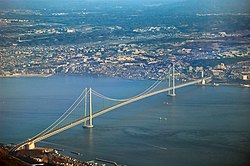
The construction of the Akashi Kaikyo Bridge required substantial underground anchorage works on both shores. These excavated spaces illustrate how tunnels support major surface infrastructure even when they are not transportation routes.
Image source: Akashi Kaikyo Bridge
1890
London opened the City and South London Railway, the world's first deep-level electric underground railway. Its circular tunnels and electric traction helped define the modern metro system.
Image source: City and South London Railway
1892
London opened the first Blackwall Tunnel beneath the River Thames for horse-drawn traffic. It provided a major east London crossing and later became an important route for motor vehicles.
1927
The Holland Tunnel opened between Manhattan and New Jersey as the first mechanically ventilated vehicular tunnel of major scale. Its ventilation towers and traffic design became models for subsequent road tunnels.
1937
The first tube of New York City's Lincoln Tunnel opened beneath the Hudson River, followed by two additional tubes in 1945 and 1957. The project demonstrated the viability of deep underwater road connections.
Image source: Lincoln Tunnel
1980
Switzerland opened the Gotthard Road Tunnel through the Alps, linking the cantons of Uri and Ticino. At about 16.9 kilometers, it was the world's longest road tunnel at the time.
1988 - 1994
Britain and France constructed twin rail tunnels beneath the English Channel, using large tunnel-boring machines and a central service tunnel. The project created a fixed link between the two countries.
Image source: Channel Tunnel
1988
Japan opened the Seikan Tunnel beneath the Tsugaru Strait, connecting Honshu and Hokkaido. Its long undersea route and demanding geology made it one of the greatest rail engineering projects of the twentieth century.
May 6, 1994
The Channel Tunnel was officially opened by Queen Elizabeth II and President François Mitterrand. Passenger and freight rail services transformed travel between Britain and continental Europe.
2000
Norway opened the Lærdal Tunnel, which connects Lærdal and Aurland. At 24.5 kilometers, it became the world's longest road tunnel and introduced illuminated rock chambers designed to reduce driver fatigue.
2015
Tunnel boring for London's Crossrail project was completed in 2015 after twin-bore machines excavated a new east-west railway beneath the city. The project integrated deep tunnels with existing rail and Underground networks.
Image source: Crossrail
Jun 1, 2016
Switzerland inaugurated the Gotthard Base Tunnel, a 57.1-kilometer railway tunnel through the Alps. Its low-gradient route shifted transalpine freight and passenger traffic from mountain approaches to a faster base-level corridor.
Image source: Gotthard Base Tunnel
2018
Norway began construction of Rogfast, a planned subsea road tunnel linking Randaberg and Bokn. Its design represents the continuing push toward longer, deeper road tunnels and improved coastal connectivity.
Oct 24, 2018
The Hong Kong–Zhuhai–Macau crossing opened with a 6.7-kilometer immersed tunnel beneath the Pearl River estuary. It formed the underwater section of one of the world's longest bridge-and-tunnel sea crossings.
Image source: Hong Kong–Zhuhai–Macau Bridge
Build a timeline like this one in minutes, for free. Start Yours →
Or browse the full history timeline directory, with more than 2,500 topics.
This History of Tunnels timeline was generated with the help of AI, using information found on the internet.
We work hard to keep these timelines accurate, but mistakes do get through. If you spot one, email us at [email protected] and we'll fix it for future visitors.
Generate yours with AI or build it from scratch, for free.
Export your timeline, add your own events, edit or remove AI-generated events, and much more
No credit card required.
15-day money-back guarantee.
You can create an unlimited number of timelines with up to 10 events on each one, customize how they look, export them to PDF, PNG, PowerPoint, CSV, and Excel, and share them with a link. Timelines made with Timeline Maker AI keep every event the generator created, and you can add up to 5 events of your own. Paid plans remove the event limit, add spreadsheet imports and hide Preceden's branding, and the higher-priced plan also adds collaborators, a custom logo and a custom domain.
Yes. You can cancel your subscription from your account page at any time, and you will not be charged again. Your subscription stays active for the rest of the period you already paid for.
Yes. We email you a reminder 15 days before your annual renewal, and we email you a receipt after every payment.
Yes. You can email us within 15 days of any payment, and we will issue you a full refund.
Check out our pricing docs or send us an email anytime: [email protected].