
-
Use Cases
-
Resources
-
Pricing
This timeline traces the development of escalators from early mechanical concepts to their widespread use in public buildings and transit systems. More Less
Build a timeline like this one in minutes, for free. Start Yours →
1859
Nathan Ames, a patent attorney from Saugus, Massachusetts, patented what is credited as the first escalator in 1859. No working model of his design was ever built.
1859
Ames's 1859 patent stated that the object of the invention was to enable people to ascend and descend between building stories. It also indicated that the device could be used in the ordinary way when desired, implying a conventional stationary staircase.
1889
Leamon Souder successfully patented an analogous device called the stairway in 1889. Its design featured a series of steps and links jointed to each other.
1892
A few months after Reno's patent was approved, George A. Wheeler patented ideas for a more recognizable moving staircase. His design was never built.
Mar 15, 1892
On March 15, 1892, Jesse W. Reno patented the Endless Conveyor or Elevator, an important predecessor of the modern escalator.
1905
George Wheeler drafted plans for helical stairways in 1905, contributing to the early exploration of spiral escalator forms.
1906
Leamon Souder patented two helical escalator designs, extending the concept beyond the conventional straight moving staircase.
1906 - 1911
Between 1906 and 1911, Charles Seeberger devised at least two helical escalator designs, including an unrealized arrangement intended for the London Underground.
1895
According to his own account, Charles Seeberger's legal counsel advised him in 1895 to name his new invention. Seeberger then set out to devise a title for it.
1900
Charles Seeberger trademarked the word escalator in 1900 to coincide with the debut of his device at the Exposition Universelle.
1906
By 1906, Seeberger noted that the public had come to pronounce the trademarked word escalator as ESS-kə-lay-tor.
1950
The landmark 1950 case Haughton Elevator Co. v. Seeberger ended Otis's exclusive control over the word escalator. It also became a cautionary example concerning trademark retention.
1980
Foster-Miller Associates developed the 1980 plan Escalator Modification for the Handicapped. The proposal was ultimately ignored in favor of installing more elevators in subway systems.
Nov 18, 1987
The King's Cross fire of 1987 illustrated the demanding maintenance requirements of escalators and their tendency to collect fluff and other small debris when not properly maintained.
Image source: King's Cross fire

1990
Despite their considerable scope, the Rehabilitation Act of 1973 and the Americans with Disabilities Act of 1990 did not directly affect escalators or their public installations.
Image source: Americans with Disabilities Act of 1990

2016
Transport for London trialed a standing-on-both-sides policy, with no walking, for several months in 2016.
May 1895
Around May 1895, Charles Seeberger began drawings for an escalator form similar to the designs George Wheeler had patented in 1892.
1896
Jesse Reno produced the first working escalator, known as the inclined elevator, and installed it beside the Old Iron Pier at Coney Island in New York City in 1896.
Nov 16, 1898
Piat installed a stepless escalator in the Harrods Knightsbridge store. The device was unveiled on November 16, 1898, and Piat later relinquished its patent rights to the department store.
1899
Seeberger teamed with the Otis Elevator Company in 1899. Together they produced the first commercial escalator, with Otis building Seeberger's prototype.
1899
Charles Seeberger bought George Wheeler's patents. Features of Wheeler's designs were subsequently incorporated into Seeberger's prototype.
1900
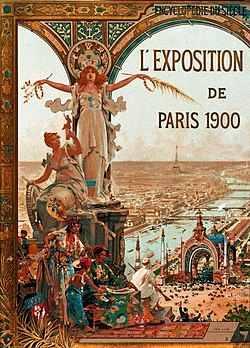
The Seeberger-Otis escalator won first prize at the 1900 Paris Exposition Universelle, helping establish the device's public profile.
Image source: Exposition Universelle (1900)
1900 - 1950
During the first half of the twentieth century, manufacturers developed competing escalator products but marketed them under different names because Otis held trademark rights to escalator. Peelle used Motorstair, while Westinghouse used Electric Stairway.
1906
Hocquardt received European patent rights for the Fahrtreppe, or moving staircase, in 1906.
1936
Although Schindler later became the world's largest escalator maker, its first escalator installation did not occur until 1936.
1979
Schindler entered the United States market in 1979 by purchasing the Haughton Elevator company.
2000
In the twenty-first century, Schindler became the world's largest maker of escalators and the second-largest maker of elevators.
1906
Jesse Reno designed the first escalators installed in an underground subway system: a helical escalator at Holloway Road tube station in London in 1906.
1933
The St Anna Pedestrian Tunnel beneath the Scheldt River in Antwerp, Belgium, opened in 1933 and used escalators to connect pedestrians with the underground crossing.
1942
The Maastunnel's bicycle and pedestrian tunnel, adjacent to its road tunnel in Rotterdam, the Netherlands, opened in 1942.
1950
In most escalator models manufactured after 1950, both the riser and tread of each step were cleated, or ribbed. Their comb-like protrusions mesh with the comb plates on the platforms and with succeeding steps in the chain.
1950
In the mid-twentieth century, some escalator handrails used a rubber-bellows design. Rings of smooth metal cladding, called bracelets, were placed between the coils.
1950
A single-width escalator traveling at approximately 0.5 metres per second can move about 2,000 people per hour when passengers ride single file.
1951
The Tyne Cyclist and Pedestrian Tunnel in Tyne and Wear, England, was constructed in 1951 and incorporated escalator access for tunnel users.
1973
By 1973, Gilbert Luna had obtained West German, Japanese, and United States patents for his version of a spiral escalator.
1985
The world's first practical spiral escalator, a Mitsubishi model, was installed in Osaka, Japan, in 1985.
1991
The Smithsonian Institution considered reassembling one of its historic 1914 escalator units in its Americana collection. Logistics and reassembly costs ultimately outweighed nostalgia, and the project was discarded.
1991
Some wooden Reno-type escalators continued operating at Downtown Crossing, an MBTA station, until preparations for Boston's Big Dig around 1991 led to their removal.
1992
Karl-Heinz Pahl received both a European patent and a United States patent for a spiral escalator in 1992.
1995
John P. Spriggs and James F. Evans patented an updated drive wheel system in 1995. Some escalators use this system today.
Build a timeline like this one in minutes, for free. Start Yours →
Or browse the full history timeline directory, with more than 2,500 topics.
This History of Escalators timeline was generated with the help of AI, using information found on the internet.
We work hard to keep these timelines accurate, but mistakes do get through. If you spot one, email us at [email protected] and we'll fix it for future visitors.
Generate yours with AI or build it from scratch, for free.
Export your timeline, add your own events, edit or remove AI-generated events, and much more
No credit card required.
15-day money-back guarantee.
15-day money-back guarantee.
You can create an unlimited number of timelines with up to 10 events on each one, customize how they look, export them to PDF, PNG, PowerPoint, CSV, and Excel, and share them with a link. Timelines made with Timeline Maker AI keep every event the generator created, and you can add up to 5 events of your own. Paid plans remove the event limit, add spreadsheet imports and hide Preceden's branding, and the higher-priced plan also adds collaborators, a custom logo and a custom domain.
Yes. You can cancel your subscription from your account page at any time, and you will not be charged again. Your subscription stays active for the rest of the period you already paid for.
Yes. We email you a reminder 15 days before your annual renewal, and we email you a receipt after every payment.
Yes. You can email us within 15 days of any payment, and we will issue you a full refund.
Check out our pricing docs or send us an email anytime: [email protected].