-
Use Cases
-
Resources
-
Pricing
7500 BC
The oldest discovered bricks were made from shaped mud before 7500 BC. They were found at Tell Aswad, in the upper Tigris region, and in southeastern Anatolia near Diyarbakir.
Image source: Mudbrick
7000 BC - 3300 BC
The inhabitants of Mehrgarh constructed air-dried mudbrick structures between 7000 and 3300 BC, establishing an early South Asian tradition of brick building that continued in later Indus Valley cities.
Image source: Mehrgarh
5000 BC - 4500 BC
Between 5000 and 4500 BC, Mesopotamian builders discovered fired brick, producing a more durable material by baking shaped clay.
3000 BC
Ceramic, or fired, brick was used by about 3000 BC in early Indus Valley cities such as Kalibangan.
Image source: Indus Valley Civilisation
3000 BC - 2000 BC
Between 3000 and 2000 BC, and perhaps earlier, several cultures used ceramic pieces to protect and decorate floors and walls. Lukas Nickel notes that these elements are more accurately classified as tiles than bricks.
Image source: Tile
300 BC
Proper brick construction for erecting walls and vaults emerged in the third century BC, when regularly shaped baked bricks began to be used in underground tomb vaulting.
Image source: Brick
4400 BC
The earliest fired bricks in China appeared around 4400 BC at Chengtoushan, a walled settlement associated with the Daxi culture.
3300 BC
By the Qujialing period, fired bricks were being used at Chengtoushan to pave roads and create foundations for buildings.
300 BC
By the end of the third century BC, Chinese builders had hollow and small bricks available for constructing walls and ceilings.
800
Starting in the ninth century CE, Chinese buildings increasingly came to be constructed entirely from fired bricks rather than using them only selectively.
1103
Published during the Song dynasty in 1103, the carpenter's manual Yingzao Fashi described brickmaking processes and glazing techniques in use at the time.
Image source: Yingzao Fashi
1600 - 1699
Using the seventeenth-century encyclopedia Tiangong Kaiwu, historian Timothy Brook described Ming brick production. Kilnmasters had to maintain a temperature that made the clay shimmer like molten gold or silver.
1571
The Green Gate in Gdansk was built in 1571 from imported Dutch brick. The bricks were too small for the colder local climate, contributing to the building's reputation as a chilly and drafty residence.
1600 - 1899
Bricks were used in construction across Northwest Europe for centuries, becoming a prominent material in regional architecture and urban building traditions.
1625
In England, the length and width of the common brick remained fairly constant from 1625, when statute regulated them at 9 by 4.5 inches, while brick depth continued to vary.
1850 - 1920
Bricks were widely used to pave roads and sidewalks, particularly during the late nineteenth and early twentieth centuries.
1896
The Monadnock Building in Chicago, completed in 1896, demonstrated the structural limits of brick skyscraper construction. Its 17 stories required exceptionally thick walls to maintain structural integrity.
1900
At the turn of the twentieth century, demand for tall office buildings led to greater use of cast and wrought iron, followed later by steel and concrete, reducing the structural role of brick in skyscrapers.
Image source: Skyscraper
1900 - 1930
In the United Kingdom, the term red brick university refers to institutions founded in the late nineteenth or early twentieth century, whose architecture often prominently employed brick.
1906
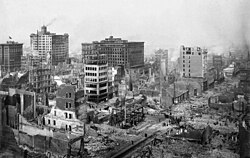
The 1906 San Francisco earthquake revealed the vulnerability of unreinforced brick masonry in earthquake-prone areas and contributed to declining brickwork use in some regions.
Image source: 1906 San Francisco earthquake
1933
The 1933 Long Beach earthquake further demonstrated the weaknesses of unreinforced brick masonry and strengthened concerns about using brickwork in earthquake-prone areas.
Image source: 1933 Long Beach earthquake
1950 - 1959
By the mid-twentieth century, municipalities across the United States began replacing brick streets with less expensive asphalt concrete.
1965
From 1965, the usual modern brick size in the United Kingdom became 215 by 102.5 by 65 millimetres. With a nominal 10-millimetre mortar joint, the resulting unit measured 225 by 112.5 by 75 millimetres.
2000
Modern brick products are made to standards including BS 6073, EN 771-3, and ASTM C55, reflecting the regulation of contemporary masonry materials.
2000
Solid clay bricks have a density of around 2,000 kilograms per cubic metre. Frogging and hollow construction reduce density, while aerated autoclaved concrete bricks can range from 450 to 850 kilograms per cubic metre.
1800 - 1850
During the first half of the nineteenth century, brick production gradually transitioned from traditional hand-moulding to mechanized mass production.
1852
Richard A. Ver Valen of Haverstraw, New York, patented the first brick-making machine in 1852, marking an important step toward mechanized production.
1853
Bradley & Craven Ltd patented its Stiff-Plastic Brickmaking Machine in 1853, contributing to the development of industrial brick manufacture.
1855
In 1855, Henry Clayton of the Atlas Works in Middlesex patented a machine capable of producing up to 25,000 bricks per day with minimal supervision.
1890 - 1899
The Bull's Trench Kiln, one of the major kiln types, was based on a design developed by British engineer W. Bull in the late nineteenth century.
1899
By the end of the nineteenth century, the Hudson River region of New York had become the world's largest brick manufacturing area, with 130 brickyards between Mechanicsville and Haverstraw employing 8,000 people.
Or browse the full history timeline directory, with more than 2,500 topics.
This History of Bricks timeline was generated with the help of AI, using information found on the internet.
We work hard to keep these timelines accurate, but mistakes do get through. If you spot one, email us at [email protected] and we'll fix it for future visitors.
Generate yours with AI or build it from scratch, for free.
Export your timeline, add your own events, edit or remove AI-generated events, and much more
No credit card required.
Cancel anytime.
Cancel anytime.
You can create an unlimited number of timelines with up to 10 events on each one, customize how they look, export them to PDF, PNG, PowerPoint, CSV, and Excel, and share them with a link. Paid plans raise the event limit and add features like spreadsheet imports and collaborators.
Yes. You can cancel your subscription from your account page at any time, and you will not be charged again. Your subscription stays active for the rest of the period you already paid for.
Yes. We will email you a reminder before the annual renewal, and we will also email you a receipt.
Yes. You can email us within 15 days of any payment, and we will issue you a full refund.
Check out our pricing docs or send us an email anytime: [email protected].