-
Use Cases
-
Resources
-
Pricing
3500 BC
The wheel emerged in Mesopotamia during the fourth millennium BC, first likely serving pottery production before enabling wheeled vehicles. It became a foundational technology for transport, machinery, and engineering.
Image source: Wheel
3200 BC
Cuneiform writing developed in ancient Mesopotamia around 3200 BC as a system for recording economic transactions and administration. Writing made durable laws, literature, scientific records, and large-scale government possible.
Image source: History of writing
105
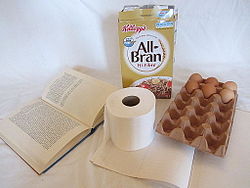
Traditional accounts credit Cai Lun of Han China with improving papermaking around 105 AD by using plant fibers, rags, and other materials. Paper became a comparatively affordable medium for communication, education, and record keeping.
Image source: Paper
1040
Bi Sheng developed ceramic movable type in China around 1040, allowing reusable characters to be arranged for printing. The technique anticipated later print revolutions, although woodblock printing remained dominant in East Asia for centuries.
Image source: Movable type
1088
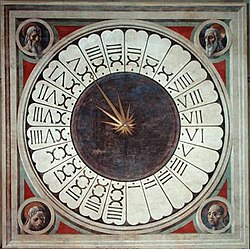
In 1088, Chinese engineer Su Song completed a sophisticated astronomical clock tower powered by water. Its escapement mechanism and rotating displays represented a major advance in precision timekeeping.
1119
Chinese navigators used magnetized needles for directional guidance by the eleventh century. The magnetic compass greatly improved open-water navigation and later supported global maritime exploration.
Image source: Compass
1270
Weight-driven mechanical clocks appeared in Europe during the late thirteenth century. Their escapements provided more regular time measurement and eventually reshaped urban life, commerce, science, and labor.
Image source: Clock
1440
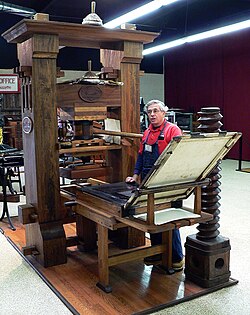
Johannes Gutenberg developed a practical movable-type press in Mainz around 1440. Its efficient production of standardized pages accelerated literacy, religious debate, scientific exchange, and the spread of political ideas.
Image source: Printing press
1596
Sir John Harington described and built an early flush toilet in England in 1596. Although widespread adoption came much later, the design established an important principle of water-based sanitation.
Image source: Flush toilet
1712
Thomas Newcomen's atmospheric engine began commercial operation in 1712 for pumping water from mines. Later improvements by James Watt made steam power more efficient and central to industrialization, transportation, and manufacturing.
Image source: Steam engine
1764
James Hargreaves developed the spinning jenny around 1764, enabling one worker to spin multiple cotton threads simultaneously. It increased textile productivity and helped launch factory-based industrial production.
Image source: Spinning jenny
1804
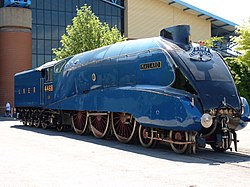
Richard Trevithick demonstrated the first full-scale steam locomotive on rails in 1804. Steam railways later transformed transportation by moving people, raw materials, and goods rapidly across continents.
Image source: Steam locomotive
1831
Cyrus McCormick's commercially successful reaper, introduced in the 1830s, mechanized grain harvesting. It reduced labor demands, increased farm productivity, and contributed to the transformation of agricultural economies.
Image source: Reaper
1839
Charles Goodyear discovered vulcanization in 1839, using heat and sulfur to make rubber stronger, more durable, and less sensitive to temperature. The process enabled practical tires, seals, belts, and countless industrial products.
Image source: Vulcanization
1867
Alfred Nobel patented dynamite in 1867 by stabilizing nitroglycerin with an absorbent material. The safer, portable explosive transformed mining, construction, tunneling, and warfare.
Image source: Dynamite
1885
Carl Benz built and patented the Benz Patent-Motorwagen in 1885–1886, widely regarded as the first practical automobile powered by an internal combustion engine. It established the basic pattern of modern motor vehicles.
Image source: Benz Patent-Motorwagen
1903
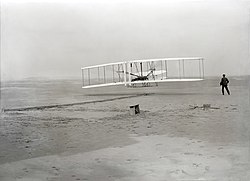
The Wright brothers achieved the first controlled, sustained, powered airplane flights at Kitty Hawk on Dec. 17, 1903. Their success established practical heavier-than-air flight and began the modern aviation era.
Image source: Wright Flyer
1907
Leo Baekeland created Bakelite in 1907, the first widely recognized fully synthetic plastic. Its heat resistance and electrical insulation made it important for telephones, radios, appliances, and industrial components.
Image source: Bakelite
1981
Hideo Kodama described an early rapid-prototyping system in 1981, and subsequent developers commercialized stereolithography and other additive-manufacturing methods. 3D printing builds objects layer by layer for design, industry, medicine, and education.
Image source: 3D printing
1714
Daniel Gabriel Fahrenheit introduced a reliable mercury thermometer in 1714 and developed a temperature scale. The instrument improved repeatable measurement in science, medicine, manufacturing, and meteorology.
Image source: Thermometer
1864
Louis Pasteur demonstrated in 1864 that controlled heating could prevent spoilage in wine and beer. Pasteurization was later applied to milk and other foods, sharply reducing disease transmission and extending shelf life.
Image source: Pasteurization
1946
ENIAC was publicly unveiled in 1946 as one of the first general-purpose electronic programmable computers. Its speed demonstrated the potential of electronic computation for military, scientific, commercial, and governmental work.
Image source: ENIAC
1958
Jack Kilby and Robert Noyce independently developed practical integrated-circuit designs in 1958–1959. By placing multiple electronic components on one semiconductor, integrated circuits enabled increasingly small, powerful, and affordable computers.
Image source: Integrated circuit
1960
Theodore Maiman demonstrated the first working laser in 1960. Lasers soon found applications in communications, surgery, manufacturing, measurement, data storage, barcode scanning, and scientific research.
Image source: Laser
1969
ARPANET transmitted its first host-to-host message on Oct. 29, 1969. Its packet-switching architecture pioneered internetworked computing and provided important foundations for the modern Internet.
Image source: ARPANET
1971
The first clinical computed tomography scanner was developed by Godfrey Hounsfield and installed for patient imaging in 1971. CT combined X-rays and computing to produce cross-sectional views of the body without surgery.
Image source: CT scan
1975
The Altair 8800, introduced in 1975, helped launch the personal-computer era. Its availability to hobbyists encouraged software development, hardware experimentation, and the formation of a rapidly growing computer industry.
Image source: Altair 8800
1989
Tim Berners-Lee proposed the World Wide Web in 1989 and developed its core technologies—HTML, HTTP, and URLs—at CERN. The web made networked information accessible through linked documents and browsers.
Image source: World Wide Web
1994
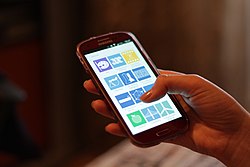
The IBM Simon, released in 1994, combined mobile telephone service with computing functions, a touchscreen, messaging, and applications. Later smartphones integrated cameras, web access, navigation, and powerful general-purpose software.
Image source: Smartphone
2012
Emmanuelle Charpentier and Jennifer Doudna published a programmable CRISPR-Cas9 gene-editing method in 2012. The technique gave researchers a comparatively precise way to alter DNA and opened new possibilities in medicine, agriculture, and biotechnology.
Image source: CRISPR gene editing
1837
Samuel Morse and collaborators developed a practical electric telegraph and signaling code in the 1830s. Telegraph networks enabled near-instant long-distance communication for governments, businesses, journalism, and railways.
Image source: Morse code
1839
Louis Daguerre publicly introduced the daguerreotype in 1839, creating detailed images on silver-coated plates. Photography permanently changed documentation, art, science, journalism, and personal memory.
Image source: History of photography
1858
The first transatlantic telegraph cable became operational in 1858, briefly linking Europe and North America by electrical communication. Later improved cables made intercontinental messaging fast and commercially dependable.
Image source: Transatlantic telegraph cable
1876
Alexander Graham Bell patented a practical telephone in 1876. Voice communication over electrical networks soon connected homes, businesses, and institutions across expanding urban and national systems.
Image source: Telephone
1879
Thomas Edison demonstrated a commercially practical incandescent lamp in 1879, supported by improvements in filaments, vacuum technology, and electrical distribution. Electric lighting extended productive and social activity beyond daylight.
Image source: Incandescent light bulb
1895
Guglielmo Marconi demonstrated wireless telegraphy over increasing distances in the 1890s. Radio transmission removed the need for physical wires and enabled broadcasting, maritime communication, navigation, and wireless networks.
Image source: History of radio
1947
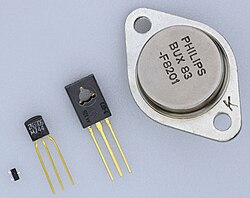
John Bardeen, Walter Brattain, and William Shockley demonstrated the first working transistor at Bell Labs in 1947. The compact semiconductor replaced many vacuum tubes and became the essential building block of modern electronics.
Image source: Transistor
1954
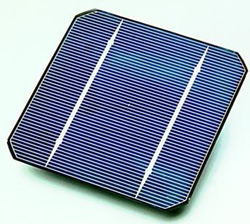
Researchers at Bell Laboratories demonstrated the first practical silicon photovoltaic cell in 1954. Solar cells converted sunlight directly into electricity and later became important for satellites, remote power, and renewable-energy systems.
Image source: Solar cell
1957
The Soviet Union launched Sputnik 1 on Oct. 4, 1957, the first artificial satellite. Its orbit demonstrated the feasibility of spaceflight and accelerated satellite communications, Earth observation, navigation, and space exploration.
Image source: Sputnik 1
1962
Telstar 1, launched in 1962, relayed live television and telephone signals across the Atlantic. Communication satellites made global broadcasting and long-distance connectivity faster and more expansive.
Image source: Telstar
1978
The first GPS satellite was launched in 1978 as part of a United States navigation system. After civilian access expanded, GPS transformed surveying, transportation, emergency response, mapping, agriculture, and everyday navigation.
Image source: Global Positioning System
Or browse the full history timeline directory, with more than 2,500 topics.
This History of Inventions timeline was generated with the help of AI, using information found on the internet.
We work hard to keep these timelines accurate, but mistakes do get through. If you spot one, email us at [email protected] and we'll fix it for future visitors.
Generate yours with AI or build it from scratch, for free.
Export your timeline, add your own events, edit or remove AI-generated events, and much more
No credit card required.
Cancel anytime.
Cancel anytime.
You can create an unlimited number of timelines with up to 10 events on each one, customize how they look, export them to PDF, PNG, PowerPoint, CSV, and Excel, and share them with a link. Paid plans raise the event limit and add features like spreadsheet imports and collaborators.
Yes. You can cancel your subscription from your account page at any time, and you will not be charged again. Your subscription stays active for the rest of the period you already paid for.
Yes. We will email you a reminder before the annual renewal, and we will also email you a receipt.
Yes. You can email us within 15 days of any payment, and we will issue you a full refund.
Check out our pricing docs or send us an email anytime: [email protected].