-
Use Cases
-
Resources
-
Pricing
The history of firearms spans over a thousand years, beginning with the invention of gunpowder in China and evolving through the development of hand cannons, matchlock and flintlock muskets, rifled barrels, cartridge ammunition, repeating rifles, semi-automatic pistols, and modern automatic weapons. This timeline traces the technological innovations that transformed firearms from crude tubes into precision instruments that reshaped warfare, hunting, and society. More Less
672 - 1400
% complete
The Eastern Roman (Byzantine) Empire used an incendiary chemical weapon known as Greek fire from the 7th through the 14th centuries. It may have been delivered through grenades or by some kind of flamethrower, representing an early precursor to later gunpowder-based incendiary weapons.
Image source: Greek fire
950
% complete
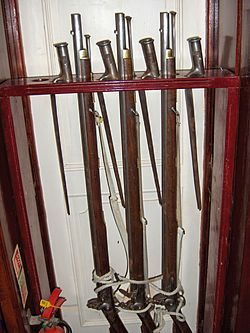
The history of the firearm begins in 10th-century China, when tubes containing gunpowder projectiles were mounted on spears to make portable fire lances. These early weapons combined spear combat with gunpowder propulsion.
Image source: Fire lance
950
% complete
The earliest known depiction of a gunpowder weapon is the illustration of a fire lance on a mid-10th century silk banner from Dunhuang, providing visual evidence of these early firearms.
1132
% complete
The De'an Shoucheng Lu, an account of the siege of De'an in 1132 during the Jin–Song Wars, records that Song forces used fire-lances against the Jurchen invaders.
Image source: Siege of De'an
1200
% complete
The earliest depiction of a gun is a sculpture from a cave in Sichuan dating to the 12th century, showing the evolution from fire lances toward true guns.
Image source: History of the firearm
1288
% complete
The oldest surviving firearm is the Heilongjiang hand cannon dated to 1288, which was discovered in modern-day Acheng District where the History of Yuan records that battles were fought.
Image source: Heilongjiang hand cannon
1598
% complete
In the Shen Qi Pu, a firearms manual written in 1598, Chinese designer Zhao Shi Zhen described Turkish muskets as superior to European muskets. Before 1598, Turks developed a pivoting matchlock mechanism that Zhao modified into the first mechanism using rack and pinion. The Wubei Zhi (1621) later described similar mechanisms not known in Europe.
1258 - 1288
% complete
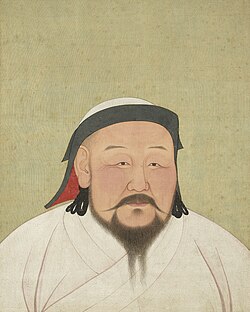
Kublai Khan's mostly failed invasion of Vietnam and of Java (1258–1288) may have spread the knowledge of making gunpowder-based weapons to Southeast Asia. Another theory holds that gunpowder reached Europe during the Mongol invasion in the first half of the 13th century.
Image source: Kublai Khan
1260
% complete
Al-Hassan claimed that the Battle of Ain Jalut in 1260 pitted the Bahri Mamluks against the Mongol Empire, an engagement associated with early use of gunpowder weapons in the Middle East.
Image source: Battle of Ain Jalut
1290 - 1300
% complete
Firearms appeared in the Middle East between the late 13th and early 14th century, spreading gunpowder technology westward from its Chinese origins.
1394 - 1465
% complete
The first references to what may have been arquebuses (tüfek) made by the Janissary corps of the Ottoman military date them to between 1394 and 1465. By as late as 1444 it is unclear whether these were truly arquebuses or small cannons, but their separate listing from cannons in mid-15th century inventories suggests they were handheld firearms.
Image source: Janissary
1450
% complete
The earliest type of Turkish hand cannons are called Şakaloz, after the Hungarian hand cannon Szakállas puska in the 15th century, reflecting cross-cultural exchange in firearm design.
Image source: Hand cannon
1450 - 1499
% complete
In the late 15th century, the Ottoman Empire used firearms as part of its regular infantry, integrating gunpowder weapons into its standing military structure.
Image source: Military of the Ottoman Empire
1465
% complete
The musket first appeared in the Ottoman Empire by 1465, introducing a heavier, more powerful class of shoulder-fired firearm.
Image source: Musket
1312
% complete
A stele inscription by Trương Hán Siêu dated to 1312 recorded guns and shots ('súng đạn') among the loot that the Vietnamese obtained from the Chams in a campaign.
1368
% complete
The first recorded use of firearms in South Asia was at the Battle of Adoni in 1368, introducing gunpowder weaponry to the Indian subcontinent.
1390
% complete
The first recorded firearms in Đại Việt were used against the Champa king Chế Bồng Nga in 1390, marking the adoption of gunpowder weapons in Vietnam.
1413
% complete
A pole gun, the bedil tombak, was recorded in Java in 1413. The knowledge of making 'true' firearms came after the middle of the 15th century, probably brought by Arab traders no earlier than 1460.
Image source: Bedil tombak
1498
% complete
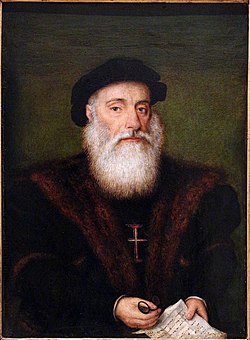
When the Portuguese reached India in 1498, they brought with them firearms, among them the matchlock musket and man-of-war ships armed with cannons, transforming warfare on the subcontinent.
Image source: Vasco da Gama
1500 - 1525
% complete
In the early 16th century, the Zamorin of Calicut began to emulate the Portuguese and arm his ships with naval gun pieces, combining local and imported technology.
Image source: Zamorin
1511
% complete
The technology further improved after the Portuguese capture of Malacca (1511), accelerating the spread and refinement of firearms in Southeast Asia.
Image source: Capture of Malacca (1511)
1526
% complete
In the 16th century, Central Asian prince Babur, the first Mughal emperor, brought Turkish firearms, which Mughal adversaries used against the Delhi Sultanate in the First Battle of Panipat, which the Rajputs and the Afghans in turn adopted. Across the 16th and 17th centuries, firearms played an important role in the Mughal military.
Image source: First Battle of Panipat
1340 - 1349
% complete
English Privy Wardrobe accounts list ribaldis, a type of cannon, in the 1340s, marking an early documented presence of gunpowder artillery in England.
Image source: Ribauldequin
1346 - 1347
% complete
Siege guns were used by the English at the Siege of Calais (1346–47), demonstrating the growing role of artillery in European warfare.
Image source: Siege of Calais (1346–1347)
1382
% complete
The first mention of firearms in Russia is found in the Sofiiskii vremennik chronicle, which stated that during the 1382 defense of Moscow from Tokhtamysh's Golden Horde, Muscovites used firearms called tyufyaki, of Eastern origin; the word derives from Turkic tüfäk 'gun'.
Image source: Sofia Second Chronicle
1396
% complete
Around the late 14th century in Italy, smaller, portable hand-cannons or schioppi were developed, creating in effect the first smoothbore personal firearm. This development dates to at least 1396.
1419 - 1421
% complete
Firearms evolved during the 1419-1434 Hussite Wars. They were first employed in auxiliary roles between 1419 and 1421 before taking on greater importance.
Image source: Hussite Wars
1421
% complete
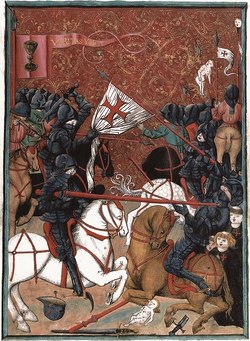
The first use of firearms as primary offensive weapons came in the 1421 Battle of Kutná Hora, where Hussite forces famously deployed war wagons and gunfire against crusader armies.
Image source: Battle of Kutná Hora
1513
% complete
Starting in 1513, German, Bohemian and Turkish gun-making traditions merged, producing new hybrid designs and advancing European firearm craftsmanship.
1586
% complete
The paper cartridge was introduced sometime before 1586, speeding up reloading, and the bayonet came to use in 16th century France, turning muskets into versatile pike-replacing weapons.
Image source: Paper cartridge
1836
% complete
This revolving pistol design dates from at least 1836, with the introduction of the Colt Paterson, one of the earliest practical repeating handguns.
Image source: Colt Paterson
1865
% complete
Springfield rifles were among the first breech-loading rifles, starting production in 1865, allowing soldiers to reload faster and from a prone position.
Image source: Springfield rifle
1884
% complete
The world's first machine gun was the Maxim gun, developed by British inventor Sir Hiram Maxim in 1884. It harnessed recoil energy to automatically reload, revolutionizing warfare.
Image source: Maxim gun
1898
% complete
The Springfield Model 1892–99, a bolt-action rifle based on the Krag design, was used during the Spanish–American War by American forces.
Image source: Springfield Model 1892–99
1908
% complete
The world's first successful self-loading rifle was the Mondragón rifle, designed in 1908 by Mexican general Manuel Mondragón, pioneering semi-automatic infantry weapons.
Image source: Mondragón rifle
1918
% complete
It was introduced in 1918 by the German Army as the primary weapon of the Stosstruppen, assault groups specialized in trench combat during World War I.
Or browse the full history timeline directory, with more than 2,000 topics.
This History of Firearms timeline was generated with the help of AI, using information found on the internet.
We work hard to keep these timelines accurate, but mistakes do get through. If you spot one, email us at [email protected] and we'll fix it for future visitors.
Generate yours with AI or build it from scratch, for free.
Export your timeline, add your own events, edit or remove AI-generated events, and much more
No credit card required.
Cancel anytime.
Cancel anytime.
You can create an unlimited number of timelines with up to 10 events on each one, customize how they look, export them to PDF, PNG, PowerPoint, CSV, and Excel, and share them with a link. Paid plans raise the event limit and add features like spreadsheet imports and collaborators.
Yes. You can cancel your subscription from your account page at any time, and you will not be charged again. Your subscription stays active for the rest of the period you already paid for.
Yes. We will email you a reminder before the annual renewal, and we will also email you a receipt.
Yes. You can email us within 15 days of any payment, and we will issue you a full refund.
Check out our pricing docs or send us an email anytime: [email protected].