
-
Use Cases
-
Resources
-
Pricing
400 BC - 301 BC
The writings attributed to Wang Xu contain the earliest Chinese literary reference to magnetism: “The lodestone attracts iron.” The text also says that people of Zheng knew their position with a south-pointer, though scholars debate whether this describes an early compass.
Image source: Magnetism
200 BC - 99 AD
During the Han dynasty, Chinese inventors developed a device called the south-governor, or sīnán. It was also known as the South Pointing Fish and represented the earliest known Chinese compass tradition.
300 - 399
The same passage about lodestone and a south-pointer was also attributed to the fourth-century writer Tshui Pao. The earlier Wang Xu attribution is generally considered more authentic.
1000 - 1099
By the mid-11th century, the South Pointing Fish was used for land navigation during the Song dynasty. Its directional function represented an important transition from symbolic magnetic devices to practical orientation tools.
1040 - 1044
A Song dynasty book dated 1040–1044 gives the earliest reference to a specific magnetic direction-finder for land navigation. This evidence indicates that the military used magnetic compasses for navigational orienteering before the middle of the 11th century.
Image source: History of the compass
1040 - 1044
The Song military used the compass for navigational orienteering by 1040–1044. This is the earliest securely documented practical military use of a magnetic compass in China.
1088
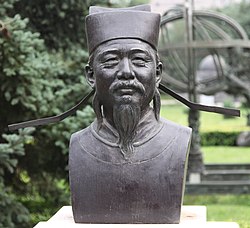
In 1088, the scholar Shen Kuo provided the first incontestable and explicit Chinese literary description of a magnetized needle. His account established a clear connection between magnetism and a directional instrument.
Image source: Shen Kuo
1100 - 1250
The Shilin Guang Ji, compiled between 1100 and 1250, describes a wooden turtle suspended by a pin. A needle attached to its tail made the turtle point north, documenting a dry-mounted directional device.
1111 - 1117
In Pingzhou Table Talks, Zhu Yu states that ship pilots knew coastal configurations and navigated by celestial bodies and magnetic direction. The passage is the earliest explicit recorded description of a compass used for maritime navigation.
1111 - 1117
Zhu Yu’s Pingzhou Table Talks records Chinese maritime use of the compass between 1111 and 1117. Sailors steered by the stars at night and the sun by day, while the account provides the earliest explicit evidence of a magnetic compass at sea.
1296
During his voyage from Wenzhou to Angkor Thom, Yuan diplomat Zhou Daguan described a mariner taking a needle direction of “ding Wei,” equivalent to 22.5 degrees southwest. His account in The Customs of Cambodia is the first recorded use of a 48-position mariner’s compass at sea.
1325
Chen Yuanjing published the Shilin Guang Ji in 1325, preserving material compiled between 1100 and 1250. Its account of a suspended wooden turtle provides evidence for a Chinese dry compass, although the date and extent of dry-needle maritime use remain debated.
300 - 399
Fourth-century Tamil nautical books mention a compass. Its early name, macchayantra, meaning “fish machine,” has been taken as evidence suggesting a Chinese origin or influence.
1187 - 1202
Alexander Neckam described a magnetized compass needle used by sailors in De utensilibus and De naturis rerum after returning to England from France. These texts document compass use in the English Channel and represent the earliest European evidence.
1190
Around 1190, Western Europe received its first literary description of a compass. Neckam’s De naturis rerum explains how sailors touched a needle with a magnet and used its north-pointing orientation when sun and stars were obscured.
1232
The earliest recorded reference to a compass in the Muslim world appears in the Persian talebook Jawami ul-Hikayat. It describes a compass used during navigation in the Red Sea or Persian Gulf.
1242 - 1282
Baylak al-Qibjāqī described a needle-and-bowl compass used during his voyage from Syria to Alexandria in 1242. His account was written in Cairo in 1282 and is the earliest Arabic description of this form of compass.
1269
Dry compasses began appearing in medieval Europe around 1269. Their pivoted needles represented a significant mechanical development beyond the earlier floating magnetic needle in a bowl of water.
1269
In Epistola de magnete, Petrus Peregrinus of Maricourt described both a floating compass for astronomical purposes and a dry compass for seafaring. His work is among the most important medieval European technical accounts of magnetism.
1275 - 1299
The Yemeni sultan and astronomer al-Malik al-Ashraf described the compass as a qibla indicator. He also explained its use for determining the meridian and the direction of Mecca.
1295 - 1302
Between 1295 and 1302, Flavio Gioja was traditionally credited with converting the floating needle into a compass with a round box and a 360-degree compass card attached to the magnetic element. This design gave the sailor’s compass its familiar form.
1300
Dry compasses began appearing in the medieval Islamic world around 1300. Their use developed alongside magnetic needle-and-bowl instruments for navigation and determining the direction of Mecca.
1300
An Arabic treatise by the Egyptian astronomer and muezzin Ibn Simʿūn describes a dry compass used as a qibla indicator. The instrument helped determine the direction toward Mecca.
1300 - 1399
The Syrian astronomer and timekeeper Ibn al-Shatir invented a timekeeping device incorporating a universal sundial and a magnetic compass. The instrument demonstrates the integration of magnetic direction-finding with astronomical timekeeping.
Image source: Ibn al-Shatir
1399
An Egyptian report from 1399 identifies two different kinds of magnetic compass. This record reflects the coexistence of multiple compass constructions in the medieval Islamic world.
1500 - 1599
China adopted the European compass-card in a box frame with a dry pivot needle after the design was transmitted through Japanese pirates who had learned it from Europeans. The older Chinese suspended dry compass nevertheless remained in use into the 18th century.
1100 - 1199
In 12th-century Denmark, about one quarter of 570 Romanesque churches were rotated several degrees clockwise from true east–west. Their orientation corresponds to the period’s magnetic declination and suggests fairly common compass use.
1200 - 1299
In Massa, Tuscany, floating magnetic needles were used underground for tunneling and for defining mining claims. This was an early application of the compass as a subterranean direction finder.
1275 - 1299
Traffic between the Mediterranean and northern Europe increased in the closing decades of the 13th century. The compass may have made crossing the Bay of Biscay safer and helped support direct commercial voyages into the English Channel.
1290
By around 1290, Mediterranean sailing seasons could begin in late January or February and continue until December. Compass-assisted navigation contributed to the gradual increase in shipping during periods formerly avoided because of unreliable skies.
1400 - 1499
In the 15th century, the navigator Ibn Majid described aligning the compass with the pole star. His account indicates awareness that magnetic north and true north could differ, an effect now called magnetic declination.
1475 - 1499
A German miner, Rülein von Calw, published the first detailed treatise devoted to the underground use of compasses. His work formalized compass-based mining surveying.
1302
Flavio Gioja, traditionally described as an Italian pilot from Amalfi, is credited with perfecting the sailor’s compass by suspending its needle over a compass card. Later evidence shows that related pivoting designs predated him.
1380
A commentary on Dante’s Divine Comedy from 1380 describes a compass with a needle attached to a rotating card. An earlier reference to a portable compass in a box, dated 1318, further supports the early European use of dry compasses.
Image source: Divine Comedy
1600
William Gilbert’s publication of De Magnete in 1600 helped move the explanation of magnetic remanence and induction away from supernatural and occult interpretations toward experimental natural philosophy.
Image source: De Magnete
1690
Sir Edmond Halley introduced a rudimentary working liquid compass at a meeting of the Royal Society in 1690. The design anticipated later efforts to damp needle movement with fluid.
Image source: Edmond Halley
1728
Dry compasses were already in common use by the early 18th century and were described in the 1728 Cyclopaedia. Their continued prevalence preceded the broad adoption of liquid-filled instruments.
1813
Englishman Francis Crow patented the first liquid mariner’s compass considered practicable for limited use. The fluid helped damp the motion of the compass card in marine conditions.
1830 - 1860
Liquid-damped marine compasses were used occasionally by the Royal Navy from the 1830s through the 1860s. The standard Admiralty compass, however, remained a dry-mounted design during this period.
1852
French physicist Léon Foucault made the first gyroscope for scientific use in 1852. His work established the rotating-instrument principle that later enabled gyrocompasses independent of magnetic direction.
Image source: Léon Foucault
1885
Marinus Gerardus van den Bos patented a gyrocompass in the Netherlands in 1885. Small electric motors made continuous spinning possible and enabled a nonmagnetic approach to finding direction.
Image source: Gyrocompass
1885
A 1885 patent introduced a hand compass with a viewing prism and lens. The arrangement allowed users to sight geographical landmarks accurately while reading the heading, creating the prismatic compass.
1902
The Bézard compass was first patented in 1902. It consisted of a field compass with a mirror mounted above it, allowing users to observe the direction while sighting.
1906
German inventor Hermann Anschütz-Kaempfe built the first practical gyrocompass in 1906. His achievement transformed the gyroscopic principle into a usable navigational instrument.
1908
Although liquid compasses had been tested earlier, they were not introduced generally into the Royal Navy until 1908. This marked a major institutional shift from dry-mount marine compasses.
1909
Captain F. O. Creagh-Osborne introduced an aircraft compass using alcohol and distilled water to damp the compass card. The design addressed the motion and vibration encountered in aviation.
1915
Creagh-Osborne adapted his aircraft-compass technology into a smaller pocket model for artillery and infantry officers. He received a patent for the individual-use design in 1915.
1931
In December 1931, the newly founded Swedish Silva Company introduced its first baseplate or bearing compass. A liquid-filled capsule damped the swing of the magnetized needle.
1932
In December 1932, Gunnar Tillander and the three Kjellström brothers formed the Silva Company. It manufactured and sold Silva orienteering compasses to Swedish orienteers, outdoorsmen, and military officers.
1932
Silva’s early-1930s designs popularized the liquid-filled capsule for field navigation. This construction improved readability and stability compared with earlier floating or dry-mounted arrangements.
1933
Surveyor Tuomas Vohlonen applied for a patent for a lightweight celluloid compass housing filled and sealed with petroleum distillate. The liquid damped the needle and protected it from shock and excessive motion.
1936
Suunto introduced the Model M-311 in a wrist-mounted form in 1936. Vohlonen’s capsule design led directly to the lightweight liquid-filled field compasses used today.
1938
An automatic sun compass developed by Lieutenant Colonel James Allason was adopted by the British Army in India in 1938. It was intended for tanks and armored vehicles, where magnetic fields could distort standard prismatic compasses.
Or browse the full history timeline directory, with more than 2,500 topics.
This History of the Compass timeline was generated with the help of AI, using information found on the internet.
We work hard to keep these timelines accurate, but mistakes do get through. If you spot one, email us at [email protected] and we'll fix it for future visitors.
Generate yours with AI or build it from scratch, for free.
Export your timeline, add your own events, edit or remove AI-generated events, and much more
No credit card required.
Cancel anytime.
Cancel anytime.
You can create an unlimited number of timelines with up to 10 events on each one, customize how they look, export them to PDF, PNG, PowerPoint, CSV, and Excel, and share them with a link. Paid plans raise the event limit and add features like spreadsheet imports and collaborators.
Yes. You can cancel your subscription from your account page at any time, and you will not be charged again. Your subscription stays active for the rest of the period you already paid for.
Yes. We will email you a reminder before the annual renewal, and we will also email you a receipt.
Yes. You can email us within 15 days of any payment, and we will issue you a full refund.
Check out our pricing docs or send us an email anytime: [email protected].