-
Use Cases
-
Resources
-
Pricing
The history of money traces humanity's evolution from bartering goods and using commodity money like shells and livestock, to minting the first coins in ancient Lydia, adopting paper currency in China, establishing banking systems and the gold standard, and ultimately developing fiat currencies, credit cards, and digital cryptocurrencies that define today's global economy. More Less
3000 BC
% complete
Around 3000 BCE, developments in Mesopotamia provided the infrastructure for the next simplest form of money of account: asset-backed credit or representative money.
Image source: History of money

2600 BC - 1900 BC
% complete
Between 2600 and 1900 BC, techniques for assaying metals helped the popularisation of metal-based commodity money and coinage, allowing value to be verified by weight and purity.
2150 BC
% complete
By 2150 BC, the shekel was nominally equivalent to a specific weight of barley, which was the preexisting and parallel form of currency in Mesopotamia.
Image source: Shekel
2050 BC
% complete
The Code of Ur-Nammu (c. 2050 BC) was among the earliest legal codes to regulate debts and payments, formalizing monetary obligations in ancient Mesopotamia.
Image source: Code of Ur-Nammu
1985 BC
% complete
Later, the Cave of Machpelah is purchased (with silver) by Abraham, some time after 1985 BC, although scholars believe the book was edited in the 6th or 5th centuries BC.
Image source: Cave of the Patriarchs
1930 BC
% complete
The Code of Eshnunna (c. 1930 BC) set fixed prices for goods and wages, providing an early legal framework for monetary exchange in Mesopotamia.
1760 BC
% complete
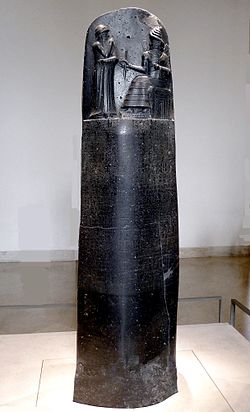
In ancient Babylon around 1760 BC, the Code of Hammurabi established detailed rules on loans, interest rates, and debt repayment, shaping early credit systems.
Image source: Code of Hammurabi
1000 BC
% complete
From about 1000 BC, money in the form of small knives and spades made of bronze was in use in China during the Zhou dynasty, with cast bronze replicas of cowrie shells in use before this.
Image source: History of Chinese currency
700 BC - 601 BC
% complete
Other coins made of electrum, a naturally occurring alloy of silver and gold, were manufactured on a larger scale about the 7th century BC in Lydia, on the coast of what is now Turkey.
Image source: Electrum
700 BC - 601 BC
% complete
Nearby cities of Ionia adopted coinage to their own standards, including Mytilene and Phokaia using electrum coins and Aegina using silver, soon spreading to mainland Greece and the Persian Empire after it incorporated Lydia in 547 BC.
Image source: Ionian League
700 BC - 601 BC
% complete
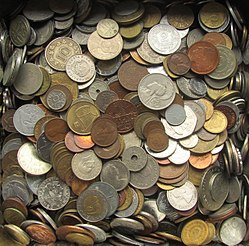
The first manufactured actual coins seem to have appeared separately in India, China, and the cities around the Aegean Sea during the 7th century BC.
Image source: Coin
700 BC - 601 BC
% complete
All modern coins are descended from coins invented in the kingdom of Lydia in Asia Minor somewhere around the 7th century BC: disk-shaped, made of gold, silver, bronze or imitations thereof, stamped with images on both sides.
Image source: Lydia
650 BC - 500 BC
% complete
Minting occurred in the late 7th century BC amongst the Greek cities of Asia Minor, spreading to the Greek islands of the Aegean and to the south of Italy by 500 BC.
Image source: Ancient drachma
500 BC - 401 BC
% complete
The use and export of silver coinage, along with soldiers paid in coins, contributed to the Athenian Empire's dominance of the region in the 5th century BC.
Image source: Delian League
400 BC - 301 BC
% complete
The worship of Moneta is recorded by Livy; a temple consecrated to the goddess was built in the earlier part of the 4th century BC, and for four centuries it contained the mint of Rome, giving us the word 'money'.
Image source: Moneta
300 BC - 201 BC
% complete
From its introduction during the Republic in the third century BC through Imperial times, Roman currency saw many changes in form, denomination, and composition, with persistent inflationary debasement and replacement of coins over the centuries.
Image source: Roman currency
300 BC
% complete
In the Indian subcontinent, the history of the rupee traces back to Ancient India circa the 3rd century BC, when early silver coinages circulated across the region.
Image source: History of the rupee
600 - 1200
% complete
At around the same time in the medieval Islamic world, a vigorous monetary economy was created during the 7th–12th centuries on the basis of expanding circulation of a stable high-value currency, the dinar.
Image source: Islamic economics
794 - 1200
% complete
Between 794 and 1200 the penny was the only denomination of coin in Western Europe, dominating everyday transactions across the Carolingian and post-Carolingian world.
Image source: Penny
1160
% complete
Minted without oversight by bishops, cities, feudal lords and fiefdoms, by 1160 coins in Venice contained only 0.05g of silver, while England's coins were minted at 1.3g.
Image source: Venetian lira
1200 - 1299
% complete
Gold coins began to be minted again in Europe in the 13th century, reviving precious-metal coinage that had largely disappeared since antiquity.
1250 - 1299
% complete
Large coins were introduced in the mid-13th century, supplementing the small penny denominations that had dominated European currency for centuries.
Image source: Groschen
1252
% complete
The Florentine florin, one of the most used coinage types in European history, was struck in Florence in the 13th century and was the first European gold coin struck in sufficient quantities since the 7th century to play a significant commercial role.
Image source: Florin
1284 - 1797
% complete
The Venetian sequin, minted from 1284 to 1797, was the most prestigious gold coin in circulation in the commercial centers of the Mediterranean Sea.
Image source: Ducat
1300 - 1399
% complete
During the 14th century Europe changed from use of silver in currency to minting of gold, with Vienna making this change in 1328.
1329
% complete
The imperial taka was officially introduced by the monetary reforms of Muhammad bin Tughluq, emperor of the Delhi Sultanate, in 1329.
Image source: Bangladeshi taka
1340 - 1429
% complete
There were periods of significant debasement in 1340–60 and 1417–29, when no small coins were minted, and by the 15th century issuance of small coin was further restricted by governments.
Image source: Debasement
1540 - 1545
% complete
Sher Shah Suri (1540–1545) introduced a silver coin called a rupiya, which became the ancestor of the modern rupee used across South Asia.
Image source: Rupee
1600 - 1699
% complete
In the early 17th century Sweden lacked precious metals, and so produced 'plate money': large slabs of copper 50 cm or more in length and width, stamped with indications of their value.
Image source: Swedish riksdaler
600 - 699
% complete
The development of the banknote began in the 7th century, with local issues of paper currency in China, laying groundwork for later government paper money.
Image source: Banknote
1000 - 1099
% complete
Paper money was introduced in Song dynasty China during the 11th century, becoming the world's first government-issued paper currency.
Image source: Jiaozi (currency)
1100 - 1199
% complete
In the 12th century, the English monarchy introduced an early version of the bill of exchange in the form of a notched piece of wood known as a tally stick; tallies persisted until the early 19th century even after paper money became prevalent.
Image source: Tally stick
1100 - 1119
% complete
By the early 12th century, the banknotes issued in a single year amounted to 26 million strings of cash coins, demonstrating the enormous scale of Song paper money.
1458 - 1461
% complete
Threatened by Alfonso V of Aragon, the Doge of Genoa in 1458 handed the Republic over to the French, but with support from Milan, Genoa revolted and the Republic was restored in 1461.
Image source: Republic of Genoa
1464 - 1499
% complete
The Milanese conquered Genoa in 1464 and held it as a fief of the French crown; between 1463–78 and 1488–99, Genoa was held by the Milanese House of Sforza.
1499 - 1528
% complete
From 1499 to 1528, the Republic of Genoa reached its nadir, being under nearly continual French occupation until Andrea Doria's alliance restored its independence.
1500 - 1599
% complete
Genoese currency became important in the 16th century during the Golden age of Genoese banking, with the Spanish Empire funnelling its wealth from Spanish America through the Bank of Saint George.
Image source: Bank of Saint George
1520 - 1671
% complete
From about 1520 the Genoese controlled the Spanish port of Panama, the first port on the Pacific, holding a concession mainly for the slave trade of the new world until the sacking of the original city in 1671.
Image source: Panama City
May 30, 1522
% complete
The Spanish, with their intramural allies, the 'old nobility' entrenched behind Genoa, captured the city on May 30, 1522, and subjected it to a pillage.
Image source: Sack of Rome (1527)
1528
% complete
When admiral Andrea Doria allied with Emperor Charles V to oust the French and restore Genoa's independence, 1528 marked the first loan from Genoese banks to Charles, opening the golden age of Genoese banking.
Image source: Andrea Doria
1557
% complete
The state bankruptcy of Philip II in 1557 threw the German banking houses into chaos and ended the reign of the Fuggers as Spanish financiers, opening the way for the Genoese banking consortium.
Image source: Philip II of Spain
1600 - 1649
% complete
In the early 17th century, scriveners in England were the first to keep deposits for the express purpose of relending them, predating goldsmith bankers as financial intermediaries.
Image source: Scrivener
1640
% complete
In 1640 King Charles I seized the private gold stored in the mint as a forced loan, undermining trust in royal custody of bullion and pushing merchants toward private goldsmiths.
Image source: Charles I of England
1646 - 1746
% complete
The silver scudo's value increased to 6.5 lire in 1646, 7.4 lire in 1671, and 8.74 lire just before the Austrian occupation of Genoa in 1746.
Image source: Citroën Jumpy
1661 - 1664
% complete
The first European banknotes were issued by Stockholms Banco, predecessor of Sweden's central bank Sveriges Riksbank, in 1661, replacing copper plates; in 1664 the bank ran out of coins to redeem notes and ceased operating.
Image source: Stockholms Banco
1694
% complete
The Bank of England was granted sole rights to issue banknotes in England after 1694, ending the practice of private note issue that continued up to that year.
Image source: Bank of England
1696
% complete
In 1696, the Bank of Scotland became the first European bank to successfully print its own paper banknotes, entering into circulation the same year.
Image source: Bank of Scotland
1770 - 1791
% complete
In India the earliest paper money was issued by Bank of Hindostan (1770–1832), General Bank of Bengal and Bihar (1773–1775), and Bengal Bank (1784–1791).
Image source: Bank of Hindostan
1775 - 1825
% complete
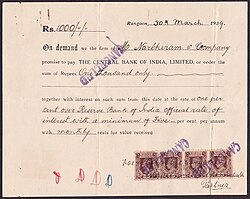
In England, bills of exchange became an important form of credit and money during the last quarter of the 18th century and the first quarter of the 19th century before banknotes, checks and cash credit lines were widely available.
Image source: Negotiable instrument
1913
% complete
Mitchell Innes articulated the credit theory of money in his 1913 article 'What is money?', arguing money is fundamentally a record of debt rather than a commodity.
Image source: Alfred Mitchell-Innes
1913
% complete
In the United States, the Federal Reserve Bank was granted rights similar to the Bank of England's after its establishment in 1913, centralizing note issuance.
Image source: Federal Reserve
1958
% complete
The Bankamericard, launched in 1958, became the first third-party credit card to acquire widespread use and acceptance in shops all over the United States, soon followed by Mastercard and American Express.
Image source: Visa Inc.
1971
% complete
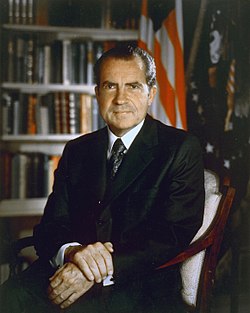
In 1971, United States President Richard Nixon announced that the US dollar would not be directly convertible to gold any more, effectively ending the Bretton Woods system.
Image source: Nixon shock
1980 - 1999
% complete
In the late 20th century, payment cards such as credit cards and debit cards became the dominant mode of consumer payment in the First World; since 1980, US credit card companies have been exempt from state usury laws.
Image source: Payment card
1990
% complete
Computer technology developed in the second half of the twentieth century allowed money to be represented digitally; by 1990, all money transferred between the US central bank and commercial banks was in electronic form.
2008
% complete
In 2008, Bitcoin was proposed under the pseudonym of Satoshi Nakamoto, introducing decentralized cryptocurrency and launching a new era of digital money.
Image source: Bitcoin
2012
% complete
In 2012, by number of transactions, 20 to 58 percent of transactions were electronic depending on country, showing the accelerating shift away from physical cash.
Image source: Cashless society
Or browse the full history timeline directory, with more than 2,000 topics.
This History of Money timeline was generated with the help of AI, using information found on the internet.
We work hard to keep these timelines accurate, but mistakes do get through. If you spot one, email us at [email protected] and we'll fix it for future visitors.
Generate yours with AI or build it from scratch, for free.
Export your timeline, add your own events, edit or remove AI-generated events, and much more
No credit card required.
Cancel anytime.
Cancel anytime.
You can create an unlimited number of timelines with up to 10 events on each one, customize how they look, export them to PDF, PNG, PowerPoint, CSV, and Excel, and share them with a link. Paid plans raise the event limit and add features like spreadsheet imports and collaborators.
Yes. You can cancel your subscription from your account page at any time, and you will not be charged again. Your subscription stays active for the rest of the period you already paid for.
Yes. We will email you a reminder before the annual renewal, and we will also email you a receipt.
Yes. You can email us within 15 days of any payment, and we will issue you a full refund.
Check out our pricing docs or send us an email anytime: [email protected].