-
Use Cases
-
Resources
-
Pricing
2100 BCE
A lump of glass found at Eridu in Iraq dates to the twenty-first century BCE or earlier. It was produced during the Akkadian Empire or the early Ur III period, providing some of the earliest evidence for glass manufacture.
1600 BCE
The earliest known Persian glass appears as beads from the late Bronze Age. These objects were discovered during excavations at Dinkhah Tepe in Iran by Charles Burney.
Image source: History of glass
1600 BCE
A fragment of a glass bottle from Büklükale in central Turkey has been estimated to be about 1600 BCE old, documenting early glass use in Anatolia.
1500 BCE
By the fifteenth century BCE, extensive glass production was occurring in Western Asia, Crete, and Egypt. A Mycenaean Greek Linear B term for workers of lapis lazuli and glass is also attested from this period.
1400 BCE
A glassmaking crucible discovered at Alalakh in the Amuq Valley of Turkey during excavations from 2011 to 2014 provides evidence of early glass production. Its material is contemporary with, or possibly slightly earlier than, fourteenth-century BCE Egyptian glass.
900 BCE
Glass production picked up again in its former centers in Syria and Cyprus during the ninth century BCE. Techniques for making colorless glass were discovered during this revival.
50 BCE
During the first century BCE, glass blowing was discovered on the Syro-Judean coast. The technique revolutionized glass production by allowing vessels to be formed rapidly and economically.
Image source: Glassblowing

1 CE
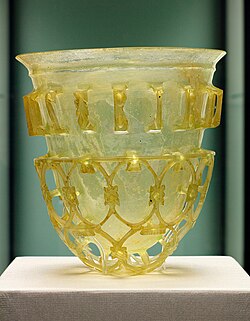
During the first century CE, the Roman glass industry underwent rapid technical growth, including the introduction of glass blowing and the increasing dominance of colorless or aqua glass.
Image source: Roman glass

100 CE
Raw glass was produced in locations separate from workshops that made finished vessels. By the end of the first century CE, large-scale manufacturing, especially in Alexandria, made glass commonly available throughout the Roman world.
This History of Glass timeline was generated with the help of AI, using information found on the internet.
We work hard to keep these timelines accurate, but mistakes do get through. If you spot one, email us at [email protected] and we'll fix it for future visitors.
Generate yours with AI or build it from scratch, for free.