-
Use Cases
-
Resources
-
Pricing
Venice, founded on lagoon islands in northeastern Italy in 421 AD, grew from a refuge settlement into the powerful Republic of Venice. As a dominant Mediterranean maritime and commercial power during the Middle Ages and Renaissance, Venice controlled trade routes between Europe and the East. The republic lasted over a millennium until Napoleon's conquest in 1797, after which Venice became part of Italy and evolved into a renowned cultural and tourist destination. More Less
421
% complete
According to tradition, Venice was founded on March 25, 421, when refugees from Roman cities fled to the lagoon islands to escape barbarian invasions. The first settlement, centered around Rialto, grew as fishing and salt production communities.
Image source: Timeline of Venice
840
% complete
The Pactum Lotharii, signed between Emperor Lothair I and Doge Pietro Tradonico, formally recognized Venetian autonomy and defined its borders, marking Venice's emergence as a distinct political entity between East and West.
697
% complete
Venetians traditionally date the beginning of their unique republican government to 697, when Paoluccio Anafesto was elected as the first Doge (Duke), a leader who would be chosen by an evolving electoral system for over a millennium.
Image source: Doge of Venice
1297
% complete
The 'Closure' (Serrata) of the Great Council restricted membership to a fixed hereditary patriciate, formalizing the oligarchic structure that would govern the Republic of Venice until its fall centuries later.
Image source: Great Council of Venice
1310
% complete
Following a failed coup by Baiamonte Tiepolo, Venice created the Council of Ten to protect the state from conspiracy and treason. Its extensive spy network made it one of history's most feared internal security bodies.
Image source: Council of Ten
1339
% complete
The acquisition of Treviso marked the beginning of Venice's Terraferma (mainland) empire. Over subsequent decades, Venice conquered much of northeastern Italy, including Padua, Verona, and Brescia.
Image source: Domini di Terraferma
1509
% complete
Venice suffered a crushing defeat at Agnadello against the League of Cambrai, losing most of its mainland territories within weeks. Remarkably, through diplomacy and resilience, the Republic recovered nearly all its lands.
Image source: Battle of Agnadello
1630 - 1631
% complete
The great plague of 1630–31 killed roughly a third of Venice's population. In thanksgiving for deliverance, the Senate commissioned Baldassare Longhena's Santa Maria della Salute, one of the city's most iconic churches.
Image source: 1629–1631 Italian plague
828
% complete
Venetian merchants smuggled the relics of St Mark the Evangelist from Alexandria, Egypt, establishing him as the patron saint of Venice and spurring the construction of St Mark's Basilica, which became a symbol of the city's identity.
Image source: St Mark's Basilica
1063
% complete
Begun under Doge Domenico Contarini, the new St Mark's Basilica blended Byzantine, Western, and Islamic architectural styles. Its opulent mosaics and golden interiors made it one of the most magnificent churches in Christendom.
1469
% complete
Venice quickly became the leading center of printing in Europe. Publishers like Aldus Manutius produced portable editions of the classics, including the first italic typeface, making Venice synonymous with Renaissance publishing.
Image source: Venice
1480 - 1507
% complete
Gentile Bellini created celebrated large-scale paintings of Venetian processions and public ceremonies, and even traveled to Istanbul to paint Sultan Mehmed II, exemplifying Venice's role as a cultural bridge between East and West.
Image source: Gentile Bellini
1510 - 1576
% complete
Titian dominated Venetian painting for decades, revolutionizing the use of color and oil technique. His workshop attracted patrons from across Europe, and his work influenced generations of European artists.
Image source: Titian
1703 - 1741
% complete
Priest and composer Antonio Vivaldi, known as the 'Red Priest,' worked at Venice's Pietà orphanage and composed hundreds of concertos, including The Four Seasons, making Venice a leading center of European music.
Image source: Antonio Vivaldi
1750 - 1783
% complete
Giacomo Casanova's memoirs immortalized 18th-century Venice as a city of pleasure, gambling, masked balls, and intrigue, even as the Republic's political and economic power quietly faded.
Image source: Giacomo Casanova
1895
% complete
The inaugural Venice Biennale launched what would become one of the world's most prestigious cultural events, drawing artists and visitors from around the globe and reinventing Venice as a hub of contemporary art.
Image source: Venice Biennale
1000
% complete
Doge Pietro II Orseolo led a successful naval expedition against pirates along the Dalmatian coast, securing Venetian dominance over the Adriatic Sea and beginning the expansion of its maritime empire.
Image source: Republic of Venice
1082
% complete
In exchange for naval assistance against Norman invaders, the Byzantine Empire granted Venice extensive tax-free trading privileges throughout its territories, laying the foundation for Venetian commercial supremacy in the eastern Mediterranean.
Image source: Byzantine–Venetian treaty of 1082
1099
% complete
A Venetian fleet joined the First Crusade, helping capture coastal cities in the Levant and earning valuable trading rights in the new crusader states, further expanding Venice's commercial network.
1124
% complete
The Venetian Crusade saw a powerful Venetian fleet help capture Tyre from Muslim forces, securing major trade privileges for Venetian merchants in the Kingdom of Jerusalem.
Image source: Venetian Crusade
1204
% complete
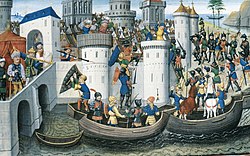
Doge Enrico Dandolo led Venice into the Fourth Crusade, diverting it to sack Constantinople. The resulting Latin Empire gave Venice control of key territories and ports, transforming it into a dominant Mediterranean colonial power.
Image source: Fourth Crusade
1271
% complete
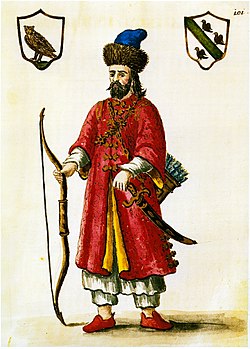
Venetian merchant Marco Polo set out for Asia with his father and uncle, eventually reaching the court of Kublai Khan. His account of travels became one of the most influential books of the medieval world.
Image source: Marco Polo
1298
% complete
Venice suffered a major naval defeat against rival Genoa at Curzola, where Marco Polo was captured. Despite the loss, Venice recovered and continued its rivalry with Genoa until Genoa's eventual decline.
Image source: Battle of Curzola
1380
% complete
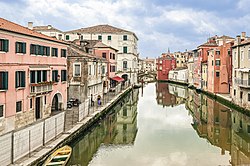
Venice narrowly defeated Genoa in the War of Chioggia, surviving an enemy occupation of the lagoon's edge. The victory cemented Venice's supremacy in Mediterranean trade as Genoa entered long-term decline.
Image source: War of Chioggia
1400 - 1500
% complete
The Venetian Arsenal, capable of producing warships at remarkable speed using assembly-line methods centuries before industrialization, employed thousands of workers and was central to Venice's naval power.
Image source: Venetian Arsenal
1538
% complete
The Ottoman fleet under Barbarossa defeated a Christian coalition at Preveza, confirming Ottoman naval dominance in the eastern Mediterranean and pressuring Venice's maritime empire and Greek island possessions.
Image source: Battle of Preveza
1571
% complete
A Venetian-led Holy League fleet destroyed the Ottoman navy at Lepanto, one of the largest naval battles in history. Though celebrated across Europe, the victory did not restore Venice's declining eastern trade.
Image source: Battle of Lepanto
1669
% complete
After a heroic 21-year siege, Candia (Heraklion) fell to the Ottomans, ending Venetian rule over Crete, its most important remaining colony, and signaling the steady erosion of its overseas empire.
Image source: Cretan War (1645–1669)
1684 - 1699
% complete
Under Doge Francesco Morosini, Venice captured the Peloponnese from the Ottomans, its last great military triumph. The gains proved temporary, being lost again after a renewed Ottoman offensive in 1715.
Image source: Morean War
1797
% complete
Napoleon's forces invaded Venice in May 1797, and the last Doge, Ludovico Manin, abdicated. After more than a thousand years, the Most Serene Republic fell; Napoleon then ceded Venice to Austria.
Image source: Fall of the Republic of Venice
1866
% complete
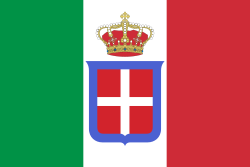
Following the Third Italian War of Independence, Austria ceded Venice and the surrounding region to the newly unified Kingdom of Italy, integrating the city into the modern Italian nation-state.
Image source: Kingdom of Italy
2003 - 2020
% complete
Facing recurrent flooding, Venice began building the MOSE system of mobile floodgates at the lagoon inlets. After years of delays and corruption scandals, the barriers successfully protected the city from record tides starting in 2020.
Image source: MOSE
Or browse the full history timeline directory, with more than 2,000 topics.
This History of Venice timeline was generated with the help of AI, using information found on the internet.
We work hard to keep these timelines accurate, but mistakes do get through. If you spot one, email us at [email protected] and we'll fix it for future visitors.
Generate yours with AI or build it from scratch, for free.
Export your timeline, add your own events, edit or remove AI-generated events, and much more
No credit card required.
Cancel anytime.
Cancel anytime.
You can create an unlimited number of timelines with up to 10 events on each one, customize how they look, export them to PDF, PNG, PowerPoint, CSV, and Excel, and share them with a link. Paid plans raise the event limit and add features like spreadsheet imports and collaborators.
Yes. You can cancel your subscription from your account page at any time, and you will not be charged again. Your subscription stays active for the rest of the period you already paid for.
Yes. We will email you a reminder before the annual renewal, and we will also email you a receipt.
Yes. You can email us within 15 days of any payment, and we will issue you a full refund.
Check out our pricing docs or send us an email anytime: [email protected].