-
Use Cases
-
Resources
-
Pricing
Vienna, the capital of Austria, boasts a rich history spanning over two millennia. Founded as a Roman military camp called Vindobona, it grew into the seat of the powerful Habsburg dynasty and the heart of a vast empire. Renowned as a center of classical music with figures like Mozart and Beethoven, Vienna also played pivotal roles in European politics, survived Ottoman sieges, endured World War II occupation, and emerged as a modern hub for international diplomacy and culture. More Less
1000 - 1099
% complete
Vienna grew from the Roman settlement known as Vindobona to be an important trading site in the 11th century.
1155
% complete
In 1155, Margrave Henry II of Austria made Vienna his capital.
Image source: Henry II, Duke of Austria
1156
% complete
In 1156, Austria was raised to a duchy in the Privilegium Minus, with Vienna becoming the seat of all future dukes.
Dec 1192
% complete
During the events surrounding the Third Crusade, King Richard the Lionheart was discovered and captured by Duke Leopold V the Virtuous two days before Christmas of 1192 in Erdberg near Vienna. Richard had been extradited by March 1193.
Image source: Leopold V, Duke of Austria
1200
% complete
The enormous ransom of 50,000 Silver Marks paid for King Richard the Lionheart allowed the creation of a mint and the construction of city walls around the year 1200.
1221
% complete
In 1221, Vienna received the rights of a city and as a staple port (Stapelrecht).
1278
% complete
In 1278, Rudolf I took control over the Austrian lands after his victory over Ottokar II of Bohemia and began to establish Habsburg rule.
Image source: Rudolf I of Germany
1280
% complete
In 1280, Jans der Enikel wrote the 'Fürstenbuch', a first history of the city.
Image source: Jans der Enikel
1327
% complete
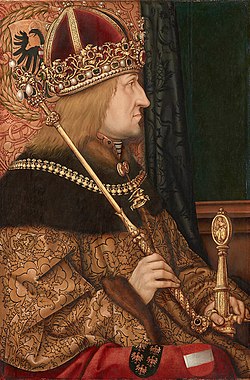
In 1327, Frederick the Handsome published his edict allowing the city to maintain an Eisenbuch (iron book) listing its privileges. A seal dated 1327 shows the combination of the heraldic eagle with the city coat of arms showing a white cross in a red field, an emblem in use throughout the 14th century in different variants.
Image source: Frederick the Fair
1365
% complete
Rudolf IV earned his epithet 'the Founder' partly for founding the University of Vienna in 1365; he also began the construction of the gothic nave in the Stephansdom.
Image source: University of Vienna
1408
% complete
In 1408, the mayor Konrad Vorlauf, an exponent of the patrician party, was executed.
Image source: List of mayors of Vienna
1421 - 1422
% complete
Albert's name is remembered for his expulsion of the Jewish population of Vienna in 1421/22.
Image source: Vienna Gesera
1469
% complete
Eventually, in 1469, Vienna was given its own bishop, and the Stephansdom became a cathedral.
Image source: Archdiocese of Vienna
1485 - 1490
% complete
In 1485, the Hungarian King Matthias Corvinus and the Black Army of Hungary conquered the city, and Vienna became the king's seat that served as the capital of Hungary until 1490.
Image source: Matthias Corvinus
1522
% complete
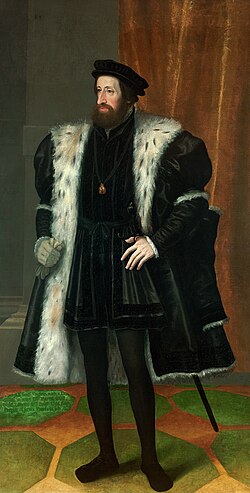
In 1522, under Ferdinand I, the Blood Judgment of Wiener Neustadt led to the execution of leading members of the opposition within the city, and thus a destruction of the political structures.
Image source: Ferdinand I, Holy Roman Emperor
1529
% complete
In 1529, Vienna was besieged by the Ottoman Turks for the first time (the First Turkish Siege), although unsuccessfully.
Image source: Siege of Vienna (1529)
1548
% complete
Following plans by Sebastian Schrantz, Vienna was expanded to a fortress in 1548. These fortifications accounted for the major part of building activities well into the 17th century.
1551
% complete
In 1551, the Jesuits were brought to town and soon gained a large influence at court. The leader of the Counter-Reformation here was Melchior Khlesl, Bishop of Vienna from 1600.
Image source: Jesuits
1556
% complete
In 1556, Vienna became the seat of the Holy Roman Emperor, with Bohemia having been added to the Habsburg realm in 1526.
Image source: Holy Roman Emperor
1670
% complete
Leopoldstadt became a site where many Jews lived, as they had been driven out of their 50-year-old ghetto in 1670.
Image source: Leopoldstadt
1679 - 1713
% complete
After the extensive plague epidemics of 1679 and 1713, the population began to grow steadily. It is estimated that 150,000 people lived in Vienna in 1724, and 200,000 in 1790.
Image source: Great Plague of Vienna
1683
% complete
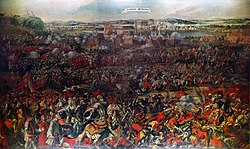
The fortress fortifications proved decisive in the Second Turkish Siege of 1683, as they allowed the city to maintain itself for two months, until the Turkish army was defeated by the army led by the Polish King John III Sobieski.
Image source: Battle of Vienna
1704
% complete
In 1704, an outer fortification, the Linienwall, was built around the Vorstädte.
Image source: Linienwall
1783
% complete
Under Emperor Joseph II, the city administration was modernized in 1783: officials in charge of only the city were introduced, and the Magistrate was created.
Image source: Vienna
1805 - 1809
% complete
During the Napoleonic Wars, Vienna was taken by the French twice, in 1805 and 1809.
Image source: Napoleonic Wars
1810
% complete
In 1810, Salomon Mayer Rothschild arrived in Vienna from Frankfurt and set up a bank named 'Mayer von Rothschild und Söhne'. The Emperor of Austria in 1823 made the five Rothschild brothers barons, and the family remained prominent until the Creditanstalt bank in Vienna was confiscated by the Nazis in 1938.
Image source: Rothschild banking family of Austria
Sep 18, 1814 - Jun 9, 1815
% complete
After Napoleon's final defeat, the Congress of Vienna took place from September 18, 1814 to June 9, 1815, in which the political map of Europe was redrawn.
Image source: Congress of Vienna
1837
% complete
The first half of the century was characterised by intensive industrialization, with Vienna being the center of the railway network after 1837.
Mar 13, 1848
% complete
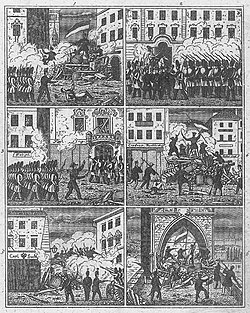
The French February Revolution of 1848 had an effect as far away as Vienna: on March 13, the March Revolution forced long-serving chancellor Metternich to resign.
Image source: Revolutions of 1848 in the Austrian Empire
1850
% complete
The city was expanded in 1850, mostly to include the area within the Linienwall.
1858
% complete
In 1858, the fortifications were demolished, and the broad Ringstraße boulevard was built in their place.
Image source: Ringstrasse
1861
% complete
In 1861, the Liberals won the first (relatively) free elections after the end of neoabsolutism.
1873
% complete
The Gründerzeit period peaked in the World Exhibition of 1873, immediately before the stock market crash, which ended the foundation era.
Image source: 1873 Vienna World's Fair
1890
% complete
In 1890, the city was expanded for a second time: the suburbs beyond the old Linienwall were incorporated into the town as districts 11 to 19 (the 10th district had been created in 1874).
1900
% complete
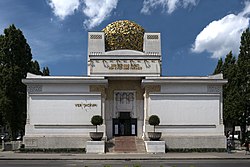
Around 1900, Vienna became a centre of the Jugendstil (Art Nouveau), most of all with Otto Wagner and the association of artists known as the Vienna Secession, after which the characteristic building on Karlsplatz is named.
Image source: Vienna Secession
1900 - 1904
% complete
Leopoldstadt was divided in 1900, with the northern part becoming the 20th district (Brigittenau). In 1904, Floridsdorf became part of Vienna as 21st district. Censuses conducted regularly from 1869 onwards showed an all-time high population in 1910, with 2,031,000 inhabitants.
Image source: Floridsdorf
1914 - 1918
% complete
World War I led to a lack of supplies due to the economic embargo imposed by the Entente powers, resulting in shortages of food and clothes. The shortages led to the 1918 Austro-Hungarian January Strike which started in Vienna. Notably, the 1916 Rent Control was never officially repealed.
Image source: Austro-Hungarian strike of January 1918
Aug 9, 1918
% complete
The Flight over Vienna propaganda flight, an air raid inspired by Gabriele d'Annunzio, was carried out on August 9, 1918, with 11 Ansaldo SVA aircraft dropping leaflets.
Image source: Flight over Vienna
Nov 12, 1918
% complete
On November 12, 1918, the Republic of Deutsch-Österreich, or German-Austria, was proclaimed in front of the parliament.
Image source: Republic of German-Austria
1921
% complete
In 1921, Vienna was separated from surrounding Lower Austria and became a state of its own, with the mayor now equivalent in rank to a state governor. It remained the nominal capital of Lower Austria until 1986.
Image source: Vienna
May 1923
% complete
In May 1923, in the presence of President Michael Hainisch, the First World Congress of Jewish Women was inaugurated at the Hofburg.
1927 - Feb 1934
% complete
The fire of the Justizpalast (Palace of Justice) in 1927 after violent demonstrations, the collapse of the Creditanstalt bank, and finally the dissolution of parliament in 1933 marked the way to the Austrian Civil War in February 1934. On the left, the Republikanische Schutzbund paramilitary group was formed in 1923/24.
Image source: Austrian Civil War
1933 - 1934
% complete
After Engelbert Dollfuß, Chancellor of Austria since 1932, had forbidden the Nazi Party, the Communist Party of Austria and the Republikanischer Schutzbund in 1933, he extended the ban to the Social Democratic Party in 1934 after the February Uprising.
Image source: Engelbert Dollfuss
1938
% complete
In the course of the expansion of the city in 1938, 91 adjoining municipalities were incorporated into Vienna, from which the 22nd through 26th districts (Groß-Enzersdorf, Schwechat, Mödling, Liesing and Klosterneuburg) were created.
Mar 1938
% complete
In March 1938 Nazi Germany occupied and annexed Austria in a process known as the Anschluss. Hitler's anti-Jewish policies fell on fertile soil in Vienna, where latent anti-Semitism had increased during the early 20th century.
Image source: Anschluss
Nov 9, 1938
% complete
During the Reichskristallnacht on November 9, 1938, the synagogues and Jewish centres—not only religious but also social life—were destroyed.
Image source: Kristallnacht
1943 - Apr 1945
% complete
Although originally out of range of Allied bombers operating from England, by 1943 the city began being attacked by bombers based in Italy. The bombings of 1944 and 1945 and the fighting during the Soviet conquest of Vienna in April 1945 caused much destruction.
Apr 29, 1945
% complete
On April 29, 1945, the parliament building passed from the occupation force to the new Austrian government, and Karl Renner announced the reinstitution of the democratic Republic of Austria. The first municipal elections were held in November 1945.
Image source: Karl Renner
1954
% complete
In 1946, it was decided that the expansion of city territory of 1938 should be reversed, but this law was delayed by a veto of the occupying powers and was not put into practice until 1954.
May 15, 1955
% complete
On May 15, 1955, the country regained its political independence and sovereignty with the Austrian State Treaty. The peace treaty was called a state treaty because Austria had temporarily ceased to exist in 1938.
Image source: Austrian State Treaty
1978
% complete
Public transport was improved by the introduction of the new Vienna U-Bahn network, the first part of which was opened in 1978.
Image source: Vienna U-Bahn
Jun 18, 1979
% complete
In 1979, the second Strategic Arms Limitation Talks treaty was signed in Vienna.
Image source: Strategic Arms Limitation Talks
1986
% complete
Vienna was the capital of the surrounding state of Lower Austria until 1986, when it was replaced by Sankt Pölten.
Image source: St. Pölten
1990 - 1999
% complete
At the end of the 20th century, a skyline consisting of several skyscrapers was created with, among others, the Andromeda Tower and Millennium Tower on the left and right sides of the Danube.
Image source: Millennium Tower (Vienna)
2001
% complete
In the municipal elections of 2001, the Social Democrats regained an absolute majority in Vienna.
Image source: Social Democratic Party of Austria
2022 - 2023
% complete
Despite the 2022 Russian invasion of Ukraine, as of July 2023 there are more than 180 accredited Russian diplomats in Vienna, reportedly more than one third using diplomatic cover for spying. Chinese, Iranian, Israeli, Saudi, American, British, and other European spies and counterspies are also active in the country.
Or browse the full history timeline directory, with more than 2,000 topics.
This History of Vienna timeline was generated with the help of AI, using information found on the internet.
We work hard to keep these timelines accurate, but mistakes do get through. If you spot one, email us at [email protected] and we'll fix it for future visitors.
Generate yours with AI or build it from scratch, for free.
Export your timeline, add your own events, edit or remove AI-generated events, and much more
No credit card required.
Cancel anytime.
Cancel anytime.
You can create an unlimited number of timelines with up to 10 events on each one, customize how they look, export them to PDF, PNG, PowerPoint, CSV, and Excel, and share them with a link. Paid plans raise the event limit and add features like spreadsheet imports and collaborators.
Yes. You can cancel your subscription from your account page at any time, and you will not be charged again. Your subscription stays active for the rest of the period you already paid for.
Yes. We will email you a reminder before the annual renewal, and we will also email you a receipt.
Yes. You can email us within 15 days of any payment, and we will issue you a full refund.
Check out our pricing docs or send us an email anytime: [email protected].