-
Use Cases
-
Resources
-
Pricing
The Congress of Vienna was a series of diplomatic meetings held in Vienna between 1814 and 1815, chaired by Austrian statesman Klemens von Metternich. Following the defeat of Napoleon Bonaparte, representatives of the major European powers—including Austria, Britain, Russia, Prussia, and France—gathered to restore stability, redraw the continent's political boundaries, reestablish a balance of power, and prevent future large-scale wars in Europe. More Less
Sep 1814 - Feb 1815
% complete
The United Kingdom was represented first by its Foreign Secretary, Viscount Castlereagh, who played a central role in brokering compromises among the powers until his return to England in February 1815.
Image source: Robert Stewart, Viscount Castlereagh
Sep 1814 - Jun 1815
% complete
Having already negotiated the Treaty of Paris (1814) for Louis XVIII, Talleyrand skillfully represented France at the Congress, leveraging divisions among the Allies to restore France to a place among the great powers.
Image source: Charles Maurice de Talleyrand-Périgord
Sep 30, 1814
% complete
The major Allies' indecision over how to conduct their affairs without provoking a united protest from the lesser powers led to the calling of a preliminary conference on protocol, to which Talleyrand of France and the Marquess of Labrador, Spain's representative, were invited on 30 September 1814.
Image source: Congress of Vienna
Sep 30, 1814
% complete
The Marquess of Labrador represented Spain when he was invited to the preliminary conference on protocol on 30 September 1814, though Spain would ultimately become the most important hold-out against the Congress settlement.
Image source: Pedro Gómez Labrador
Jan 3, 1815
% complete
Britain, France, and Austria signed a secret treaty among only the three of them, agreeing to go to war against Russia and Prussia if necessary to prevent the Russo-Prussian partition plans for Poland and Saxony from coming to fruition.
Feb 1815 - Jun 1815
% complete
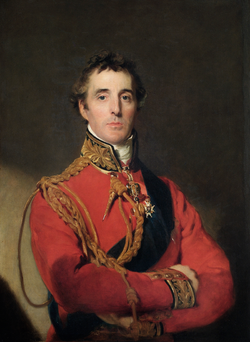
After Castlereagh's return to England in February 1815, the Duke of Wellington took over as Britain's principal representative at the Congress of Vienna.
Image source: Arthur Wellesley, 1st Duke of Wellington
Feb 1815 - Jun 1815
% complete
Portugal pressed at the Congress for the return of the town of Olivenza and other territories ceded to Spain by the Treaty of Badajoz of 1801, a claim that made Spain the most important hold-out against the settlement.
Image source: Olivenza
Mar 1815 - Jun 1815
% complete
Tsar Alexander I succeeded in forming the basis of the Holy Alliance, based on monarchism and anti-secularism, created to combat any threat of revolution or republicanism, drawing on the spirit of the Congress deliberations.
Image source: Holy Alliance
Sep 20, 1814 - Jun 9, 1815
% complete
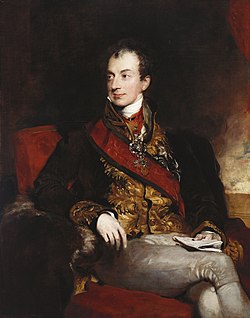
Austrian statesman Klemens von Metternich, Duke Metternich, chaired the Congress throughout its duration in Vienna, guiding the diplomatic proceedings and shaping the conservative settlement that would define European politics for decades.
Image source: Klemens von Metternich
Sep 20, 1814
% complete
The Congress of Vienna formally began its work in Vienna in September 1814, gathering representatives of the great European powers to discuss and agree upon a new political and constitutional order for Europe following the downfall of French emperor Napoleon Bonaparte.
Mar 20, 1815 - Jun 9, 1815
% complete
Remarkably, negotiations continued unaffected despite the outbreak of fighting triggered by Napoleon's return from exile and resumption of power in France during the Hundred Days of March to July 1815.
Image source: Hundred Days
Jun 9, 1815
% complete
The Final Act, embodying all the separate treaties produced by the Congress, was signed on 9 June 1815, nine days before Napoleon's final defeat at Waterloo, completing the redrawing of the European order.
Oct 1814 - Jan 1815
% complete
The fate of Poland and Saxony became the most explosive issue at the Congress, as Tsar Alexander I sought most of the Duchy of Warsaw while Prussia demanded all of Saxony, alarming Austria, Britain, and France.
Oct 1814
% complete
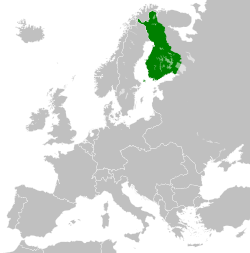
In addition to its role in Poland, Russia retained Finland at the Congress, which it had annexed from Sweden in 1809 and would hold until 1917 as the Grand Duchy of Finland.
Image source: Grand Duchy of Finland
Oct 1814
% complete
Swedish Pomerania, which had been given to Denmark in January 1814 in return for the Kingdom of Norway, was sold to Prussia as part of the territorial rearrangements settled at the Congress.
Image source: Swedish Pomerania
Nov 1814
% complete
Most of the territorial gains of Bavaria, Württemberg, Baden, Hesse-Darmstadt, and Nassau under the mediatizations of 1801–1806 were recognized by the Congress, confirming these states' enlarged territories.
Image source: German mediatisation
Nov 1814
% complete
The Duchy of Lucca was established temporarily as compensation for the House of Bourbon-Parma, with reversionary rights to Parma after the death of Marie Louise, attributed through a collateral treaty stipulating Lucca would later be annexed by Tuscany.
Image source: Duchy of Lucca
Nov 1814 - Jun 1815
% complete
The consolidation of Germany from the nearly 300 states of the dissolved Holy Roman Empire into a much less complex system of thirty-nine states, four of which were free cities, was confirmed through protracted negotiation at the Congress.
Image source: German Confederation
Dec 1814
% complete
Among the decisions reaffirmed from the Treaty of Chaumont was the division of Italy into independent states, reversing the unification imposed under Bonaparte and restoring dynastic rulers across the peninsula.
Dec 1814
% complete
The Congress reaffirmed decisions including the restoration of the Bourbon kings of Spain, part of the broader principle of legitimacy championed by the Allies after the fall of Napoleon.
Dec 1814
% complete
The Congress agreed to enlarge the Netherlands to include what in 1830 became modern Belgium, creating a strong buffer state on France's northern border.
Image source: United Kingdom of the Netherlands
Dec 1814 - Jun 1815
% complete
A key decision reaffirmed from the Treaty of Chaumont was the establishment of a confederated Germany, replacing the old Holy Roman Empire with a loose association of sovereign German states.
Mar 1815 - May 1815
% complete
Joachim Murat, the king installed by Bonaparte in Naples, supported Napoleon in the Hundred Days and started the 1815 Neapolitan War by attacking Austria, jeopardizing his throne.
Image source: Neapolitan War
Apr 1815
% complete
Under Article VIII of the Treaty of Paris (1814), France ceded Tobago, Saint Lucia, the Isle of France and its dependencies including Rodrigues and the Seychelles to Britain, arrangements woven into the Congress settlement.
May 1815
% complete
Following Murat's defeat, Ferdinand IV, the Bourbon King of Sicily, moved to regain control of the Kingdom of Naples, a restoration underpinned by the Congress's settlement of Italy.
Image source: Ferdinand I of the Two Sicilies
May 1815
% complete
Under the compromise reached, Prussia received 60 percent of Saxony, much of which became part of the new Province of Saxony from 1816, while the remainder returned to King Frederick Augustus I as his Kingdom of Saxony.
Image source: Province of Saxony
May 1815
% complete
Apart from its other results, the Congress confirmed France's loss of the territories it had annexed between 1795 and 1810, which had already been settled by the Treaty of Paris.
Jun 1815
% complete
Among the Congress's principal results was the enlargement of Russia, which gained most of the Duchy of Warsaw, creating the Congress Kingdom of Poland under the Tsar's rule.
Image source: Duchy of Warsaw
Jun 1815
% complete
Prussia acquired the district of Poznań, Swedish Pomerania, Westphalia, and the northern Rhineland, significantly strengthening its position in western Germany as a barrier against France.
May 1815 - Jun 9, 1815
% complete
The Congress of Vienna settlement gave birth to the Concert of Europe, an international political doctrine emphasizing maintaining political boundaries, the balance of powers, and respecting spheres of influence, guiding European foreign policy until 1914.
Or browse the full history timeline directory, with more than 2,000 topics.
This Congress of Vienna timeline was generated with the help of AI, using information found on the internet.
We work hard to keep these timelines accurate, but mistakes do get through. If you spot one, email us at [email protected] and we'll fix it for future visitors.
Generate yours with AI or build it from scratch, for free.
Export your timeline, add your own events, edit or remove AI-generated events, and much more
No credit card required.
Cancel anytime.
Cancel anytime.
You can create an unlimited number of timelines with up to 10 events on each one, customize how they look, export them to PDF, PNG, PowerPoint, CSV, and Excel, and share them with a link. Paid plans raise the event limit and add features like spreadsheet imports and collaborators.
Yes. You can cancel your subscription from your account page at any time, and you will not be charged again. Your subscription stays active for the rest of the period you already paid for.
Yes. We will email you a reminder before the annual renewal, and we will also email you a receipt.
Yes. You can email us within 15 days of any payment, and we will issue you a full refund.
Check out our pricing docs or send us an email anytime: [email protected].