-
Use Cases
-
Resources
-
Pricing
Warsaw is the capital of Poland and has served as the country's political, cultural, and economic center since the late 16th century. Founded around 1300 on the Vistula River, it became the royal residence of the Polish kings in 1596. The city endured partitions, occupation by Nazi Germany, near-total destruction during World War II, and decades of communist rule, before rebuilding itself—often called the 'Phoenix City'—into one of Europe's most dynamic capitals. More Less
1300
% complete
A fortified stronghold belonging to the Dukes of Mazovia was established on the left bank of the Vistula River, marking the earliest origins of the settlement that would grow into the city of Warsaw.
Image source: History of Warsaw
1323
% complete
Warsaw received its municipal charter under the Magdeburg Law, formally establishing it as a town and allowing it to develop its own government, markets, and legal system.
1413
% complete
The Dukes of Masovia made Warsaw the seat of their duchy, elevating its political importance in the region and spurring growth of the Old Town.
1526
% complete
With the extinction of the Masovian ducal line, Warsaw and the surrounding lands were absorbed into the Polish Crown, integrating the city into the wider Polish state.
1596
% complete
King Sigismund III Vasa transferred his court from Kraków to Warsaw, beginning the city's transformation into the de facto capital of Poland due to its central location between Kraków and Lithuania.
1644
% complete
King Władysław IV erected a column honoring his father Sigismund III Vasa in Castle Square, which became one of Warsaw's most famous landmarks and symbols of the city.
Image source: Sigismund's Column
1655
% complete
During the Swedish invasion known as the Deluge, Warsaw was occupied and plundered by Swedish forces, suffering extensive destruction and population loss.
Image source: Deluge (history)
1702
% complete
Swedish and Saxon armies occupied and fought over Warsaw during the Great Northern War, bringing plague, looting, and economic hardship to the city.
Image source: Great Northern War
1764
% complete
The election of Stanisław August Poniatowski began an era in which Warsaw flourished culturally, becoming a center of Enlightenment thought and artistic achievement.
Image source: Stanisław August Poniatowski
1768
% complete
Confederates opposing King Stanisław August and Russian influence briefly seized parts of Warsaw, reflecting growing tensions over foreign domination of the Polish-Lithuanian Commonwealth.
Image source: Bar Confederation
1773
% complete
Established in Warsaw, the Commission of National Education became the world's first ministry of education, spearheading educational reforms across the Commonwealth.
Image source: Commission of National Education
1788 - 1792
% complete
The Four-Year Sejm met in Warsaw and enacted sweeping reforms, culminating in the Constitution of May 3, 1791, Europe's first modern codified constitution.
Image source: Great Sejm
Apr 17, 1794
% complete
As part of the Kościuszko Insurrection, Warsaw's citizens rose against the Russian garrison occupying the city, achieving initial success before the uprising was ultimately crushed later that year.
Image source: Warsaw Uprising (1794)
1795
% complete
Following the Third Partition of Poland, Warsaw came under Prussian rule, ending over two centuries of the city's role as capital of an independent Polish state.
Image source: Third Partition of Poland
1807
% complete
Napoleon Bonaparte established the Duchy of Warsaw with the city as its capital, briefly restoring a Polish polity after Napoleon's victories over Prussia.
Image source: Duchy of Warsaw
1815
% complete
After Napoleon's defeat, the Congress of Vienna created the Kingdom of Poland (Congress Poland) under Russian rule, with Warsaw as its capital and seat of a nominally autonomous administration.
Image source: Congress Poland
1816
% complete
Tsar Alexander I approved the establishment of the University of Warsaw, making it one of Poland's leading institutions of higher learning and scholarship.
Image source: University of Warsaw
Nov 29, 1830
% complete
Polish cadets and civilians in Warsaw rose against Russian rule, sparking a nationwide insurrection that was suppressed by 1831, leading to harsh reprisals and the loss of Polish autonomy.
Image source: November Uprising
1845
% complete
The opening of the Warsaw–Vienna railway connected the city to Central European trade networks, fueling industrialization and rapid urban growth.
Image source: Warsaw–Vienna railway
Jan 22, 1863 - 1864
% complete
An armed rebellion against Russian rule spread from Warsaw throughout the partitioned lands. Its defeat led to intensified Russification and the abolition of remaining autonomy.
Image source: January Uprising
1912
% complete
The grand Orthodox cathedral on Saxon Square symbolized Russian dominance over Warsaw. It was demolished after Poland regained independence in the 1920s.
Image source: St. Alexander Nevsky Cathedral, Warsaw
Nov 11, 1918
% complete
With the end of World War I and the collapse of the partitioning powers, Poland regained independence, and Warsaw again became the capital of a sovereign Polish state.
Image source: Second Polish Republic
Aug 13, 1920 - Aug 25, 1920
% complete
Polish forces under Józef Piłsudski decisively defeated the advancing Red Army near Warsaw during the Polish-Soviet War, saving Poland's independence and earning the battle the name 'Miracle on the Vistula.'
Image source: Battle of Warsaw (1920)
Sep 1, 1939
% complete
Nazi Germany invaded Poland, launching heavy air raids on Warsaw from the war's first days and beginning nearly six years of occupation and devastation for the city.
Image source: Invasion of Poland
Sep 8, 1939 - Sep 28, 1939
% complete
After three weeks of bombardment and fierce defense, Warsaw capitulated to German forces on September 28, 1939, beginning a brutal occupation marked by repression and terror.
Image source: Siege of Warsaw (1939)
Nov 16, 1940
% complete
The Nazis enclosed more than 400,000 Jews within the Warsaw Ghetto behind walls and barbed wire, imposing starvation rations and preparing for mass deportations to death camps.
Image source: Warsaw Ghetto
Apr 19, 1943 - May 16, 1943
% complete
Jewish resistance fighters in the Warsaw Ghetto launched an armed revolt against German deportations. Though crushed by SS forces who razed the ghetto, it became an enduring symbol of resistance.
Image source: Warsaw Ghetto Uprising
Aug 1, 1944 - Oct 2, 1944
% complete
The Polish Home Army rose to liberate Warsaw from German occupation ahead of the Soviet advance. After 63 days of brutal fighting, the insurgents surrendered, and the Germans systematically destroyed much of the city.
Image source: Warsaw Uprising
Jan 17, 1945
% complete
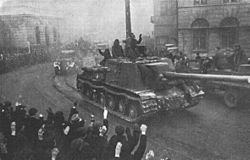
Soviet troops and units of the Polish Army entered Warsaw, finding the city almost entirely destroyed, with roughly 85% of its buildings in ruins and most of its population dead or displaced.
Image source: Vistula–Oder offensive
1945 - 1966
% complete
Under communist rule, Varsovians undertook a massive reconstruction effort, meticulously rebuilding the Old Town using paintings and photographs, work recognized by UNESCO World Heritage listing in 1980.
Image source: Warsaw Reconstruction Office
1955
% complete
The Stalinist skyscraper, a 'gift' from the Soviet Union designed by Lev Rudnev, was completed and became the tallest building in Poland and a controversial landmark dominating the city skyline.
Image source: Palace of Culture and Science
Mar 8, 1968
% complete
Student demonstrations at the University of Warsaw sparked nationwide protests against censorship and the regime, which were violently suppressed and accompanied by an antisemitic purge driving thousands of Jews out of Poland.
Image source: 1968 Polish political crisis
Jun 2, 1979 - Jun 10, 1979
% complete
Pope John Paul II returned to his homeland for the first time, celebrating Masses attended by millions in Victory Square in Warsaw, inspiring the Solidarity movement and hastening communism's decline.
Image source: 1979 visit by Pope John Paul II to Ireland
Sep 1980
% complete
The Solidarity independent trade union, born of the Gdańsk strikes, quickly gained millions of members including many workers in Warsaw, challenging communist authority until martial law was imposed in December 1981.
Dec 13, 1981 - Jul 22, 1983
% complete
General Wojciech Jaruzelski declared martial law, with tanks on Warsaw streets, internment of Solidarity leaders, and suppression of civil liberties until its suspension in 1983.
Image source: Martial law in Poland
Feb 6, 1989 - Apr 5, 1989
% complete
Negotiations between the communist government and the Solidarity-led opposition held at the Council of Ministers building in Warsaw paved the way for partially free elections and the peaceful fall of communism in Poland.
Image source: Polish Round Table Agreement
Sep 12, 1989
% complete
Following Solidarity's electoral victory, Tadeusz Mazowiecki formed Poland's first non-communist government since the war in Warsaw, marking a milestone in the collapse of Soviet bloc regimes.
Image source: Tadeusz Mazowiecki
Apr 16, 1991
% complete
Poland's stock market resumed trading for the first time since before World War II, signaling Warsaw's emergence as a financial center of post-communist Central Europe.
Image source: Warsaw Stock Exchange
Mar 12, 1999
% complete
Poland's accession to NATO, alongside the Czech Republic and Hungary, anchored Warsaw firmly in Western security structures half a century after the end of World War II.
Image source: Enlargement of NATO
May 1, 2004
% complete
Poland's entry into the EU triggered an economic boom in Warsaw, transforming it into one of Europe's fastest-growing capitals and a major hub for business and investment.
Image source: 2004 enlargement of the European Union
Apr 2013
% complete
The POLIN Museum opened on the site of the former Warsaw Ghetto, presenting a thousand years of Jewish life in Poland and honoring the memory of pre-war Warsaw's vibrant Jewish community.
Image source: POLIN Museum of the History of Polish Jews
Nov 11, 2013 - Nov 23, 2013
% complete
Warsaw hosted the COP19 United Nations climate conference, drawing delegates from around the world and underscoring the city's growing international profile.
Image source: 2013 United Nations Climate Change Conference
Jul 25, 2016 - Jul 31, 2016
% complete
Millions of young Catholics gathered in Kraków and passed through Warsaw during Pope Francis's visit for World Youth Day, one of the largest religious gatherings ever held in Poland.
Image source: World Youth Day 2016
Nov 11, 2018
% complete
Warsaw hosted major celebrations marking 100 years since Poland regained independence in 1918, including parades, ceremonies, and international dignitaries gathered in the capital.
Image source: Pro Bono Poloniae Medal
Or browse the full history timeline directory, with more than 2,000 topics.
This History of Warsaw timeline was generated with the help of AI, using information found on the internet.
We work hard to keep these timelines accurate, but mistakes do get through. If you spot one, email us at [email protected] and we'll fix it for future visitors.
Generate yours with AI or build it from scratch, for free.
Export your timeline, add your own events, edit or remove AI-generated events, and much more
No credit card required.
Cancel anytime.
Cancel anytime.
You can create an unlimited number of timelines with up to 10 events on each one, customize how they look, export them to PDF, PNG, PowerPoint, CSV, and Excel, and share them with a link. Paid plans raise the event limit and add features like spreadsheet imports and collaborators.
Yes. You can cancel your subscription from your account page at any time, and you will not be charged again. Your subscription stays active for the rest of the period you already paid for.
Yes. We will email you a reminder before the annual renewal, and we will also email you a receipt.
Yes. You can email us within 15 days of any payment, and we will issue you a full refund.
Check out our pricing docs or send us an email anytime: [email protected].