-
Resources
-
Pricing
The Warsaw Pact was a Soviet-led military alliance formed in 1955 by the USSR and several Eastern European states as a counterbalance to NATO during the Cold War. More Less
Build a timeline like this one in minutes, for free. Start Yours →
20 Mar 1952
Talks initiated by the Stalin Note about German reunification ended after the United Kingdom, France, and the United States insisted that a unified Germany should be neutral only in the context of freedom to join the European Defence Community and rearm.
Image source: Stalin Note
1954
Fearing the restoration of German militarism in West Germany, the Soviet Union suggested that it join NATO. The United States rejected the proposal, which reflected the growing confrontation between the Soviet bloc and the Western alliance.
Image source: 2021 Russian ultimatum to NATO
1954
British General Hastings Ismay opposed the Soviet request to join NATO in 1954, comparing it to “an unrepentant burglar requesting to join the police force.”
Feb 1954
The Berlin Conference of January–February 1954 preceded the Soviet Union’s proposal to join NATO. The request arose amid disputes over German reunification, West German rearmament, and the future security structure of Europe.
Apr 1954
In April 1954, West German Chancellor Konrad Adenauer made his first visit to the United States, meeting Richard Nixon, Dwight Eisenhower, and John Foster Dulles during negotiations over West Germany’s place in Western security arrangements.
30 Aug 1954
The French Parliament rejected the European Defence Community, ensuring its failure and blocking a major United States objective: associating West Germany militarily with the Western European states.
Image source: Treaty establishing the European Defence Community
23 Oct 1954
On 23 October 1954, the admission of the Federal Republic of Germany to the North Atlantic Pact was finally decided, intensifying Soviet fears about a remilitarized West Germany.
Image source: Germany–United States relations
Nov 1954
The Soviet Union proposed a new European Security Treaty in November 1954 as a final attempt to prevent a remilitarized West Germany from becoming aligned against the Soviet Union. The proposal was unsuccessful.
Image source: European Security Treaty
1955
Because the Soviet Union already maintained armed forces and political domination throughout its Eastern European satellite states, the Warsaw Pact was long considered superfluous. NATO officials reportedly characterized the hurriedly conceived alliance as a “cardboard castle.”
Image source: Warsaw Pact
9 May 1955
The incorporation of West Germany into NATO on 9 May 1955 was described by Norwegian Foreign Affairs Minister Halvard Lange as a decisive turning point in European history.
14 May 1955
The Soviet Union and seven other Eastern European countries established the Treaty of Friendship, Cooperation and Mutual Assistance, commonly called the Warsaw Pact, in Warsaw, Poland. The alliance was presented as a response to West Germany’s integration into NATO and as a system of collective security.
1956
After 1956, Soviet leader Nikita Khrushchev reduced the Ground Forces while building up the Strategic Rocket Forces. The policy emphasized nuclear capabilities within Soviet and Warsaw Pact military planning.
Image source: Nikita Khrushchev
1956
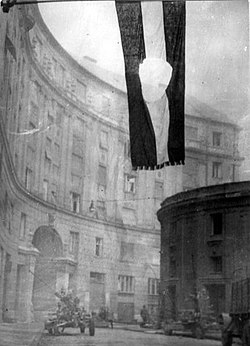
The government of Imre Nagy declared Hungary’s withdrawal from the Warsaw Pact. Soviet troops then entered the country and removed the government, preventing Hungary from leaving the Soviet-led alliance.
Image source: Hungarian Revolution of 1956
Nov 1956
Soviet forces invaded Hungary, a Warsaw Pact member, and violently suppressed the Hungarian Revolution. The intervention demonstrated that the alliance could be used to preserve Soviet political control within its member states.
1957
Marshal Georgy Zhukov was removed from the Soviet Politburo in 1957 after opposing Khrushchev’s reductions in the Ground Forces.
Image source: Georgy Zhukov
1964 - 1979
Soviet and Warsaw Pact forces repeatedly rehearsed the large-scale use of nuclear weapons in invasion exercises. Scenarios included a 1964 Czech plan involving the seizure of Lyon by the ninth day and Poland’s 1979 Seven Days to the River Rhine exercise.
Aug 1968
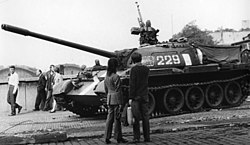
Warsaw Pact forces invaded Czechoslovakia, one of the alliance’s own member states, in August 1968. The operation suppressed the Prague Spring and was the multinational Communist armed forces’ sole joint military action.
Image source: Warsaw Pact invasion of Czechoslovakia
17 Dec 1956
The Soviet Union concluded a bilateral 20-year treaty with Poland on 17 December 1956. The agreement helped ensure that Soviet troops could remain deployed in Poland.
Image source: Poland–Russia relations
12 Mar 1957
A bilateral 20-year treaty between the Soviet Union and the German Democratic Republic was signed on 12 March 1957, supporting the continued deployment of Soviet troops in East Germany.
Image source: East Germany–Soviet Union relations
15 Apr 1957
The Soviet Union and Romania signed a bilateral 20-year treaty on 15 April 1957. Soviet forces were later removed as part of Romania’s de-satellization and increasingly autonomous foreign policy.
Image source: Romania–Russia relations
27 May 1957
The Soviet Union and Hungary signed a bilateral 20-year treaty on 27 May 1957, helping ensure the continued presence of Soviet troops in Hungary after the suppression of the 1956 revolution.
Image source: Hungary–Soviet Union relations
1958
Romania requested and obtained the complete withdrawal of the Soviet Army from its territory in 1958, an important step in the country’s development of greater autonomy within the Warsaw Pact.
Image source: Soviet occupation of Romania
1961
China terminated its observer status in 1961 as a consequence of the Albanian-Soviet split. China backed Albania against the Soviet Union during the broader Sino-Soviet split.
Image source: Sino-Soviet split
1963
Soviet troops were deployed to Romania for the last time in 1963 as part of a Warsaw Pact exercise. After 1964, the Soviet Army was barred from returning because Romania refused to participate in joint Pact exercises.
Jul 1963
Romania blocked Mongolia’s accession to the Warsaw Pact in July 1963, illustrating Bucharest’s increasingly independent position within the Soviet-led alliance.
Jul 1963
The Mongolian People’s Republic asked to join the Warsaw Pact under Article 9 of the treaty in July 1963. The request did not result in full membership.
Image source: Warsaw Pact
22 Apr 1964
The Romanian Communist Party issued a declaration proclaiming the sovereign right of every Marxist–Leninist party to choose its own methods of socialist construction. The statement rejected superior and subordinate communist parties and opposed a single model for socialism.
Image source: 1957 International Meeting of Communist and Workers Parties
Dec 1964
Romania became the only Warsaw Pact member other than Albania to withdraw all Soviet advisers, including those serving in intelligence and security institutions.
1966
The Soviet government agreed to station troops in Mongolia in 1966, extending Soviet military presence in East Asia even though Mongolia’s request to join the Warsaw Pact had not produced membership.
Image source: Mongolia–Russia relations
1968
Albania officially left the Warsaw Pact in 1968 in protest against the invasion of Czechoslovakia, becoming an exception to the alliance’s continued membership structure.
Apr 1985
Leaders of the Warsaw Pact members met in Warsaw in April 1985 and renewed the alliance for thirty years. The renewal would formally have extended the treaty until May 2015, although political changes soon made it irrelevant.
1989 - 1991
From 1989 to 1991, Communist governments were overthrown in Poland, Hungary, Czechoslovakia, East Germany, Romania, Bulgaria, and the Soviet Union. The collapse of these governments destroyed the political structure supporting the Warsaw Pact.
Image source: Revolutions of 1989
Jun 1989
The Solidarity movement achieved electoral success in Poland in June 1989. Its victory formed part of the wider revolutionary wave that began to unravel the Warsaw Pact’s political foundation.
Image source: 1989 Polish parliamentary election
Aug 1989
The Pan-European Picnic in August 1989 became a symbolic beginning of the end of the Warsaw Pact. It helped expose the weakening of Communist control and contributed to the spread of the Revolutions of 1989.
Image source: Pan-European Picnic
1990
East Germany withdrew from the Warsaw Pact following German reunification in 1990, removing one of the alliance’s most strategically important members.
Image source: German reunification
25 Feb 1991
At a meeting in Hungary, the defence and foreign ministers of the six remaining member states jointly declared the Warsaw Pact disbanded on 25 February 1991.
1 Jul 1991
In Prague on 1 July 1991, Czechoslovak President Václav Havel formally ended the 1955 Treaty of Friendship, Cooperation and Mutual Assistance, disestablishing the Warsaw Treaty after 36 years.
Dec 1991
The Soviet Union disestablished itself in December 1991. Its dissolution finalized the collapse of the state that had created and dominated the Warsaw Pact, while many former Soviet republics soon pursued new security arrangements.
Image source: Dissolution of the Soviet Union
1992
Russia and several other post-Soviet states joined the Collective Security Treaty in 1992, later forming the Collective Security Treaty Organization as a successor security framework for some former Soviet republics.
Image source: Collective Security Treaty Organization
1996
Russia and some other post-Soviet states joined the Shanghai Five in 1996. The organization was renamed the Shanghai Cooperation Organisation after Uzbekistan joined in 2001.
Image source: Shanghai Cooperation Organisation
12 Mar 1999 - 1 Apr 2009
The Czech Republic, Hungary, and Poland joined NATO on 12 March 1999. Bulgaria, Estonia, Latvia, Lithuania, Romania, Slovenia, and Slovakia joined in March 2004, followed by Croatia and Albania on 1 April 2009.
Image source: Enlargement of NATO
Nov 2005
In November 2005, the Polish government opened Warsaw Treaty archives to the Institute of National Remembrance. The institute published about 1,300 declassified documents in January 2006, while 100 documents remained pending military declassification.
Image source: Institute of National Remembrance
Build a timeline like this one in minutes, for free. Start Yours →
Or browse the full history timeline directory, with more than 2,500 topics.
This Warsaw Pact timeline was generated with the help of AI, using information found on the internet.
We work hard to keep these timelines accurate, but mistakes do get through. If you spot one, email us at [email protected] and we'll fix it for future visitors.
Generate yours with AI or build it from scratch, for free.
Export your timeline, add your own events, edit or remove AI-generated events, and much more
No credit card required.
15-day money-back guarantee.
You can create an unlimited number of timelines with up to 10 events on each one, customize how they look, export them to PDF, PNG, PowerPoint, CSV, and Excel, and share them with a link. Timelines made with Timeline Maker AI keep every event the generator created, and you can add up to 5 events of your own. Paid plans remove the event limit, add spreadsheet imports and hide Preceden's branding, and the higher-priced plan also adds collaborators, a custom logo and a custom domain.
Yes. You can cancel your subscription from your account page at any time, and you will not be charged again. Your subscription stays active for the rest of the period you already paid for.
Yes. We email you a reminder 15 days before your annual renewal, and we email you a receipt after every payment.
Yes. You can email us within 15 days of any payment, and we will issue you a full refund.
Check out our pricing docs or send us an email anytime: [email protected].