-
Use Cases
-
Resources
-
Pricing
The Kellogg-Briand Pact was an international agreement signed in Paris in 1928 by 15 nations, later joined by most others, in which signatories renounced war as an instrument of national policy. Though it failed to prevent World War II, it established a foundation for modern international law against aggressive war. More Less
1928
% complete
The Kellogg–Briand Pact, officially the General Treaty for Renunciation of War as an Instrument of National Policy, was drafted as a 1928 international agreement on peace in which signatory states promised not to use war to resolve 'disputes or conflicts of whatever nature or of whatever origin they may be, which may arise among them'.
Image source: Kellogg–Briand Pact
1928
% complete
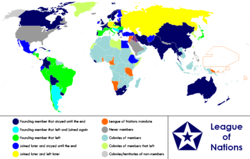
The 1928 Kellogg–Briand Pact was concluded outside the League of Nations, making it an independent international agreement. Remarkably, it remains in effect to this day.
Image source: League of Nations
Aug 27, 1928
% complete
The pact was first signed on 27 August 1928 in Paris at the French Foreign Ministry by the representatives from Australia, Belgium, Canada, Czechoslovakia, France, Germany, the United Kingdom, India, the Irish Free State, Italy, Japan, New Zealand, Poland, South Africa, and the United States. Most other states signed soon after.
1929 - Dec 31, 1929
% complete
After the pact took effect, twelve additional parties joined: Persia, Greece, Honduras, Chile, Luxembourg, Danzig, Costa Rica, Mexico, Venezuela, Paraguay, Switzerland and the Dominican Republic, bringing the total to 57 state parties by 1929.
Feb 9, 1929
% complete
With the signing of the Litvinov Protocol in Moscow on February 9, 1929, the Soviet Union and its western neighbors, including Romania, agreed to put the Kellogg–Briand Pact in effect without waiting for other western signatories to ratify.
Image source: Litvinov Protocol
Jul 24, 1929
% complete
The Kellogg–Briand Pact formally took effect on 24 July 1929 after sufficient ratifications had been deposited.
1930 - 1934
% complete
Six states joined the pact between 1930 and 1934: Haiti, Colombia, Saudi Arabia, Ecuador, Iraq and Brazil, further expanding its membership around the world.
Sep 18, 1931
% complete
The pact helped erase the legal distinction between war and peace, because signatories having renounced war began waging wars without declaring them, as in the Japanese invasion of Manchuria in 1931.
Image source: Japanese invasion of Manchuria
Oct 3, 1935
% complete
Italy, a signatory of the pact, invaded Abyssinia (Ethiopia) in 1935 without a formal declaration of war, illustrating how signatories waged undeclared wars after renouncing war as an instrument of national policy.
Image source: Second Italo-Ethiopian War
1939 - 1945
% complete
Despite the sweeping renunciation of war, the Kellogg–Briand Pact was unable to prevent the Second World War, which devastated much of the globe between 1939 and 1945.
Image source: World War II
Sep 1, 1939
% complete
Germany and the Soviet Union invaded Poland without declarations of war consistent with the pact's erosion of legal distinctions. The Free City of Danzig, which had joined the Pact in 1929, ceased to exist in 1939 and became a regular part of Poland after World War II.
Image source: Invasion of Poland
Nov 30, 1939
% complete
The Soviet Union, bound by the pact, invaded Finland in 1939 without declaring war, further demonstrating the erosion of the legal distinction between war and peace among signatories.
Image source: Winter War
1945
% complete
Furthermore, declared wars became very rare after 1945, a striking shift attributed in part to the norm against conquest established by the Kellogg–Briand Pact.
1945
% complete
Hathaway and Shapiro show that between 1816 and 1928 there was on average one military conquest every ten months. After 1945, in very sharp contrast, the number of such conflicts declined to one in every four years.
1945
% complete
Although civil wars continued, wars between established states have been rare since 1945, with a few major exceptions such as the Indo-Pakistani War of 1971 and various conflicts in the Middle East.
1946
% complete
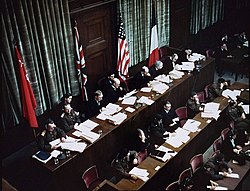
Although the pact failed to prevent war, it provided the legal basis for the postwar trials and execution of German wartime leaders in 1946, giving the renunciation of war practical juridical significance.
Image source: Nuremberg trials
1971
% complete
After the Second World War, Barbados declared its accession to the Kellogg–Briand Pact in 1971, showing the treaty's continuing relevance decades after its signing.
Image source: Barbados
1973
% complete
Fiji declared its accession to the Kellogg–Briand Pact in 1973, following Barbados's accession two years earlier.
Image source: Fiji
1988
% complete
In 1988, both Antigua and Barbuda and Dominica declared their accession to the Kellogg–Briand Pact, continuing the pattern of new states joining the long-standing agreement.
Image source: Antigua and Barbuda
1992
% complete
As a result of the dissolution of Yugoslavia, Slovenia declared its accession to the Kellogg–Briand Pact in 1992.
Image source: Slovenia
1993
% complete
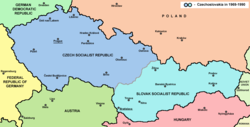
After Czechoslovakia dissolved in 1993, both the Czech Republic and Slovakia declared their accession to the Kellogg–Briand Pact as successor states.
Image source: Dissolution of Czechoslovakia
1994
% complete
As a result of the dissolution of Yugoslavia, Bosnia and Herzegovina and Croatia declared their accession to the Kellogg–Briand Pact in 1994, completing the succession of Yugoslav successor states into the treaty.
Image source: Croatia
Or browse the full history timeline directory, with more than 2,000 topics.
This Kellogg-Briand Pact timeline was generated with the help of AI, using information found on the internet.
We work hard to keep these timelines accurate, but mistakes do get through. If you spot one, email us at [email protected] and we'll fix it for future visitors.
Generate yours with AI or build it from scratch, for free.
Export your timeline, add your own events, edit or remove AI-generated events, and much more
No credit card required.
Cancel anytime.
Cancel anytime.
You can create an unlimited number of timelines with up to 10 events on each one, customize how they look, export them to PDF, PNG, PowerPoint, CSV, and Excel, and share them with a link. Paid plans raise the event limit and add features like spreadsheet imports and collaborators.
Yes. You can cancel your subscription from your account page at any time, and you will not be charged again. Your subscription stays active for the rest of the period you already paid for.
Yes. We will email you a reminder before the annual renewal, and we will also email you a receipt.
Yes. You can email us within 15 days of any payment, and we will issue you a full refund.
Check out our pricing docs or send us an email anytime: [email protected].