-
Use Cases
-
Resources
-
Pricing
The Spanish Civil War was a devastating conflict fought between the democratically elected Republican government and Nationalist rebels led by General Francisco Franco. The war became a proxy battleground for broader ideological struggles, drawing in Nazi Germany and Fascist Italy on the Nationalist side and the Soviet Union along with international volunteers on the Republican side. It ended with a Nationalist victory, establishing a dictatorship that lasted until 1975. More Less
Apr 14, 1931
% complete
King Alfonso XIII left Spain after republican victories in municipal elections, and the Second Spanish Republic was proclaimed. This marked the end of the Bourbon Restoration and ushered in an era of intense political polarization between republicans, socialists, conservatives, and monarchists.
Image source: Second Spanish Republic
Dec 9, 1931
% complete
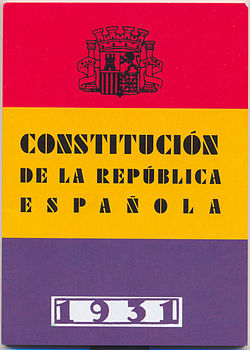
The constituent Cortes approved a progressive constitution establishing a secular state, civil marriage, regional autonomy, and universal male suffrage. It alienated Catholics, the military, and conservatives, deepening divisions that would later fuel civil conflict.
Image source: Spanish Constitution of 1931
Oct 4, 1934 - Oct 19, 1934
% complete
Left-wing workers in Asturias rose against the entry of the right-wing CEDA party into government. The revolt was brutally suppressed by the army under General Francisco Franco, foreshadowing the violence and repression that would characterize the coming war.
Image source: Asturian Revolution of 1934
Feb 16, 1936
% complete
A coalition of left-wing parties known as the Popular Front narrowly won the national elections. The victory triggered political violence from both extremes, land seizures by peasants, and growing fear among conservatives and military officers of a communist takeover.
Image source: 1936 Spanish general election
Jul 13, 1936
% complete
The murder of prominent monarchist politician José Calvo Sotelo by leftist police operatives shocked the right and served as the immediate catalyst for the military conspiracy to seize power, which had been planned for weeks under General Mola.
Image source: José Calvo Sotelo
Jul 17, 1936 - Jul 18, 1936
% complete
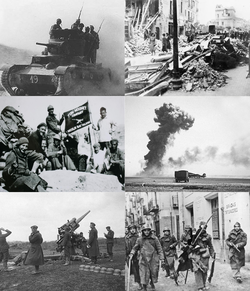
Army garrisons in Spanish Morocco rose against the Republican government on July 17, followed by uprisings across mainland Spain on July 18. Led by Generals Mola, Sanjurjo, and Franco, the coup succeeded in only part of Spain, plunging the country into civil war.
Image source: Spanish Civil War
Oct 1, 1936
% complete
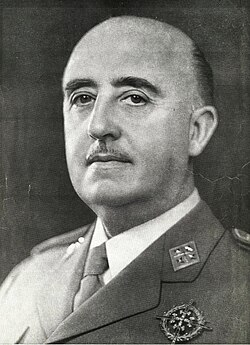
Following the deaths of Generals Sanjurjo and Mola, Francisco Franco was named Generalísimo of the Nationalist forces and head of state. He would dominate Spain for nearly four decades after the war's conclusion in 1939.
Image source: Francisco Franco
Mar 5, 1939
% complete
Colonel Casado led an anti-communist coup in Madrid seeking a negotiated peace with Franco. The ensuing internal fighting among Republican factions devastated morale, and Franco refused all terms except unconditional surrender.
Image source: Segismundo Casado
Jul 21, 1936 - Sep 27, 1936
% complete
Nationalist forces under Colonel Moscardó held the fortified Alcázar of Toledo against sustained Republican assault for over two months. Its relief by Franco's army became a powerful propaganda symbol for the Nationalist cause.
Image source: Siege of the Alcázar
Nov 7, 1936
% complete
Nationalist forces launched their assault on Madrid, but determined Republican resistance, aided by newly arrived International Brigades and Soviet equipment, halted the offensive. The city would hold out until nearly the end of the war.
Image source: Siege of Madrid
Feb 6, 1937 - Feb 27, 1937
% complete
Franco attempted to cut the Valencia road southeast of Madrid to encircle the capital. Fierce fighting involving many International Brigades resulted in heavy casualties on both sides but ended in stalemate, with the road remaining in Republican hands.
Image source: Battle of Jarama
Mar 8, 1937 - Mar 23, 1937
% complete
Italian corps sent by Mussolini attacked northeast of Madrid but were decisively defeated by Republican forces in poor weather. The humiliating loss of Italian troops damaged fascist prestige and boosted Republican morale.
Image source: Battle of Guadalajara
Apr 26, 1937
% complete
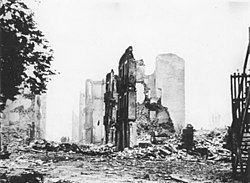
The German Condor Legion and Italian aircraft destroyed much of the Basque town of Guernica on market day, killing hundreds of civilians. The attack became an infamous symbol of terror bombing and inspired Picasso's celebrated painting.
Image source: Bombing of Guernica
Jun 19, 1937
% complete
After a devastating spring campaign in the Basque Country, Nationalist troops captured Bilbao, Spain's key industrial center in the north. The fall crippled Republican industry and marked a turning point in the northern campaign.
Image source: The Campaign for North Africa
Jul 6, 1937 - Jul 25, 1937
% complete
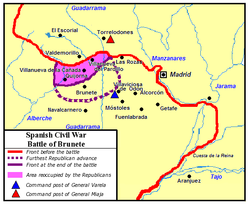
Hoping to relieve pressure on the north, the Republicans launched a costly offensive west of Madrid. Initial gains were reversed by Nationalist counterattacks and aerial superiority, leaving some 40,000 casualties without strategic benefit.
Image source: Battle of Brunete
Aug 31, 1937 - Oct 22, 1937
% complete
The Nationalists completed the conquest of northern Spain, taking Santander in September and Gijón in October. With the entire northern industrial region lost, the Republicans were left heavily outgunned and dependent on Soviet supply lines through Catalonia.
Dec 15, 1937 - Feb 22, 1938
% complete
In brutal winter conditions, Republicans briefly captured Teruel before Franco mounted a massive counteroffensive that retook the city in February. The battle drained both armies, but Nationalist momentum carried them onward toward the Mediterranean.
Image source: Battle of Teruel
Apr 15, 1938
% complete
Franco's forces drove to the sea along the Ebro front, cutting Republican territory in two and isolating Catalonia from the rest of Republican-held Spain. The achievement placed the Nationalists within reach of final victory.
Image source: Aragon Offensive
Jul 25, 1938
% complete
In a bold gamble, Republican armies crossed the Ebro River hoping to relieve pressure on Valencia and restore contact with Catalonia. After months of ferocious attritional fighting, they were forced back across the river by November.
Image source: Battle of the Ebro
Nov 16, 1938
% complete
The last Republican troops withdrew south of the Ebro after suffering catastrophic losses in men and matériel. The defeat effectively decided the war, leaving the exhausted Republic unable to mount further major offensives.
Dec 23, 1938 - Feb 10, 1939
% complete
With overwhelming manpower and air power, Nationalist armies overran Republican Catalonia. Barcelona fell on January 26, 1939, and by February hundreds of thousands of soldiers and civilians fled across the French border into exile.
Image source: Catalonia Offensive
Sep 21, 1938
% complete
Prime Minister Juan Negrín announced the unilateral withdrawal of the International Brigades, hoping reciprocal German and Italian withdrawals would follow and win democratic support abroad. The farewell parade in Barcelona was an emotional moment for foreign volunteers.
Image source: International Brigades
Sep 30, 1938
% complete
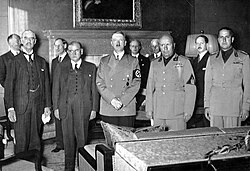
Britain and France appeased Hitler over Czechoslovakia, shattering Negrín's hope that European democracies might confront fascism and come to the Republic's aid. The agreement demoralized Republican leadership and presaged the Republic's diplomatic isolation.
Image source: Munich Agreement
Jan 27, 1939
% complete
As Catalonia collapsed, roughly half a million Spanish refugees crossed into France in what became known as La Retirada. Many were interned in harsh camps on beaches such as Argelès-sur-Mer under dire conditions.
Image source: La Retirada
Feb 27, 1939
% complete
Britain and France formally recognized the Nationalist government, abandoning any pretense of supporting the Republic. Diplomatic recognition sealed the Republic's fate and encouraged internal conspiracies against the Negrín government.
Image source: Non-intervention in the Spanish Civil War
Apr 1, 1939
% complete
Nationalist troops occupied Madrid on March 28, and on April 1 Franco declared the war over. The victory established his authoritarian regime, which would rule Spain until his death in 1975.
Apr 1, 1939 - 1945
% complete
Following victory, the Franco regime imprisoned, exiled, or executed vast numbers of former Republicans. Tens of thousands were killed or died in prisons and labor battalions during the postwar years, while others fled into long exile.
Image source: White Terror (Spain)
Sep 1, 1939 - May 8, 1945
% complete
Although ideologically aligned with the Axis and indebted to Germany and Italy, Franco kept Spain formally neutral throughout World War II, allowing the regime to survive the defeat of fascism in Europe.
Image source: Spain during World War II
Dec 12, 1946
% complete
The UN General Assembly recommended withdrawing ambassadors from Madrid due to the regime's origins in Axis support. Spain faced international isolation until Cold War geopolitics shifted Western attitudes in the early 1950s.
Image source: Spanish question (United Nations)
Or browse the full history timeline directory, with more than 2,000 topics.
This Spanish Civil War timeline was generated with the help of AI, using information found on the internet.
We work hard to keep these timelines accurate, but mistakes do get through. If you spot one, email us at [email protected] and we'll fix it for future visitors.
Generate yours with AI or build it from scratch, for free.
Export your timeline, add your own events, edit or remove AI-generated events, and much more
No credit card required.
Cancel anytime.
Cancel anytime.
You can create an unlimited number of timelines with up to 10 events on each one, customize how they look, export them to PDF, PNG, PowerPoint, CSV, and Excel, and share them with a link. Paid plans raise the event limit and add features like spreadsheet imports and collaborators.
Yes. You can cancel your subscription from your account page at any time, and you will not be charged again. Your subscription stays active for the rest of the period you already paid for.
Yes. We will email you a reminder before the annual renewal, and we will also email you a receipt.
Yes. You can email us within 15 days of any payment, and we will issue you a full refund.
Check out our pricing docs or send us an email anytime: [email protected].