-
Use Cases
-
Resources
-
Pricing
The Russian Civil War was a multi-party conflict fought primarily between the Bolshevik Red Army and the anti-Bolshevik White Army, along with various socialist factions, nationalist movements, and foreign interventionists. Following the October Revolution of 1917, the war devastated Russia, resulting in millions of deaths from combat, famine, and disease, and ultimately led to the establishment of the Soviet Union in 1922. More Less
Mar 8, 1917 - Mar 16, 1917
% complete
Mass protests in Petrograd over bread shortages and war weariness escalated into revolution. Tsar Nicholas II abdicated on March 15, 1917, ending over 300 years of Romanov rule and establishing a Provisional Government that shared power with the Petrograd Soviet.
Image source: February Revolution
Apr 16, 1917
% complete
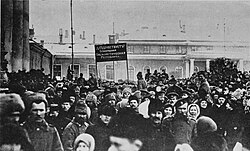
Vladimir Lenin returned to Petrograd via Germany in a sealed train, immediately issuing his April Theses calling for Soviet power, peace with Germany, land redistribution, and nationalization of industry, setting the Bolshevik agenda.
Image source: Sealed train
Aug 27, 1917 - Aug 30, 1917
% complete
Army commander Lavr Kornilov appeared to march on Petrograd, prompting the Provisional Government under Kerensky to arm Bolshevik Red Guards for defense. The coup fizzled, but it fatally weakened the Provisional Government and strengthened the Bolsheviks.
Image source: Kornilov affair
Nov 7, 1917 - Nov 8, 1917
% complete
Bolshevik forces led by Lenin and Trotsky stormed the Winter Palace in Petrograd, overthrowing the Provisional Government. The new Council of People's Commissars immediately decreed peace and land reform, igniting resistance across the former empire.
Image source: October Revolution
Jan 19, 1918
% complete
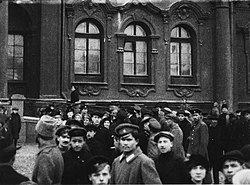
The Constituent Assembly, Russia's first democratically elected legislature dominated by the Socialist Revolutionary Party, met for a single day before being forcibly dispersed by the Bolsheviks, eliminating legal opposition to Soviet rule.
Image source: Russian Constituent Assembly
Mar 3, 1918
% complete
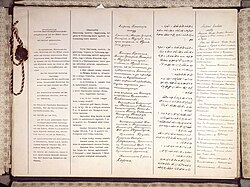
Soviet Russia signed a punitive peace with the Central Powers, ceding vast territories including Ukraine, the Baltics, and Poland. The humiliating terms fueled anti-Bolshevik sentiment and gave foreign powers a pretext for intervention.
Image source: Treaty of Brest-Litovsk
Mar 9, 1918
% complete
British marines landed at Murmansk with local Soviet consent to guard supplies against Finland and German forces, marking the start of the multi-national Allied intervention that would grow to involve Britain, France, the US, Japan, and others.
Image source: Allied intervention in the Russian Civil War
Nov 11, 1918
% complete
Germany's surrender removed the original justification for limited Allied intervention in Russia. The Allies debated whether to intervene more deeply against Bolshevism or withdraw, ultimately expanding aid to the Whites while public opinion turned against involvement.
Image source: Armistice of 11 November 1918
Dec 17, 1918
% complete
Under Admiral Walter Cowan, British light forces launched daring torpedo attacks on the Baltic Fleet, sinking battleship Andrei Pervozvanny's sister ship and other vessels, supporting Estonian independence forces against the Red Army.
Image source: North Russia intervention
Apr 25, 1920
% complete
Polish forces under Józef Piłsudski, allied with Petliura's Ukrainians, launched the Kiev Expedition, briefly taking Kiev in May. The conflict intertwined with the Civil War, culminating in the Red counteroffensive halted at the Battle of Warsaw in August 1920.
Image source: Polish–Soviet War
Oct 25, 1922
% complete
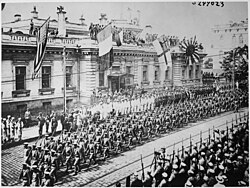
Japan, the last major foreign force, withdrew from Vladivostok after years of costly occupation, allowing the Far Eastern Republic and Red partisans to take the city and consolidating Soviet control over the Russian Far East.
Image source: Japanese intervention in Siberia
May 14, 1918
% complete
The Czechoslovak Legion, some 50,000 former Austro-Hungarian POWs seeking passage home, seized control of key cities along the Trans-Siberian Railway after clashes with Bolshevik authorities, giving the anti-Bolshevik cause control of Siberia.
Image source: Revolt of the Czechoslovak Legion
Jun 8, 1918 - Oct 6, 1918
% complete
Socialist Revolutionaries formed the Committee of Members of the Constituent Assembly (Komuch) in Samara, attempting to revive democratic government against the Bolsheviks with support from the Czechoslovak Legion.
Image source: Committee of Members of the Constituent Assembly
Jul 17, 1918
% complete
As White forces approached Yekaterinburg, the Ural Soviet ordered the execution of Nicholas II, Alexandra, their five children, and four servants in the basement of the Ipatiev House, ending any possibility of restoring the monarchy around the Tsar himself.
Image source: Murder of the Romanov family
Aug 5, 1918 - Sep 10, 1918
% complete
White and Czechoslovak forces captured the strategic city of Kazan on the Volga, seizing part of the Imperial gold reserve, before Leon Trotsky personally organized the Red Army's counteroffensive which retook the city in September.
Nov 18, 1918
% complete
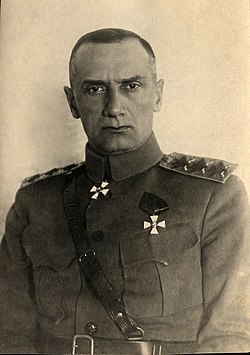
Admiral Alexander Kolchak staged a coup against the socialist Directory in Omsk and declared himself Supreme Ruler of Russia, unifying much of the White movement under military rule and becoming its most prominent figurehead.
Image source: Alexander Kolchak
Mar 4, 1919 - Apr 30, 1919
% complete
Kolchak's armies drove west across the Urals, capturing Ufa and threatening the Volga. The offensive stalled before Samara due to overextended supply lines, Red resistance, and spring thaw, marking the high-water mark of White fortunes in Siberia.
Image source: Great Siberian Ice March
May 5, 1919
% complete
General Nikolai Yudenich organized the White Northwestern Army in Estonia with Allied backing, aiming to strike toward Petrograd, where the Bolshevik capital faced threats from multiple directions in 1919.
Image source: Northwestern Army (Russia)
Jun 24, 1919 - Jul 3, 1919
% complete
General Anton Denikin's Volunteer Army took Kharkov in June and Tsaritsyn in early July, securing the Donbass coal fields and grain regions. Emboldened, he issued the Moscow Directive ordering an advance on the Bolshevik heartland.
Image source: Anton Denikin
Oct 10, 1919 - Nov 14, 1919
% complete
Yudenich's Northwestern Army reached the suburbs of Petrograd but was repulsed by Trotsky's hastily mobilized defenses, aided by British naval support for the Soviets and Estonian refusal to assist further. His army retreated into Estonia and was disarmed.
Image source: Battle of Petrograd
Oct 13, 1919 - Oct 20, 1919
% complete
Denikin's forces reached their northernmost point near Orel, only about 250 miles from Moscow, while Cossack cavalry raided as far as Tula. Overextended and harassed by Makhno's rear-area raids, the Whites were soon thrown back by massive Red counterattacks.
Image source: Armed Forces of South Russia
Dec 12, 1919 - Dec 16, 1919
% complete
In a sweeping winter counteroffensive, Budyonny's cavalry and other Red formations retook Kharkov, Kiev, and Tsaritsyn, shattering the Armed Forces of South Russia and sending Denikin's army into a catastrophic retreat toward the Black Sea.
Image source: Kharkiv Operation (December 1919)
Dec 31, 1919 - Feb 7, 1920
% complete
With Omsk falling to the Red Army in November 1919, Kolchak's retreating forces endured a horrific winter march along the Trans-Siberian Railway. Abandoned by allies, Kolchak was handed over by Czechoslovak troops, executed at Irkutsk on February 7, 1920.
Apr 4, 1920
% complete
After the disastrous Novorossisk evacuation, Denikin resigned and Pyotr Wrangel took command of the remnants in Crimea, reorganizing them into the Russian Army and pursuing a more pragmatic policy of land reform and alliances with Cossacks and Ukrainians.
Image source: Pyotr Wrangel
Jun 6, 1920 - Jun 30, 1920
% complete
Wrangel broke out of the Perekop isthmus into northern Taurida and the Kuban, hoping to rally Cossack support, but gains proved temporary as the Red Army, freed by the Polish armistice, massed overwhelming forces against him in October.
Nov 7, 1920 - Nov 16, 1920
% complete
Frunze's Red Army stormed the fortified Perekop and Chongar isthmuses, forcing Wrangel's evacuation of some 150,000 soldiers and civilians by sea from Sevastopol. This marked the effective end of major White military operations in European Russia.
Image source: Siege of Perekop (1920)
Sep 5, 1918 - Nov 28, 1921
% complete
Nestor Makhno built an anarchist peasant army, the Revolutionary Insurgent Army of Ukraine, which fought Germans, Austrians, Whites, and intermittently allied with then fought the Bolsheviks, embodying the 'Free Territory' experiment in southern Ukraine.
Image source: Nestor Makhno
Dec 14, 1918
% complete
The Ukrainian Directory under Symon Petliura overthrew Pavlo Skoropadskyi's German-backed Hetmanate, restoring the Ukrainian People's Republic amid chaotic fighting between Ukrainian nationalists, Reds, Whites, anarchists, and Polish forces.
Image source: Directorate of Ukraine
Aug 28, 1921 - Nov 28, 1921
% complete
After the Bolsheviks turned on their former anarchist allies, Makhno's dwindling insurgent bands waged guerrilla warfare until being hunted down by large Red Army contingents. Wounded, Makhno escaped into exile through Romania in August 1921.
Image source: Revolutionary Insurgent Army of Ukraine
Apr 6, 1920
% complete
To avoid war with Japan still occupying eastern Siberia, Moscow created the nominally independent Far Eastern Republic, which gradually absorbed White-held territory including Vladivostok before merging with Soviet Russia in November 1922.
Image source: Far Eastern Republic
Mar 7, 1921 - Mar 18, 1921
% complete
Sailors at the Kronstadt naval base, once heroes of the October Revolution, rose demanding free soviets and an end to food requisitioning. Tukhachevsky's Red Army stormed the fortress across ice, crushing the revolt and prompting Lenin's New Economic Policy.
Image source: Kronstadt rebellion
Dec 30, 1922
% complete
The Treaty on the Creation of the USSR united the Russian, Ukrainian, Byelorussian, and Transcaucasian Soviet republics, formalizing the Bolshevik victory and creating the state structure that would dominate Eurasia for nearly seven decades.
Image source: Soviet Union
Or browse the full history timeline directory, with more than 2,000 topics.
This Russian Civil War timeline was generated with the help of AI, using information found on the internet.
We work hard to keep these timelines accurate, but mistakes do get through. If you spot one, email us at [email protected] and we'll fix it for future visitors.
Generate yours with AI or build it from scratch, for free.
Export your timeline, add your own events, edit or remove AI-generated events, and much more
No credit card required.
Cancel anytime.
Cancel anytime.
You can create an unlimited number of timelines with up to 10 events on each one, customize how they look, export them to PDF, PNG, PowerPoint, CSV, and Excel, and share them with a link. Paid plans raise the event limit and add features like spreadsheet imports and collaborators.
Yes. You can cancel your subscription from your account page at any time, and you will not be charged again. Your subscription stays active for the rest of the period you already paid for.
Yes. We will email you a reminder before the annual renewal, and we will also email you a receipt.
Yes. You can email us within 15 days of any payment, and we will issue you a full refund.
Check out our pricing docs or send us an email anytime: [email protected].