-
Use Cases
-
Resources
-
Pricing
Adolf Hitler (1889–1945) was an Austrian-born German politician who led the Nazi Party and became dictator of Germany from 1933 to 1945. His aggressive expansionist policies triggered World War II in Europe, and his regime perpetrated the Holocaust, the systematic murder of six million Jews and millions of other victims. More Less
Apr 20, 1889
% complete
Adolf Hitler was born on April 20, 1889, in Braunau am Inn, Austria-Hungary, the fourth of six children of Alois Hitler and Klara Pölzl. His early years were marked by a strict father, academic struggles, and dreams of becoming an artist.
Image source: Adolf Hitler
Jan 3, 1903
% complete
Hitler's father, Alois, a stern customs official, died suddenly when Adolf was 13. The death removed a major disciplinary influence from his life, and his school performance continued to decline in the following years.
Image source: Alois Hitler
Oct 1907
% complete
Hitler was twice rejected admission to the Vienna Academy of Fine Arts, in 1907 and 1908. Devastated, he remained in Vienna living in poverty, selling postcard paintings and absorbing the city's antisemitic and nationalist politics.
Image source: Paintings by Adolf Hitler
Dec 21, 1907
% complete
Klara Hitler died of breast cancer at age 47. Her Jewish doctor later recalled that no one had ever seen her son so grief-stricken. Hitler moved permanently to Vienna shortly afterward.
Image source: Klara Hitler
May 1913
% complete
Hitler left Vienna for Munich, partly to avoid Austrian military service. He continued to live as a struggling painter until World War I broke out, when he volunteered for the German army.
Aug 1914 - Nov 11, 1918
% complete
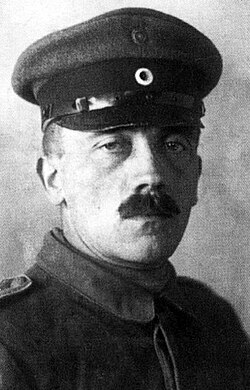
Hitler served as a message runner on the Western Front with the Bavarian army, earning the Iron Cross First Class. He was wounded in 1916 and temporarily blinded by a British gas attack in October 1918. Germany's defeat deeply embittered him.
Image source: Military career of Adolf Hitler
Sep 1919
% complete
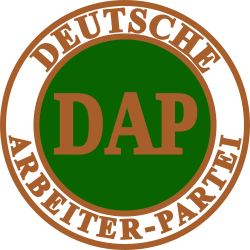
Assigned by the army to spy on the small German Workers' Party (DAP) in Munich, Hitler instead joined it as member number 555. His talent for fiery oratory quickly made him the party's most prominent figure.
Image source: German Workers' Party
Jul 29, 1921
% complete
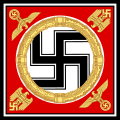
The DAP was renamed the National Socialist German Workers' Party (NSDAP), or Nazi Party. Hitler forced out rivals and assumed leadership, adopting the swastika emblem and building a cult of personality around himself.
Image source: Nazi Party
Nov 8, 1923 - Nov 9, 1923
% complete
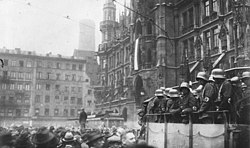
Hitler attempted to seize power in Bavaria with a coup launched from a Munich beer hall. The march on the war ministry was broken up by police; sixteen Nazis died. The failed putsch made Hitler a national figure.
Image source: Beer Hall Putsch
Apr 1, 1924 - Dec 20, 1924
% complete
Sentenced to five years for treason, Hitler served only about nine months in comfortable confinement at Landsberg Prison. There he dictated Mein Kampf, laying out his ideology of extreme nationalism, antisemitism, and Lebensraum.
Image source: Mein Kampf
Sep 14, 1930
% complete
Exploiting the Great Depression's economic misery, the Nazi Party surged from 12 to 107 seats in the Reichstag, becoming the second-largest party and transforming Hitler into a serious contender for national power.
Image source: 1930 German federal election
Mar 13, 1932 - Apr 10, 1932
% complete
Hitler challenged Paul von Hindenburg for the presidency, winning about 37% in the runoff. Though defeated, the campaign demonstrated the mass appeal of Nazism across Germany.
Image source: 1932 German presidential election
Jan 30, 1933
% complete
Conservative elites persuaded President Hindenburg to appoint Hitler chancellor, believing they could control him. Within months he had dismantled democracy and established a one-party dictatorship.
Image source: Adolf Hitler's rise to power
Feb 27, 1933
% complete
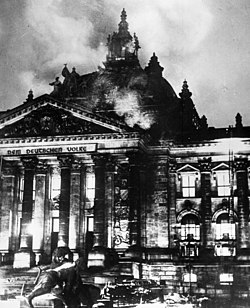
The Reichstag building burned days before elections. Blaming communists, Hitler pushed through the Reichstag Fire Decree, suspending freedom of speech, press, and assembly, enabling mass arrests of political opponents.
Image source: Reichstag fire
Mar 23, 1933
% complete
The Reichstag passed the Enabling Act, allowing Hitler to enact laws without parliamentary consent. Combined with suppression of opposition parties, it gave him legal cover for total dictatorship.
Image source: Enabling Act of 1933
Jun 30, 1934 - Jul 2, 1934
% complete
Hitler ordered the murder of SA leader Ernst Röhm and dozens of other perceived rivals, consolidating support from the army and conservative elites while eliminating dissent within his own movement.
Image source: Night of the Long Knives
Aug 2, 1934
% complete
When President Hindenburg died, Hitler merged the offices of chancellor and president, taking the title Führer und Reichskanzler. The army swore a personal oath of loyalty to him, cementing his absolute rule.
Image source: Führer
Sep 15, 1935
% complete
At the Nuremberg rally, Hitler announced laws excluding Jews from citizenship and forbidding marriage between Jews and Germans. These laws institutionalized racial persecution and laid groundwork for the Holocaust.
Image source: Nuremberg Laws
Nov 9, 1938 - Nov 10, 1938
% complete
Following the assassination of a German diplomat in Paris, Nazis unleashed a nationwide pogrom: synagogues burned, thousands of Jewish businesses were destroyed, some 30,000 Jewish men were sent to concentration camps, and nearly 100 were killed.
Image source: Kristallnacht
Jan 20, 1942
% complete
Senior Nazi officials met near Berlin to coordinate the systematic deportation and murder of Europe's Jews. The conference formalized the industrialized genocide already underway at killing centers like Auschwitz.
Image source: Wannsee Conference
Jan 27, 1945
% complete
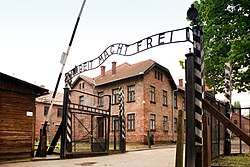
Soviet troops liberated Auschwitz-Birkenau, exposing the scale of Nazi genocide to the world. By war's end, roughly six million Jews had been murdered in the Holocaust ordered under Hitler's regime.
Image source: Auschwitz concentration camp
Mar 7, 1936
% complete
German troops marched into the demilitarized Rhineland in violation of the Treaty of Versailles. The unopposed move emboldened Hitler's expansionism, as France and Britain chose not to respond militarily.
Image source: Remilitarization of the Rhineland
Mar 12, 1938
% complete
German troops entered Austria, which was absorbed into the Third Reich amid widespread Nazi celebrations. The Anschluss violated the Versailles Treaty but drew only diplomatic protests from Western powers.
Image source: Anschluss
Sep 30, 1938
% complete
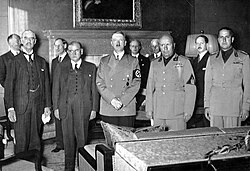
Britain and France appeased Hitler by allowing Germany to annex the Sudetenland from Czechoslovakia. Hitler promised peace in return, but occupied the rest of Czechoslovakia within six months.
Image source: Munich Agreement
Aug 23, 1939
% complete
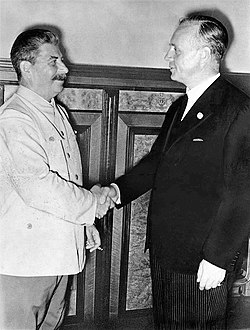
Germany and the USSR signed a non-aggression pact with secret protocols dividing Eastern Europe into spheres of influence. It freed Hitler to attack Poland without fear of a two-front war.
Image source: Molotov–Ribbentrop Pact
Sep 1, 1939 - Oct 6, 1939
% complete
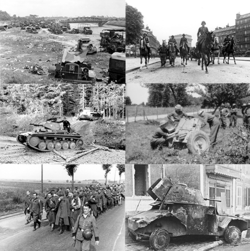
Germany invaded Poland using blitzkrieg tactics. Britain and France declared war two days later, beginning World War II. Poland fell within weeks, partitioned between Germany and the Soviet Union.
Image source: Invasion of Poland
May 10, 1940 - Jun 25, 1940
% complete
German forces swept through the Low Countries and France in six weeks, forcing France's armistice. Hitler toured Paris in June 1940 at the height of his power, having conquered most of continental Europe.
Image source: Battle of France
Jul 10, 1940 - Oct 31, 1940
% complete
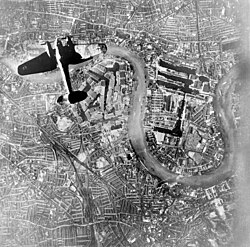
The Luftwaffe's attempt to destroy the Royal Air Force and prepare for invasion of Britain failed. Hitler postponed Operation Sea Lion indefinitely, suffering his first major strategic setback.
Image source: Battle of Britain
Jun 22, 1941
% complete
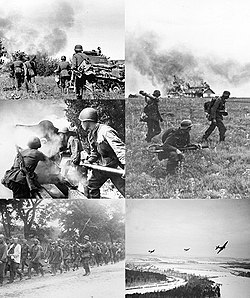
Ignoring his pact with Stalin, Hitler launched the largest invasion in history against the Soviet Union. Initial advances stalled before Moscow, opening a brutal eastern front that would ultimately destroy the Third Reich.
Image source: Operation Barbarossa
Dec 11, 1941
% complete
Days after Pearl Harbor, Hitler declared war on the United States, bringing America fully into the European conflict. The decision proved catastrophic as American industrial might turned the tide against Germany.
Image source: German declaration of war against the United States
Feb 2, 1943
% complete
Hitler refused to allow the trapped Sixth Army to retreat; its destruction at Stalingrad destroyed Germany's aura of invincibility and began the long Soviet advance westward toward Berlin.
Image source: Battle of Stalingrad
Jul 20, 1944
% complete
Colonel Claus von Stauffenberg planted a bomb at Hitler's East Prussian headquarters. Hitler survived with minor injuries and responded with brutal reprisals, executing thousands suspected of involvement.
Image source: 20 July plot
Apr 29, 1945
% complete
As Soviet forces fought through Berlin, Hitler married his longtime companion Eva Braun in a brief ceremony in the Führerbunker beneath the Chancellery garden.
Image source: Eva Braun
Apr 30, 1945
% complete
With Berlin surrounded, Hitler shot himself while Eva Braun took poison. Their bodies were burned in the bunker courtyard. Admiral Dönitz succeeded him, and Germany surrendered unconditionally a week later.
Image source: Death of Adolf Hitler
Nov 20, 1945 - Oct 1, 1946
% complete
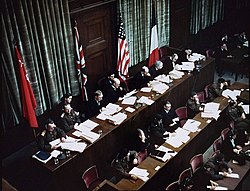
The Allies tried surviving Nazi leaders for crimes against humanity, establishing precedents for international law. Hitler, dead by trial's start, became the enduring symbol of totalitarian evil and genocide.
Image source: Nuremberg trials
Or browse the full history timeline directory, with more than 2,000 topics.
This Adolf Hitler timeline was generated with the help of AI, using information found on the internet.
We work hard to keep these timelines accurate, but mistakes do get through. If you spot one, email us at [email protected] and we'll fix it for future visitors.
Generate yours with AI or build it from scratch, for free.
Export your timeline, add your own events, edit or remove AI-generated events, and much more
No credit card required.
Cancel anytime.
Cancel anytime.
You can create an unlimited number of timelines with up to 10 events on each one, customize how they look, export them to PDF, PNG, PowerPoint, CSV, and Excel, and share them with a link. Paid plans raise the event limit and add features like spreadsheet imports and collaborators.
Yes. You can cancel your subscription from your account page at any time, and you will not be charged again. Your subscription stays active for the rest of the period you already paid for.
Yes. We will email you a reminder before the annual renewal, and we will also email you a receipt.
Yes. You can email us within 15 days of any payment, and we will issue you a full refund.
Check out our pricing docs or send us an email anytime: [email protected].