-
Use Cases
-
Resources
-
Pricing
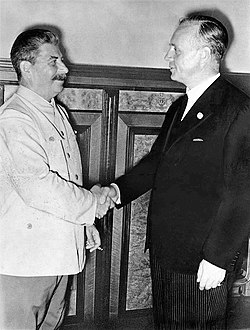
The Molotov-Ribbentrop Pact was a non-aggression treaty signed on August 23, 1939 between Nazi Germany and the Soviet Union. Named after foreign ministers Joachim von Ribbentrop and Vyacheslav Molotov, it included secret protocols dividing Eastern Europe into German and Soviet spheres of influence. The pact allowed Hitler to invade Poland without fear of Soviet intervention and enabled Stalin to annex the Baltic states and eastern Poland, until Germany betrayed the agreement with Operation Barbarossa in 1941. More Less
Jun 28, 1919
% complete
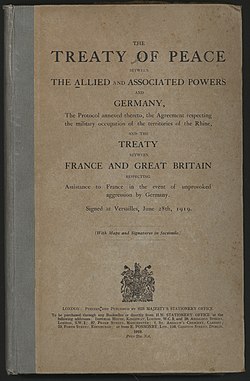
The Treaty of Versailles ended World War I, redrawing European borders and imposing harsh penalties on Germany. The treaty's territorial provisions and the creation of new states like Poland sowed grievances in Germany that the Nazi regime would later exploit, setting the stage for revisionist diplomacy in Eastern Europe.
Image source: Treaty of Versailles
Apr 16, 1922
% complete
Germany and Soviet Russia signed the Treaty of Rapallo at Genoa, restoring diplomatic relations and renouncing mutual claims. This early rapprochement included secret military cooperation, foreshadowing later pragmatic dealings between the two powers despite ideological differences.
Image source: Treaty of Rapallo (1922)
Jan 30, 1933
% complete
Adolf Hitler became Chancellor of Germany, bringing to power a regime ideologically committed to anti-communism and eastward expansion for Lebensraum. Initially hostile toward the Soviet Union, Nazi Germany's foreign policy would shift dramatically by the late 1930s.
Image source: Adolf Hitler's rise to power
Nov 25, 1936
% complete
Nazi Germany and Imperial Japan signed the Anti-Comintern Pact, directed against the Communist International. Italy joined a year later. The pact highlighted the ideological hostility between the Axis powers and the Soviet Union, making the eventual Nazi-Soviet pact all the more surprising.
Image source: Anti-Comintern Pact
Dec 1, 1936
% complete
By the mid-1930s Joseph Stalin had established unchallenged control over the Soviet Union. Amid the Great Purges, which devastated the Red Army's officer corps, Stalin pursued a foreign policy seeking collective security with Western powers while keeping options open for accommodation with Germany.
Image source: Joseph Stalin
Sep 30, 1938
% complete
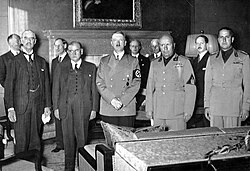
Britain and France appeased Hitler by allowing Germany to annex the Sudetenland from Czechoslovakia without Czech or Soviet participation. The exclusion of the USSR from Munich convinced Stalin that the Western powers might be maneuvering Germany into conflict with the Soviet Union.
Image source: Munich Agreement
Mar 15, 1939
% complete
German troops occupied Prague and established the Protectorate of Bohemia and Moravia, destroying what remained of Czechoslovakia. The move shattered faith in Hitler's promises, prompted Britain to guarantee Polish independence, and intensified diplomatic maneuvering over Poland.
Image source: Occupation of Czechoslovakia (1938–1945)
Mar 31, 1939
% complete
Prime Minister Neville Chamberlain announced Britain's unilateral guarantee of Polish independence, soon formalized with France. This pledge raised the stakes of any German move against Poland and made Soviet policy toward both Berlin and London critically important.
Image source: Anglo-Polish alliance
Apr 17, 1939 - Aug 21, 1939
% complete
Throughout spring and summer 1939, Britain and France engaged in slow, half-hearted talks with the Soviet Union about a mutual defense agreement. Disputes over passage rights through Poland and Romania and mutual mistrust left the negotiations deadlocked.
May 3, 1939
% complete
Maxim Litvinov, an advocate of collective security and Jewish, was replaced by Vyacheslav Molotov as Soviet Commissar for Foreign Affairs. The change signaled a possible shift in Soviet diplomacy and was widely interpreted as opening the door to negotiations with Nazi Germany.
Image source: Vyacheslav Molotov
May 23, 1939
% complete
At a meeting with military leaders at the Berghof, Hitler declared his intention to attack Poland at the first suitable opportunity, hoping Britain and France would not intervene. He ordered preparations for Case White while seeking to neutralize the possibility of Soviet involvement.
May 30, 1939 - Aug 19, 1939
% complete
Economic talks between Germany and the Soviet Union accelerated through the summer of 1939. On August 19 they concluded a credit agreement providing German industrial goods in exchange for Soviet raw materials, paving the way politically for a broader political settlement.
Jul 26, 1939
% complete
German diplomat Karl Schnurre met with Soviet embassy counselor Georgii Astakhov in Berlin, where Ribbentrop's staff floated sweeping proposals: improved relations, delimitation of spheres of interest, and potential agreements covering Poland and the Baltic states. Moscow responded cautiously but positively.
Image source: Joachim von Ribbentrop
Aug 3, 1939
% complete
Meeting German Ambassador Schulenburg, Molotov proposed that economic discussions be tied to a broader political settlement, asking pointedly whether Germany was prepared to conclude a non-aggression pact with the Soviet Union — the clearest signal yet that a deal was possible.
Image source: Molotov–Ribbentrop Pact
Aug 12, 1939 - Aug 21, 1939
% complete
A low-level Anglo-French military delegation traveled to Leningrad and Moscow by slow ship, arriving without authority to make binding commitments. When Soviet Marshal Voroshilov asked how British forces could fight alongside the Red Army if it could not cross Poland, the delegates could not answer, dooming the talks.
Aug 19, 1939
% complete
Stalin personally received Ambassador Schulenburg and informed him that the Soviet government agreed to receive German Foreign Minister Joachim von Ribbentrop in Moscow within days. Hitler seized on this message to accelerate final preparations for war against Poland.
Aug 19, 1939
% complete
Building on the August credit agreement, expanded commercial arrangements saw the Soviet Union supply grain, oil, and strategic raw materials to Germany in exchange for machinery and weapons. These economic ties sustained the partnership until June 1941.
Aug 23, 1939
% complete
A secret additional protocol assigned Finland, Estonia, Latvia, and eastern Poland to the Soviet sphere, while western Poland and Lithuania went to Germany (Lithuania was reassigned to the USSR in September). Bessarabia was recognized as a Soviet interest. Both governments pledged strict secrecy.
Image source: Molotov–Ribbentrop Pact negotiations
Aug 23, 1939
% complete
In the early hours of August 24 Moscow time, Vyacheslav Molotov and Joachim von Ribbentrop signed the Treaty of Non-Aggression between Germany and the Soviet Union in Moscow, with Stalin present. The public treaty promised neutrality if either party were attacked by a third power; a secret protocol divided Eastern Europe into spheres of influence.
Aug 24, 1939 - Aug 31, 1939
% complete
News of the pact stunned the world, especially communists abroad who had been instructed to oppose fascism via popular fronts. In Japan, it contributed to the fall of the pro-German Hiranuma cabinet. Britain and France realized their hopes of deterring Hitler via Soviet alignment had collapsed.
Nov 12, 1940 - Nov 13, 1940
% complete
Molotov traveled to Berlin to discuss the USSR potentially joining the Tripartite Pact. Talks foundered when Molotov pressed for clarification of German intentions regarding Finland, Bulgaria, and Turkey, and demanded Soviet rights in the Balkans. The failure convinced Hitler that the partnership was untenable.
Image source: German–Soviet Axis talks
Aug 31, 1939
% complete
SS operatives staged a fake Polish attack on the Gleiwitz radio station, planting bodies dressed in Polish uniforms as supposed evidence. The false-flag operation gave Hitler propaganda justification for launching the invasion of Poland the next morning.
Image source: Gleiwitz incident
Sep 1, 1939
% complete
Wehrmacht forces invaded Poland at dawn, employing blitzkrieg tactics. Britain and France issued ultimatums and declared war on Germany two days later, transforming the regional conflict into the Second World War. The secret protocols ensured the Soviet Union would remain neutral.
Image source: Invasion of Poland
Sep 17, 1939 - Oct 6, 1939
% complete
With Polish resistance collapsing, the Red Army invaded eastern Poland under the pretext of protecting Ukrainian and Belarusian populations amid the state's dissolution. Soviet and German forces met along the demarcation line and held joint parades, including at Brest-Litovsk on September 22.
Image source: Soviet invasion of Poland
Sep 28, 1939
% complete
Molotov and Ribbentrop signed a second treaty adjusting the partition line: Germany took all of western Poland, and the Soviet sphere shifted to include Lithuania. A confidential protocol called for suppressing Polish agitation in each other's territories, sealing Poland's fourth partition.
Image source: German–Soviet Boundary and Friendship Treaty
Nov 30, 1939 - Mar 13, 1940
% complete
Seeking territory in its sphere of influence, the Soviet Union attacked Finland after Helsinki rejected territorial demands. Despite heroic Finnish resistance and staggering Soviet losses, Finland ceded about ten percent of its territory in the Moscow Peace Treaty, remaining independent.
Image source: Winter War
Jun 15, 1940 - Aug 6, 1940
% complete
Using staged border incidents and ultimatums, the USSR forced Lithuania, Latvia, and Estonia to accept Soviet bases and then puppet governments. Rigged elections followed, and the three states were formally annexed as Soviet republics in August 1940, with mass deportations of 'anti-Soviet elements.'
Image source: Occupation of the Baltic states
Jun 28, 1940 - Jul 3, 1940
% complete
Backed by the pact's provisions, the USSR presented Romania an ultimatum demanding Bessarabia and Northern Bukovina. Romania yielded, and the Red Army occupied the regions, incorporating most of them into the Moldavian SSR. The loss destabilized Romania's government and pushed Bucharest toward the Axis.
Image source: Soviet occupation of Bessarabia and Northern Bukovina
Aug 30, 1940
% complete
Germany and Italy arbitrated the Hungarian-Romanian dispute, forcing Romania to cede Northern Transylvania to Hungary. The award demonstrated Axis dominance over Southeastern Europe and completed the realignment of Romania, whose Ploiești oil fields became vital to Germany.
Image source: Second Vienna Award
Nov 20, 1940 - Jun 21, 1941
% complete
Hungary, Romania, and Slovakia joined the Tripartite Pact, and Germany sent troops into Romania and Bulgaria and conquered Yugoslavia and Greece. The USSR protested these moves near its borders, while both sides continued trade talks as a cover for increasingly hostile posturing.
Image source: Balkans campaign (World War II)
Jun 22, 1941
% complete
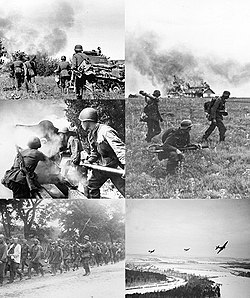
Ignoring the non-aggression treaty, Nazi Germany launched the largest invasion in history against the Soviet Union along a 2,900-kilometer front. Stalin, who had ignored numerous intelligence warnings, was caught off guard. The pact's collapse opened the deadliest theater of World War II.
Image source: Operation Barbarossa
Jan 1, 1989 - Aug 24, 1989
% complete
Under glasnost, the Soviet Congress of People's Deputies examined evidence of the secret protocol, long denied by Moscow. On December 24, 1989 the congress officially condemned the pact and acknowledged its secret protocols, vindicating decades of Baltic claims that their incorporation had been illegitimate.
Image source: Katyn massacre
Aug 23, 1989
% complete
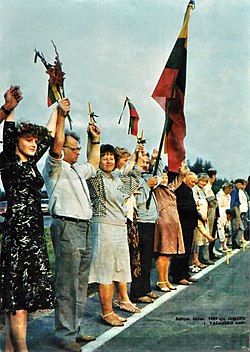
On the fiftieth anniversary of the pact, roughly two million people joined hands in a 600-kilometer human chain linking Tallinn, Riga, and Vilnius. The peaceful demonstration drew global attention to the Baltics' independence movements and became an iconic symbol of the region's liberation struggle.
Image source: Baltic Way
Or browse the full history timeline directory, with more than 2,000 topics.
This Molotov-Ribbentrop Pact timeline was generated with the help of AI, using information found on the internet.
We work hard to keep these timelines accurate, but mistakes do get through. If you spot one, email us at [email protected] and we'll fix it for future visitors.
Generate yours with AI or build it from scratch, for free.
Export your timeline, add your own events, edit or remove AI-generated events, and much more
No credit card required.
Cancel anytime.
Cancel anytime.
You can create an unlimited number of timelines with up to 10 events on each one, customize how they look, export them to PDF, PNG, PowerPoint, CSV, and Excel, and share them with a link. Paid plans raise the event limit and add features like spreadsheet imports and collaborators.
Yes. You can cancel your subscription from your account page at any time, and you will not be charged again. Your subscription stays active for the rest of the period you already paid for.
Yes. We will email you a reminder before the annual renewal, and we will also email you a receipt.
Yes. You can email us within 15 days of any payment, and we will issue you a full refund.
Check out our pricing docs or send us an email anytime: [email protected].