-
Use Cases
-
Resources
-
Pricing
Nazi Germany refers to the period from 1933 to 1945 when Adolf Hitler and the National Socialist German Workers' Party (NSDAP) ruled Germany as a totalitarian dictatorship. The regime dismantled democracy, persecuted Jews and other minorities, initiated World War II in Europe, and carried out the Holocaust, the systematic murder of six million Jews, before collapsing with Germany's defeat in 1945. More Less
Jul 29, 1921
% complete
Adolf Hitler assumed leadership of the National Socialist German Workers' Party (Nazi Party), transforming it into a highly centralized organization built around his cult of personality, ultranationalist ideology, and virulent antisemitism.
Image source: Adolf Hitler's rise to power
Nov 8, 1923 - Nov 9, 1923
% complete
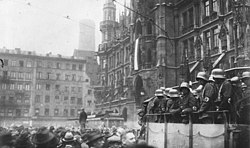
Hitler and Nazi Party members attempted to seize power in Bavaria through a coup in Munich. The putsch failed, Hitler was imprisoned, and he used his trial and time in prison to gain national publicity and write Mein Kampf.
Image source: Beer Hall Putsch
Jul 18, 1925
% complete
Hitler published the first volume of Mein Kampf, outlining his ideology of racial hierarchy, Lebensraum (living space) in Eastern Europe, and hatred of Jews. The book became the ideological blueprint for the Nazi regime.
Image source: Mein Kampf
Sep 14, 1930
% complete
Exploiting economic crisis from the Great Depression, the Nazi Party surged from 12 to 107 seats in the Reichstag, becoming the second-largest party and demonstrating its growing mass appeal.
Image source: 1930 German federal election
Jan 30, 1933
% complete
President Paul von Hindenburg appointed Hitler as Chancellor, believing conservative allies could control him. Instead, Hitler rapidly dismantled democratic institutions and established a totalitarian dictatorship within months.
Feb 27, 1933
% complete
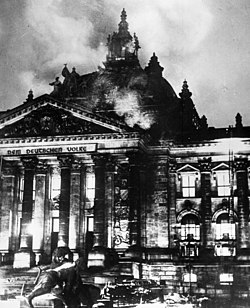
The burning of the Reichstag building was blamed on communists, allowing Hitler to push through the Reichstag Fire Decree, which suspended civil liberties and enabled mass arrests of political opponents.
Image source: Reichstag fire
Mar 23, 1933
% complete
The Reichstag passed the Enabling Act, allowing Hitler's government to enact laws without parliamentary consent. This legal foundation let the Nazis eliminate opposition and consolidate total control over Germany.
Image source: Enabling Act of 1933
Jun 30, 1934 - Jul 2, 1934
% complete
Hitler ordered the extrajudicial killing of SA leader Ernst Röhm and other political rivals, eliminating potential opposition within the party and securing the army's loyalty to his regime.
Image source: Night of the Long Knives
Aug 1, 1936 - Aug 16, 1936
% complete
Nazi Germany used the Olympics as a propaganda showcase, temporarily masking persecution while presenting an image of a modern, unified nation. Jesse Owens' four gold medals undermined claims of Aryan supremacy.
Image source: 1936 Summer Olympics
Mar 22, 1933
% complete
The SS established Dachau near Munich to imprison political prisoners, primarily communists and social democrats. It became the model for the vast network of concentration camps that followed across Nazi-controlled Europe.
Image source: Dachau concentration camp
Sep 15, 1935
% complete
The Nuremberg Laws institutionalized racial antisemitism, defining Jews by ancestry, stripping them of German citizenship, and banning marriages between Jews and Germans, laying the legal groundwork for escalating persecution.
Image source: Nuremberg Laws
Nov 9, 1938 - Nov 10, 1938
% complete
In a coordinated nationwide pogrom, Nazis destroyed synagogues and Jewish businesses, murdered dozens of Jews, and arrested some 30,000 Jewish men, marking a dramatic escalation toward the Holocaust.
Image source: Kristallnacht
Sep 1, 1939 - Aug 24, 1941
% complete
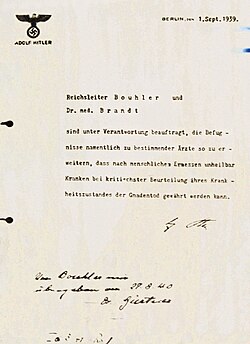
The Nazi regime systematically murdered tens of thousands of people with disabilities deemed 'unworthy of life,' pioneering gas chamber techniques later used in the extermination camps of the Holocaust.
Image source: Aktion T4
Jan 1, 1942 - Jan 27, 1945
% complete
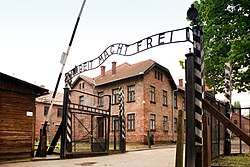
Auschwitz-Birkenau became the center of the Holocaust, where approximately 1.1 million people, mostly Jews, were murdered in gas chambers or died from starvation, disease, and forced labor.
Image source: Auschwitz concentration camp
Jan 20, 1942
% complete
Senior Nazi officials met at Wannsee to coordinate the systematic deportation and murder of Europe's Jews, formalizing the bureaucratic machinery of the Holocaust and the industrialized killing process.
Image source: Wannsee Conference
Apr 19, 1943 - May 16, 1943
% complete
Jewish fighters in the Warsaw Ghetto mounted armed resistance against deportation to death camps. The SS brutally crushed the uprising, burning the ghetto and deporting survivors to extermination camps.
Image source: Warsaw Ghetto Uprising
Jan 27, 1945
% complete
Soviet troops liberated Auschwitz-Birkenau, exposing to the world the full scale of Nazi genocide. The date is now commemorated internationally as Holocaust Remembrance Day.
Mar 7, 1936
% complete
German troops marched into the demilitarized Rhineland in violation of the Treaty of Versailles. The unopposed move emboldened Hitler and demonstrated the weakness of Allied resolve against Nazi aggression.
Image source: Remilitarization of the Rhineland
Mar 12, 1938
% complete
German troops entered Austria, which was annexed into the Third Reich following pressure and a staged plebiscite. The Anschluss marked the first major territorial expansion of Nazi Germany.
Image source: Anschluss
Sep 30, 1938
% complete
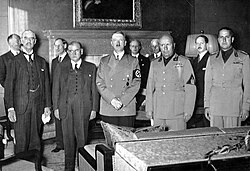
Britain and France appeased Hitler by permitting the annexation of Czechoslovakia's Sudetenland. The agreement briefly averted war but encouraged further Nazi aggression.
Image source: Munich Agreement
Mar 15, 1939
% complete
In violation of the Munich Agreement, German forces seized Bohemia and Moravia, establishing the Protectorate of Bohemia and Moravia and revealing that appeasement had failed to contain Hitler's ambitions.
Image source: Occupation of Czechoslovakia (1938–1945)
Aug 23, 1939
% complete
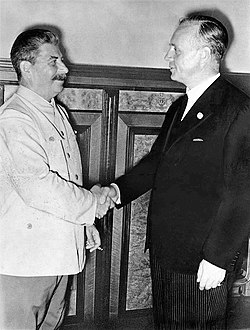
Germany and the USSR signed a non-aggression pact with secret protocols dividing Eastern Europe into spheres of influence, clearing the way for the invasion of Poland.
Image source: Molotov–Ribbentrop Pact
Sep 1, 1939 - Oct 6, 1939
% complete
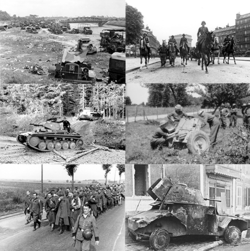
Germany invaded Poland using blitzkrieg tactics, prompting Britain and France to declare war on September 3. Poland was quickly defeated and partitioned between Germany and the Soviet Union.
Image source: Invasion of Poland
May 10, 1940 - Jun 25, 1940
% complete
Germany invaded France, Belgium, the Netherlands, and Luxembourg, achieving a stunning rapid victory. France surrendered in June, and the collaborationist Vichy regime was installed in the unoccupied south.
Image source: Battle of France
Jul 10, 1940 - Oct 31, 1940
% complete
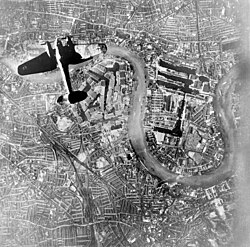
The Luftwaffe's campaign to destroy the Royal Air Force and prepare for invasion of Britain failed. British resistance forced Hitler to postpone Operation Sea Lion indefinitely, marking his first major setback.
Image source: Battle of Britain
Jun 22, 1941
% complete
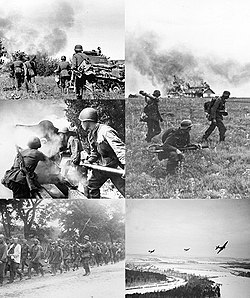
Germany launched the largest military invasion in history against the USSR, seeking Lebensraum and the destruction of 'Judeo-Bolshevism.' The campaign opened the brutal Eastern Front and ultimately doomed the Nazi regime.
Image source: Operation Barbarossa
Feb 2, 1943
% complete
Field Marshal Paulus surrendered the encircled German Sixth Army after months of devastating urban combat. The catastrophic loss shattered the myth of German invincibility and shifted momentum on the Eastern Front.
Image source: Battle of Stalingrad
Jun 6, 1944
% complete
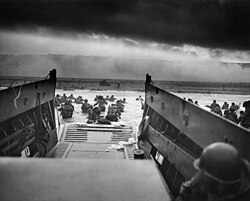
D-Day saw Allied forces storm the beaches of Normandy, opening a second front in Western Europe. The successful invasion trapped Nazi Germany between advancing Soviet and Western armies.
Image source: Normandy landings
Jul 20, 1944
% complete
Colonel Claus von Stauffenberg planted a bomb at Hitler's headquarters, but the explosion failed to kill him. In retaliation, thousands of suspected conspirators were executed in brutal purges.
Image source: 20 July plot
Dec 16, 1944 - Jan 25, 1945
% complete
Hitler launched a desperate counteroffensive through the Ardennes aimed at splitting Allied forces. The attack stalled amid fierce resistance and fuel shortages, exhausting Germany's final reserves.
Image source: Battle of the Bulge
Apr 16, 1945 - May 2, 1945
% complete
Soviet forces stormed Berlin in fierce street fighting. As the city fell, Hitler committed suicide in his bunker on April 30, effectively ending the Nazi regime.
Image source: Battle of Berlin
May 8, 1945
% complete
Germany signed unconditional surrender documents, ending World War II in Europe. Victory in Europe Day marked the collapse of the Third Reich after twelve years of Nazi rule.
Image source: German Instrument of Surrender
Nov 20, 1945 - Oct 1, 1946
% complete
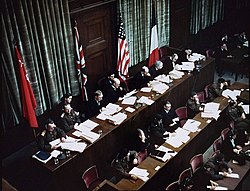
The Allies tried leading Nazi officials for crimes against peace, war crimes, and crimes against humanity. Twelve defendants received death sentences, and the trials established precedents for international criminal law.
Image source: Nuremberg trials
May 23, 1949
% complete
The Federal Republic of Germany was founded in the western zones, followed by the communist German Democratic Republic in October. The division of Germany became a central symbol of the Cold War until reunification in 1990.
Image source: History of Germany (1945–1990)
Or browse the full history timeline directory, with more than 2,000 topics.
This Nazi Germany timeline was generated with the help of AI, using information found on the internet.
We work hard to keep these timelines accurate, but mistakes do get through. If you spot one, email us at [email protected] and we'll fix it for future visitors.
Generate yours with AI or build it from scratch, for free.
Export your timeline, add your own events, edit or remove AI-generated events, and much more
No credit card required.
Cancel anytime.
Cancel anytime.
You can create an unlimited number of timelines with up to 10 events on each one, customize how they look, export them to PDF, PNG, PowerPoint, CSV, and Excel, and share them with a link. Paid plans raise the event limit and add features like spreadsheet imports and collaborators.
Yes. You can cancel your subscription from your account page at any time, and you will not be charged again. Your subscription stays active for the rest of the period you already paid for.
Yes. We will email you a reminder before the annual renewal, and we will also email you a receipt.
Yes. You can email us within 15 days of any payment, and we will issue you a full refund.
Check out our pricing docs or send us an email anytime: [email protected].