-
Use Cases
-
Resources
-
Pricing
Jun 9, 1815
The Congress of Vienna created the German Confederation, a loose association of 39 German states under Austrian presidency. Although it restored political fragmentation after the Napoleonic Wars, it also established a framework within which German nationalists and Prussian leaders later pursued unity.
Image source: Congress of Vienna
Jun 12, 1815
Student fraternities known as Burschenschaften emerged after the Napoleonic Wars and promoted constitutional government and German national unity. Their activities helped spread nationalist ideas among educated Germans, despite repression by the conservative authorities of the German Confederation.
Image source: Burschenschaft
Sep 20, 1819
The Carlsbad Decrees imposed censorship, restricted universities, and persecuted nationalist and liberal organizations across the German Confederation. Led by Austria's Klemens von Metternich, the measures delayed political unification while helping radicalize opposition to the existing order.
Image source: Carlsbad Decrees
May 27, 1832 - May 30, 1832
Thousands gathered at Hambach Castle in the Palatinate to demand civil liberties, constitutional government, and German national unity. The festival demonstrated the growing connection between liberalism and nationalism, although governments responded with renewed surveillance and repression.
Image source: Hambach Festival
Jan 1, 1834
The Zollverein created a customs union dominated by Prussia and removed many internal trade barriers among participating German states. It promoted economic integration, strengthened Prussia's influence, and gave practical substance to the idea of a unified Germany without Austrian participation.
Image source: Zollverein
May 18, 1848 - May 31, 1849
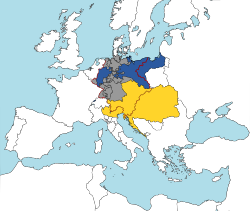
The Frankfurt Parliament, elected during the revolutions of 1848, met in St. Paul's Church to draft a constitution for a united Germany. It debated whether Austria should be included and ultimately favored a smaller Germany led by Prussia.
Image source: Frankfurt Parliament
Mar 28, 1849
The Frankfurt Parliament elected a constitutional German monarch and offered the imperial crown to Prussian King Frederick William IV. He rejected the offer, famously refusing a crown associated with popular revolution, causing the parliamentary unification project to collapse.
Mar 20, 1850 - Dec 1850
Prussia attempted to establish a federal German union excluding Austria through the Erfurt Union Parliament. The project received support from several northern and central German states but was abandoned after Austrian pressure and the diplomatic crisis known as the Punctation of Olmütz.
Nov 29, 1850
Under diplomatic and military pressure, Prussia agreed at Olmütz to abandon the Erfurt Union and revive the German Confederation under Austrian influence. The humiliation convinced many Prussian leaders that future German leadership would require military and administrative reform.
Jan 2, 1861
William I succeeded Frederick William IV as king of Prussia. His reign brought a more determined approach to army reform and eventually placed Otto von Bismarck in the position from which he would direct Prussia's campaign for German unification.
Image source: Wilhelm I
1862 - 1866
Despite opposition from the Prussian Landtag, Bismarck, War Minister Albrecht von Roon, and Chief of Staff Helmuth von Moltke expanded and modernized the army. Universal military service, improved organization, railways, and modern weapons gave Prussia the capacity to defeat Austria and France.
Image source: Prussian Army
Sep 23, 1862
William I appointed Otto von Bismarck minister-president of Prussia during a constitutional crisis over army reform. Bismarck pledged to resolve the major political questions of the age through blood and iron, using diplomacy, military power, and controlled nationalism.
Image source: Otto von Bismarck
Jul 1, 1867
The confederation's constitution established shared authority over foreign policy, defense, customs, and communications. Although member states retained internal governments, Prussia controlled the military and the federal presidency, making the confederation a major step toward national unity.
Jul 12, 1867
The North German Confederation united the states north of the Main under Prussian leadership. Its constitution made the Prussian king president and Bismarck chancellor, while a federal parliament and common institutions prepared the political structure of the later German Empire.
Image source: North German Confederation
Feb 12, 1868
The Customs Parliament included representatives from the southern German states alongside the North German Confederation. Its limited success demonstrated continuing economic links and gave nationalists a forum for encouraging eventual political union.
Feb 1, 1864 - Oct 30, 1864
Prussia and Austria jointly invaded Denmark over the duchies of Schleswig and Holstein. The war allowed Bismarck to present Prussia as a defender of German interests and created a territorial dispute that he later used to provoke conflict with Austria.
Image source: Second Schleswig War
Apr 18, 1864
Prussian forces captured the Danish fortifications at Dybbøl after a major assault. The victory broke Danish resistance in Schleswig and contributed to Denmark's acceptance of territorial losses in the Treaty of Vienna.
Image source: Battle of Dybbøl
Oct 30, 1864
Denmark ceded Schleswig, Holstein, and Lauenburg to Prussia and Austria. Prussia administered Schleswig while Austria administered Holstein, creating an arrangement that intensified rivalry between the two German powers.
Aug 14, 1865
The Gastein Convention assigned Schleswig to Prussia and Holstein to Austria while allowing Prussia to acquire Lauenburg. The compromise temporarily avoided war but left Bismarck with an issue he could exploit against Austria.
Image source: Gastein Convention
Apr 8, 1866
Prussia and Italy agreed to attack Austria if war began within three months. The alliance forced Austria to divide its military attention and gave the conflict a broader national dimension by promising Italy Venetia.
Image source: Austro-Prussian War
Jun 1, 1866
Prussia challenged Austria's administration of Holstein and proposed a national German parliament. Austria responded by bringing the dispute before the German Confederation, a move Bismarck treated as a violation of the 1865 arrangement and a justification for war.
Jun 14, 1866 - Aug 23, 1866
The Seven Weeks' War pitted Prussia and its allies against Austria and several northern and southern German states. Prussia's rapid mobilization, rail network, command structure, and needle gun enabled it to seek decisive victory before Austria could coordinate its forces.
Jul 3, 1866
At Königgrätz, also called Sadowa, the Prussian army decisively defeated Austria's forces in Bohemia. The victory established Prussia as the dominant German power and ended Austria's ability to control the political future of Germany.
Aug 23, 1866
The Treaty of Prague confirmed Austria's exclusion from German affairs and dissolved the German Confederation. Prussia annexed Schleswig-Holstein, Hanover, Hesse-Kassel, Nassau, and Frankfurt, creating a much stronger northern German state.
Image source: Peace of Prague (1866)
1868 - Jul 12, 1870
After Spain's 1868 revolution, diplomatic efforts sought a new monarch and considered the Hohenzollern prince Leopold. France feared encirclement by Hohenzollern rulers, while Bismarck recognized that the dispute could unite German states behind Prussia.
Jul 12, 1870
Leopold withdrew his candidacy for the Spanish throne under pressure from France and Prussia. French demands for permanent assurances that no Hohenzollern would ever become Spanish monarch prolonged the crisis and gave Bismarck an opportunity to sharpen the confrontation.
Image source: Leopold, Prince of Hohenzollern
Jul 13, 1870
Bismarck edited and published a report of King William I's meeting with the French ambassador at Bad Ems. The shortened wording made the exchange appear insulting to both sides, provoking French outrage and helping produce the war Bismarck believed would complete German unification.
Image source: Ems Dispatch
Jul 19, 1870 - May 10, 1871
France declared war on Prussia, but the conflict quickly became a German national war as the southern German states honored their military agreements with Prussia. The crisis transformed political support for unity into military cooperation among nearly all German states.
Image source: Franco-Prussian War
Aug 6, 1870
Prussian and allied German forces defeated the French Army of the Rhine at Wörth in Alsace. The victory opened the route into France and strengthened national enthusiasm among Germans who were now fighting under coordinated command.
Aug 16, 1870
German forces fought the French near Mars-la-Tour and prevented Marshal Bazaine's army from retreating toward Verdun. The engagement helped isolate the French Army of the Rhine at Metz and enabled Germany to maintain the initiative.
Aug 18, 1870
The largest battle of the Franco-Prussian War forced the French Army of the Rhine back into Metz. Its isolation culminated in the surrender of Marshal Bazaine's army, removing a major French force from the war.
Sep 1, 1870
German armies defeated the French at Sedan and captured Emperor Napoleon III. The disaster ended the Second French Empire, encouraged the proclamation of a French republic, and created the decisive military and political conditions for German imperial unification.
Image source: Battle of Sedan
1871 - 1878
After 1871, imperial institutions, military integration, legal standardization, and economic coordination gradually bound the German states together. Prussia remained dominant within the federation, while industrial growth and national politics helped transform unification into a durable European great power.
Jan 18, 1871
King William I of Prussia was proclaimed German Emperor in the Hall of Mirrors at the Palace of Versailles. The ceremony symbolized the unification of the German states under Prussian leadership, although the choice of Versailles also intensified French resentment.
Image source: Proclamation of the German Empire
Jan 18, 1871
Bavaria, Württemberg, Baden, and Hesse-Darmstadt entered the new German Empire through treaties concluded during and after the Franco-Prussian War. They retained some special privileges, but their integration completed the political unification of most German-speaking states.
Mar 21, 1871
Otto von Bismarck became the first chancellor of the German Empire after directing the diplomatic and military process of unification. He then focused on consolidating the new federal state, managing tensions between imperial institutions, Prussia, political parties, and the churches.
Image source: Chancellor of Germany
Apr 16, 1871
The constitution of the German Empire established a federal monarchy composed of the former German states. The Prussian king held the imperial title, Bismarck became imperial chancellor, and authority was divided among the emperor, Bundesrat, Reichstag, and state governments.
Image source: Constitution of the German Empire
May 10, 1871
The Treaty of Frankfurt formally ended the war between France and the German Empire. France ceded Alsace and part of Lorraine and paid a large indemnity, while German occupation continued until payment, leaving a lasting source of Franco-German hostility.
Image source: Treaty of Frankfurt (1871)
Or browse the full history timeline directory, with more than 2,500 topics.
This Unification of Germany timeline was generated with the help of AI, using information found on the internet.
We work hard to keep these timelines accurate, but mistakes do get through. If you spot one, email us at [email protected] and we'll fix it for future visitors.
Generate yours with AI or build it from scratch, for free.
Export your timeline, add your own events, edit or remove AI-generated events, and much more
No credit card required.
Cancel anytime.
Cancel anytime.
You can create an unlimited number of timelines with up to 10 events on each one, customize how they look, export them to PDF, PNG, PowerPoint, CSV, and Excel, and share them with a link. Paid plans raise the event limit and add features like spreadsheet imports and collaborators.
Yes. You can cancel your subscription from your account page at any time, and you will not be charged again. Your subscription stays active for the rest of the period you already paid for.
Yes. We will email you a reminder before the annual renewal, and we will also email you a receipt.
Yes. You can email us within 15 days of any payment, and we will issue you a full refund.
Check out our pricing docs or send us an email anytime: [email protected].