-
Use Cases
-
Resources
-
Pricing
The Reunification of Germany refers to the process by which the German Democratic Republic (East Germany) joined the Federal Republic of Germany (West Germany), ending over four decades of division following World War II. Sparked by the peaceful revolution in East Germany and the fall of the Berlin Wall in November 1989, reunification was completed on October 3, 1990. More Less
Feb 4, 1945 - Feb 11, 1945
% complete
Roosevelt, Churchill, and Stalin met at Yalta to plan postwar Europe. They agreed that defeated Germany would be divided into occupation zones controlled by the United States, Britain, France, and the Soviet Union, laying the groundwork for the eventual division of the country.
Image source: Yalta Conference
May 8, 1945
% complete
Following Germany's unconditional surrender in World War II, Allied forces took control of German territory. The country was administered by the four occupying powers, with each zone governed according to its occupier's policies, beginning decades of division.
Image source: Allied-occupied Germany
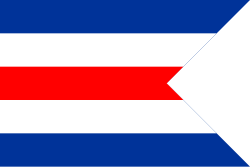
Jul 17, 1945 - Aug 2, 1945
% complete
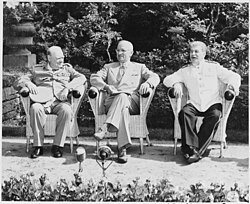
Truman, Stalin, and Churchill (later Attlee) met at Potsdam to finalize plans for occupied Germany. Germany was divided into four occupation zones, Berlin was similarly split, and principles of denazification, demilitarization, and decentralization were established.
Image source: Potsdam Conference
May 23, 1949
% complete
The Federal Republic of Germany was formally established from the three western occupation zones, with Bonn as its provisional capital. Its democratic constitution, the Basic Law, laid the foundation for a parliamentary democracy aligned with the West.
Image source: West Germany
Oct 7, 1949
% complete
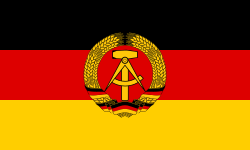
The Soviet zone became the German Democratic Republic, a socialist state under the leadership of the Socialist Unity Party. The founding cemented the division of Germany into two separate states with opposing political and economic systems.
Image source: East Germany
Aug 13, 1961
% complete
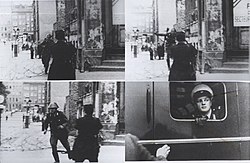
Overnight, East German forces sealed the border between East and West Berlin, beginning construction of the Berlin Wall. The barrier physically divided the city and became the starkest symbol of the Cold War and Germany's partition.
Image source: Berlin Wall
Jun 24, 1948 - May 12, 1949
% complete
The Soviet Union blocked all land and water routes to West Berlin in response to Western currency reforms. The Western Allies responded with the Berlin Airlift, supplying the city by air for nearly a year until Stalin lifted the blockade, deepening East-West divisions.
Image source: Berlin Blockade
May 6, 1955
% complete
West Germany's accession to NATO marked its full integration into the Western alliance system and its remilitarization. In response, the Soviet Union formed the Warsaw Pact days later, entrenching the military division of Europe.
Sep 14, 1955
% complete
West Germany declared it would not maintain diplomatic relations with any state that recognized East Germany, asserting the FRG as the sole legitimate representative of the German people. The doctrine shaped West German foreign policy for nearly two decades.
Image source: Hallstein Doctrine
Nov 1956
% complete
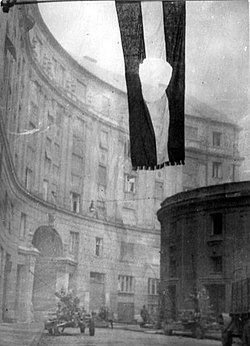
After Soviet forces crushed the Hungarian Revolution, roughly 200,000 Hungarians fled westward, many through Austria to West Germany. The crisis highlighted the desire for freedom in Eastern Europe and increased pressure on the GDR to stop its own citizens from leaving.
Image source: Hungarian Revolution of 1956
Nov 27, 1958
% complete
Soviet leader Nikita Khrushchev demanded that the Western powers withdraw from West Berlin within six months or he would sign a separate peace treaty with East Germany. The ultimatum triggered the first major Berlin crisis of the Cold War.
Image source: Berlin Crisis of 1958–1959
Jan 1961 - Aug 1961
% complete
Throughout the 1950s and peaking in 1961, millions of East Germans fled to the West, many via West Berlin. The brain drain threatened the economic viability of the GDR, prompting its government to seek drastic measures to seal the border.
Image source: Emigration from the Eastern Bloc
Dec 21, 1972
% complete
Under Chancellor Willy Brandt's Ostpolitik, West and East Germany signed the Basic Treaty, recognizing each other's existence while maintaining claims to eventual unity. Both states joined the United Nations the following year.
Sep 18, 1973
% complete
Following the Basic Treaty, the Federal Republic and the Democratic Republic were simultaneously admitted to the UN, formalizing their coexistence on the international stage even as both officially professed the goal of German unity.
Image source: United Nations
Aug 1, 1975
% complete
The Conference on Security and Co-operation in Europe produced the Helsinki Final Act, which included commitments to human rights. These provisions later empowered dissident movements across Eastern Europe, including in East Germany.
Image source: Helsinki Accords
Aug 31, 1980
% complete
The independent trade union Solidarity was founded at the Gdańsk Shipyard, becoming the first non-communist trade union in the Eastern Bloc. Its success inspired opposition movements throughout the region, including East German dissidents.
Mar 11, 1985
% complete
Gorbachev's rise to General Secretary ushered in reforms of glasnost and perestroika. His refusal to prop up hardline regimes in Eastern Europe fundamentally altered the dynamics that had kept Germany divided.
Image source: Mikhail Gorbachev
Jun 12, 1987
% complete
President Ronald Reagan delivered his famous speech at the Brandenburg Gate in West Berlin, challenging Gorbachev to dismantle the Berlin Wall. The speech became an iconic moment in the campaign for freedom in Eastern Europe.
Image source: Tear down this wall!
Jun 27, 1989
% complete
Austrian Foreign Minister Alois Mock and Hungarian counterpart Gyula Horn symbolically cut the border fence between their countries. The opening allowed thousands of East Germans to flee to the West via Hungary, accelerating the collapse of the GDR.
Image source: Pan-European Picnic
Aug 19, 1989
% complete
Hundreds of East Germans seized the opportunity of a peace demonstration at the Austro-Hungarian border to escape to the West. The event is considered a pivotal milestone in the fall of the Iron Curtain.
Sep 25, 1989
% complete
Weekly peaceful protests after Monday prayers at Leipzig's Nikolaikirche grew into mass demonstrations demanding freedom and democracy. The chant 'Wir sind das Volk' (We are the people) became the rallying cry of the Peaceful Revolution.
Image source: Monday demonstrations in East Germany
Oct 18, 1989
% complete
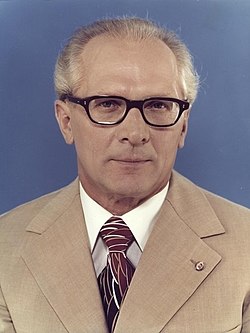
Under mounting pressure from protests and mass emigration, the East German Politburo removed longtime leader Erich Honecker, replacing him with Egon Krenz. The change failed to stem the revolutionary tide sweeping the country.
Image source: Erich Honecker
Nov 9, 1989
% complete
After a botched press conference announcing relaxed travel rules, crowds surged to crossing points and overwhelmed border guards, who opened the gates. Jubilant Berliners danced atop the wall, marking the symbolic end of Germany's division.
Image source: Fall of the Berlin Wall
Nov 28, 1989
% complete
Without consulting allies, Helmut Kohl unveiled a ten-point program for overcoming Germany's division, culminating in confederation and eventual reunification. The plan set the agenda for the dramatic months ahead.
Image source: Helmut Kohl
Dec 2, 1989 - Dec 3, 1989
% complete
President George H. W. Bush and Mikhail Gorbachev met off Malta and effectively declared the Cold War over. The summit cleared the diplomatic path for negotiations over German reunification.
Image source: Malta Summit
Feb 10, 1990
% complete
In Moscow, Chancellor Kohl secured Gorbachev's acknowledgment that German reunification was a matter for the Germans themselves to decide, removing the principal external obstacle to unification.
Image source: German reunification
Mar 13, 1990 - Sep 12, 1990
% complete
The two German states and the four former occupying powers negotiated the external aspects of reunification. The resulting Treaty on the Final Settlement granted Germany full sovereignty and settled borders and military questions.
Image source: Treaty on the Final Settlement with Respect to Germany
Mar 18, 1990
% complete
East Germans voted in the first free multiparty elections in the GDR's history. Parties favoring swift reunification won decisively, giving the new government a clear mandate to negotiate accession to the Federal Republic.
Image source: 1990 East German general election
Jul 1, 1990
% complete
The Deutsche Mark replaced the East German mark as the currency of the GDR, uniting the two economies. The monetary union, agreed in May 1990, was a crucial step toward full political unification.
Aug 23, 1990
% complete
The Volkskammer of East Germany voted for accession to the Federal Republic effective October 3, and the Bundestag ratified the Unification Treaty shortly thereafter, setting the legal machinery of unification in motion.
Sep 12, 1990
% complete
The two German states plus the US, UK, France, and USSR signed the 'Two Plus Four Treaty,' granting united Germany full sovereignty, confirming the Oder-Neisse border with Poland, and clearing the last international hurdle to reunification.
Oct 3, 1990
% complete
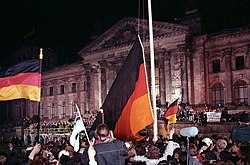
At midnight, East Germany formally acceded to the Federal Republic under Article 23 of the Basic Law. Germany regained full sovereignty, October 3 became German Unity Day, and celebrations were held across the newly unified nation.
Image source: German Unity Day
Dec 2, 1990
% complete
Voters across unified Germany went to the polls for the first time since Weimar-era elections. Helmut Kohl's coalition won comfortably, providing political continuity during the challenging integration of East and West.
Image source: 1990 German federal election
Aug 31, 1994
% complete
With a farewell ceremony in Berlin attended by President Yeltsin and Chancellor Kohl, the final units of the former Soviet army withdrew from German soil, completing the end of the Allied occupation era.
Or browse the full history timeline directory, with more than 2,000 topics.
This Reunification of Germany timeline was generated with the help of AI, using information found on the internet.
We work hard to keep these timelines accurate, but mistakes do get through. If you spot one, email us at [email protected] and we'll fix it for future visitors.
Generate yours with AI or build it from scratch, for free.
Export your timeline, add your own events, edit or remove AI-generated events, and much more
No credit card required.
Cancel anytime.
Cancel anytime.
You can create an unlimited number of timelines with up to 10 events on each one, customize how they look, export them to PDF, PNG, PowerPoint, CSV, and Excel, and share them with a link. Paid plans raise the event limit and add features like spreadsheet imports and collaborators.
Yes. You can cancel your subscription from your account page at any time, and you will not be charged again. Your subscription stays active for the rest of the period you already paid for.
Yes. We will email you a reminder before the annual renewal, and we will also email you a receipt.
Yes. You can email us within 15 days of any payment, and we will issue you a full refund.
Check out our pricing docs or send us an email anytime: [email protected].