-
Use Cases
-
Resources
-
Pricing
The Fall of the Soviet Union marks the collapse of the world's largest communist state, driven by economic stagnation, political reforms under Mikhail Gorbachev, rising nationalist movements in Soviet republics, and the failed August 1991 coup. The process culminated on December 26, 1991, when the USSR was formally dissolved and replaced by independent republics, ending the Cold War era. More Less
Dec 24, 1979 - Feb 15, 1989
% complete
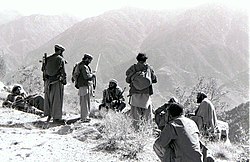
The Soviet Union invaded Afghanistan to support the communist government against mujahideen insurgents. The costly decade-long war killed tens of thousands of Soviet soldiers, damaged the economy, and became a symbol of Soviet overreach, accelerating the decline of the state.
Image source: Soviet–Afghan War
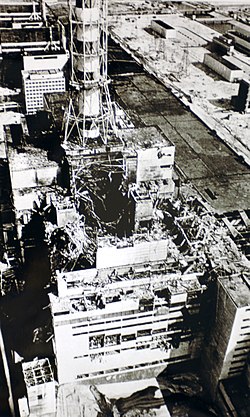
Apr 26, 1986
% complete
A reactor explosion at the Chernobyl nuclear plant in Ukraine released massive radiation across Europe. The government's slow, secretive response eroded public trust, exposed systemic failures, cost billions to clean up, and emboldened Gorbachev's policy of openness about the state's problems.
Image source: Chernobyl disaster
May 15, 1988 - Feb 15, 1989
% complete
Under the Geneva Accords, the Soviet Union began withdrawing its troops from Afghanistan, completing the pullout in February 1989. The humiliating exit after nearly a decade of war further weakened the prestige of the Soviet military and the Communist Party at home.
Image source: Soviet withdrawal from Afghanistan
Aug 31, 1980
% complete
Following strikes at the Gdańsk shipyard led by Lech Wałęsa, the independent trade union Solidarity was formed in Poland. It grew into a mass anti-communist movement of millions, challenging Soviet control over Eastern Europe and inspiring dissent across the Eastern Bloc.
Dec 13, 1981 - Jul 22, 1983
% complete
General Wojciech Jaruzelski declared martial law in Poland to crush the Solidarity movement, arresting thousands of activists. Although Solidarity was driven underground, it survived and re-emerged later, demonstrating the fragility of communist authority in Eastern Europe.
Image source: Martial law in Poland
Feb 6, 1989 - Apr 5, 1989
% complete
Negotiations between Poland's communist government and the banned Solidarity movement produced agreements legalizing Solidarity and allowing partially free elections. The talks opened the door to the peaceful end of communism in Poland and set a precedent for the rest of Eastern Europe.
Image source: Polish Round Table Agreement
Jun 4, 1989 - Jun 18, 1989
% complete
In Poland's first semi-free elections since World War II, Solidarity candidates won a landslide victory, capturing all available seats. The communist government collapsed peacefully, and Tadeusz Mazowiecki became the first non-communist prime minister in the Eastern Bloc.
Image source: 1989 Polish parliamentary election
Aug 19, 1989
% complete
Hundreds of East German citizens crossed from Hungary into Austria during a peace demonstration at the border near Sopron. The event demonstrated that the Iron Curtain was dissolving and encouraged mass emigration of East Germans through Hungary, hastening the fall of the Berlin Wall.
Image source: Pan-European Picnic
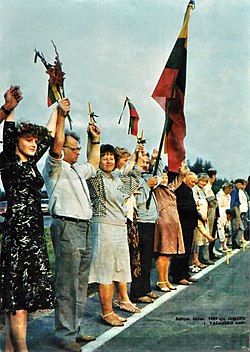
Aug 23, 1989
% complete
Around two million people joined hands in a 600-kilometer human chain spanning Estonia, Latvia, and Lithuania on the 50th anniversary of the Molotov-Ribbentrop Pact. The unprecedented demonstration demanded independence for the Baltic states and drew worldwide attention to their cause.
Image source: Baltic Way
Sep 11, 1989
% complete
Hungary officially opened its border with Austria, allowing thousands of East German refugees to flee to the West. This breach of the Iron Curtain made the Berlin Wall effectively obsolete and accelerated the collapse of communist regimes across Eastern Europe.
Image source: Removal of Hungary's border fence with Austria
Nov 9, 1989
% complete
After weeks of mass protests in East Germany, the government announced relaxed travel restrictions, and crowds surged through checkpoints in Berlin. Jubilant Germans dismantled the wall by hand, symbolizing the collapse of communist control in Eastern Europe and the division of Europe itself.
Image source: Fall of the Berlin Wall
Nov 17, 1989 - Dec 29, 1989
% complete
Peaceful student protests in Prague escalated into nationwide demonstrations against the communist regime. Within weeks, the government capitulated without violence, and playwright Václav Havel was elected president, completing Czechoslovakia's transition to democracy.
Image source: Velvet Revolution
Nov 10, 1982
% complete
Leonid Brezhnev died after 18 years in power, leaving behind a stagnant economy, gerontocratic leadership, and widespread public cynicism. His death began a rapid succession of aging leaders — Yuri Andropov and Konstantin Chernenko — before reform finally arrived with Gorbachev.
Image source: Death and state funeral of Leonid Brezhnev
Mar 11, 1985
% complete
Mikhail Gorbachev was elected General Secretary of the Communist Party after the deaths of three elderly leaders in quick succession. Recognizing the severity of the USSR's economic problems, he launched a program of radical reforms intended to revitalize socialism but which ultimately unraveled the Soviet system.
Image source: Mikhail Gorbachev
Oct 11, 1986 - Oct 12, 1986
% complete
Ronald Reagan and Mikhail Gorbachev met in Iceland to discuss sweeping nuclear arms reductions. Though the summit ended without agreement, it marked a dramatic thaw in Cold War tensions and signaled Gorbachev's willingness to reduce military spending that burdened the Soviet economy.
Image source: Reykjavík Summit
Dec 8, 1987
% complete
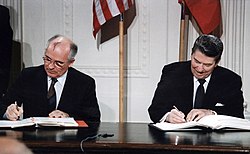
Gorbachev and Reagan signed the Intermediate-Range Nuclear Forces Treaty in Washington, eliminating an entire class of nuclear missiles. The treaty marked a major de-escalation of the Cold War and reflected Gorbachev's priority of easing defense burdens on the struggling Soviet economy.
Image source: Intermediate-Range Nuclear Forces Treaty
Feb 20, 1988
% complete
Ethnic Armenians in Nagorno-Karabakh voted to join Armenia, triggering violence between Armenians and Azerbaijanis. The conflict was the first major interethnic clash under glasnost, revealing how liberalization unleashed nationalist forces that Moscow could no longer contain.
Image source: First Nagorno-Karabakh War
Dec 2, 1989 - Dec 3, 1989
% complete
George H. W. Bush and Mikhail Gorbachev met off Malta and declared the Cold War effectively over. Gorbachev pledged not to intervene in Eastern Europe, confirming Soviet acceptance of the region's democratic revolutions and marking a new era of superpower cooperation.
Image source: Malta Summit
Mar 13, 1990
% complete
The Congress of People's Deputies amended the Soviet constitution to remove Article 6, ending the Communist Party's constitutionally guaranteed monopoly on power. Multi-party politics became legal, fundamentally undermining the party's control over the Soviet state.
Image source: 1977 Constitution of the Soviet Union
Mar 15, 1990
% complete
The Congress of People's Deputies elected Mikhail Gorbachev as the first and only President of the Soviet Union. The new executive presidency was intended to stabilize his authority amid growing challenges from both hardline communists and republican separatists.
Image source: President of the Soviet Union
Mar 17, 1991
% complete
In the first-ever nationwide referendum in the USSR, a majority of voters in nine participating republics supported preserving a renewed union. However, six republics boycotted the vote, and the result could not halt the momentum toward full dissolution.
Image source: 1991 Soviet Union referendum
Aug 15, 1991
% complete
Drafting of the New Union Treaty, meant to transform the USSR into a loose confederation of sovereign republics, neared completion for signing on August 20, 1991. Hardline communists viewed the treaty as the final destruction of the Soviet state and moved to act against it.
Image source: New Union Treaty
Mar 11, 1990
% complete
Lithuania became the first Soviet republic to formally declare independence from the USSR. Moscow responded with an economic blockade and later military force, but Lithuania's bold move inspired other republics to pursue sovereignty and secession.
Image source: Act of the Re-Establishment of the State of Lithuania
Jun 12, 1990
% complete
The Russian SFSR, the largest Soviet republic, declared that its laws took precedence over Soviet laws. Led by Boris Yeltsin, Russia's assertion of sovereignty fatally undermined the central Soviet government and is now commemorated as Russia Day.
Oct 3, 1990
% complete
East Germany acceded to West Germany, reunifying the country less than a year after the fall of the Berlin Wall. The unification of Germany within NATO was a profound geopolitical defeat for the Soviet Union and a milestone in ending the postwar division of Europe.
Image source: German reunification
Jan 13, 1991
% complete
Soviet troops stormed the television tower and other facilities in Vilnius, killing 14 civilians and injuring hundreds. The violent crackdown failed to stop the Baltic independence movements and instead galvanized international condemnation and local resistance.
Image source: January Events
Aug 19, 1991 - Aug 21, 1991
% complete
Hardline communists, including KGB chief Vladimir Kryuchkov, detained Gorbachev at his Crimean dacha and attempted to seize power to prevent the New Union Treaty. Mass resistance led by Boris Yeltsin in Moscow defeated the coup within three days, but the episode destroyed the credibility of the central government and the Communist Party.
Image source: 1991 Soviet coup d'état attempt
Aug 23, 1991
% complete
Following the failed coup, Boris Yeltsin suspended and then outlawed the Communist Party of the Soviet Union in Russia, seizing its assets. Gorbachev resigned as General Secretary days later, stripping the party that had ruled the USSR for decades of all power.
Image source: Boris Yeltsin
Aug 24, 1991
% complete
Ukraine's parliament declared independence in the wake of the August coup. In a December referendum, over 90 percent of Ukrainians approved secession, and Ukraine's departure removed any realistic possibility of preserving a meaningful Soviet union.
Image source: Declaration of Independence of Ukraine
Dec 8, 1991
% complete
Leaders of Russia, Ukraine, and Belarus met in Belovezha Forest and declared the Soviet Union ceased to exist, establishing the Commonwealth of Independent States in its place. The accord formally dissolved the USSR and was ratified by most remaining republics shortly afterward.
Image source: Belovezha Accords
Dec 21, 1991
% complete
Eleven former Soviet republics signed the Alma-Ata Protocol, formally joining the Commonwealth of Independent States and recognizing the end of the USSR. The CIS provided a framework for coordinating economic and security matters among the successor states.
Image source: Commonwealth of Independent States
Dec 25, 1991
% complete
In a televised address, Mikhail Gorbachev resigned as President of the Soviet Union, transferring control of nuclear weapons to Boris Yeltsin of Russia. That evening the hammer-and-sickle flag was lowered from the Kremlin, ending nearly 70 years of Soviet rule.
Image source: Mikhail Gorbachev
Or browse the full history timeline directory, with more than 2,000 topics.
This Fall of the Soviet Union timeline was generated with the help of AI, using information found on the internet.
We work hard to keep these timelines accurate, but mistakes do get through. If you spot one, email us at [email protected] and we'll fix it for future visitors.
Generate yours with AI or build it from scratch, for free.
Export your timeline, add your own events, edit or remove AI-generated events, and much more
No credit card required.
Cancel anytime.
Cancel anytime.
You can create an unlimited number of timelines with up to 10 events on each one, customize how they look, export them to PDF, PNG, PowerPoint, CSV, and Excel, and share them with a link. Paid plans raise the event limit and add features like spreadsheet imports and collaborators.
Yes. You can cancel your subscription from your account page at any time, and you will not be charged again. Your subscription stays active for the rest of the period you already paid for.
Yes. We will email you a reminder before the annual renewal, and we will also email you a receipt.
Yes. You can email us within 15 days of any payment, and we will issue you a full refund.
Check out our pricing docs or send us an email anytime: [email protected].