-
Use Cases
-
Resources
-
Pricing
Niagara Falls is a group of three waterfalls—Horseshoe Falls, American Falls, and Bridal Veil Falls—located on the border between the United States and Canada. Formed at the end of the last Ice Age, the falls have evolved from a sacred site for Indigenous peoples into a center of hydroelectric power, industrial innovation, and one of the most visited tourist attractions in the world. More Less
1000
% complete
Long before European contact, Indigenous peoples including the Iroquois (Haudenosaunee), Neutral Nation, and Ongiara inhabited the Niagara region. The name 'Niagara' is believed to derive from an Iroquoian word meaning 'neck' or 'thunder of waters,' reflecting the falls' spiritual significance as a place of power and ceremony.
Image source: Iroquois
1615
% complete
French explorer Étienne Brûlé is widely credited with being the first European to witness Niagara Falls around 1615, while traveling with Huron peoples. His sighting introduced the natural wonder to European knowledge, though his accounts were largely undocumented.
Image source: Étienne Brûlé
Dec 1678
% complete
Belgian priest Father Louis Hennepin visited Niagara Falls in December 1678 and provided the first detailed written and illustrated description of the falls in Europe. His 1683 book 'A New Discovery of a Vast Country in America' brought international fame to Niagara Falls and sparked centuries of fascination with the site.
Image source: Louis Hennepin
Jul 1759
% complete
British forces captured Fort Niagara from the French in July 1759 after a lengthy siege, shifting control of the strategic Niagara region from France to Britain. The fort's position near the falls made it a crucial military and trading post throughout colonial conflicts.
Image source: Battle of Fort Niagara
1812 - 1814
% complete
The Niagara River corridor became one of the most contested battlegrounds of the War of 1812 between the United States and Britain. Major engagements including the Battle of Queenston Heights, Battle of Chippawa, and Battle of Lundy's Lane occurred within sight or sound of the falls, devastating local communities.
Image source: Niagara Frontier
1830 - 1860
% complete
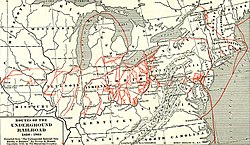
Before the Civil War, freedom seekers escaping slavery crossed the Niagara River into Canada, where slavery had been abolished. Harriet Tubman and other conductors guided many through this region, making Niagara an important terminus of the Underground Railroad.
Image source: Underground Railroad
1883
% complete
During harsh winters of the late 1800s, massive ice chunks accumulated below the falls forming an 'ice bridge' where vendors sold whiskey and visitors strolled between countries. Tragedy struck in February 1912 when the ice broke apart, killing three people, leading authorities to ban access to the frozen river.
Image source: Ice bridge
1804
% complete
After Napoleon Bonaparte's brother Jerome visited the falls with his American bride in 1804, Niagara Falls gained a reputation as a premier romantic destination. By the mid-19th century it had become the honeymoon capital of the world, a title it still holds today with millions of couples visiting each year.
Image source: Niagara Falls
1822
% complete
In the early 1820s, entrepreneurs recognized Niagara Falls' potential as a tourist destination and began constructing hotels and viewing areas on both the American and Canadian sides. The completion of the Erie Canal in 1825 dramatically increased visitor traffic, transforming the remote wilderness into a thriving resort area.
1846
% complete
The Maid of the Mist began as a ferry service across the Niagara River in 1846 and evolved into one of North America's oldest tourist attractions. Generations of visitors have donned rain ponchos to experience the thunderous mist at the base of the falls aboard these iconic boats.
Image source: Maid of the Mist
Jun 30, 1859
% complete
French acrobat Jean François Gravelet, known as 'The Great Blondin,' crossed the Niagara Gorge on a tightrope on June 30, 1859, thrilling crowds of thousands. He performed the crossing numerous times, once carrying his manager on his back, igniting an era of daredevil stunts at the falls.
Image source: Charles Blondin
Jul 1876
% complete
Italian aerialist Maria Spelterini became the first and only woman to cross the Niagara Gorge on a tightrope in July 1876. She made several crossings, including one wearing peach baskets on her feet and another blindfolded, cementing her place in Niagara daredevil history.
Image source: Maria Spelterini
1889
% complete
Beginning as the original 'Behind the Sheet' tunnel attraction in 1889, Journey Behind the Falls allows visitors to descend deep into the bedrock and stand in observation portals directly beside the thundering Horseshoe Falls. It remains one of Niagara's signature experiences.
Image source: Journey Behind the Falls
Oct 24, 1901
% complete
On October 24, 1901, 63-year-old schoolteacher Annie Edson Taylor became the first person to survive going over Niagara Falls in a barrel. Seeking fame and financial security, she plunged over the Horseshoe Falls and emerged battered but alive, launching the tradition of daredevils attempting to conquer the falls.
Image source: Annie Edson Taylor
Jul 25, 1911
% complete
Englishman Bobby Leach went over the Horseshoe Falls in a steel barrel on July 25, 1911, becoming the second person to survive such a plunge. Despite breaking both kneecaps and his jaw, he recovered and toured the world recounting his daring feat.
Image source: Bobby Leach
1925
% complete
Nightly illumination of Niagara Falls began in 1925 using powerful searchlights, transforming the falls into a glowing spectacle after dark. Modern LED systems installed decades later allow dynamic color displays, making the illuminated falls a beloved evening tradition for millions of visitors.
Image source: The Amazing Race Canada 10
1926
% complete
The Table Rock complex opened near the crest of the Horseshoe Falls, providing visitors with close-up views and access to tunnels behind the falls. It has been rebuilt multiple times and remains one of the most popular observation points on the Canadian side.
Image source: Table Rock Welcome Centre
Sep 1938
% complete
A fierce September 1938 storm demolished much of the Cave of the Winds wooden walkway at the base of Bridal Veil Falls. The popular attraction, which took visitors within feet of the cascading water, was rebuilt and continues to thrill visitors with its Hurricane Deck experience.
Image source: Cave of the Winds (New York)
Nov 1, 1941
% complete
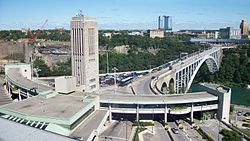
The Rainbow Bridge officially opened on November 1, 1941, replacing the collapsed Honeymoon Bridge as the principal crossing between Niagara Falls, New York, and Niagara Falls, Ontario. Its elegant arch design offers spectacular views and remains a vital border crossing today.
Image source: Rainbow Bridge (Niagara Falls)
Oct 6, 1965
% complete
The Skylon Tower opened on October 6, 1965, rising 775 feet above the Canadian falls district. Its revolving dining room and observation decks offered unprecedented panoramic views of both the Horseshoe and American falls, becoming a landmark of the Niagara skyline.
Image source: Skylon Tower
Jun 15, 2012
% complete
Aerialist Nik Wallenda fulfilled his family's century-old dream by walking a tightrope across the Niagara Gorge directly over the falls on June 15, 2012. After legal changes allowing the stunt for the first time since 1896, he crossed from the US side to Canada on live television before 100,000 spectators.
Image source: Nik Wallenda
1869
% complete
Led by landscape architect Frederick Law Olmsted and artist Frederick Edwin Church, the Free Niagara movement campaigned against the mills, factories, and fences that had commercialized the falls. Their efforts led to New York creating the Niagara Reservation at Niagara Falls in 1885, the oldest state park in the United States.
Image source: Frederick Law Olmsted
Jul 15, 1885
% complete
New York State dedicated the Niagara Reservation on July 15, 1885, restoring public access to Prospect Point, Goat Island, and other key vantage points around the American falls. Designed by Frederick Law Olmsted and Calvert Vaux, it set a precedent for preserving natural wonders for public enjoyment.
Image source: Niagara Falls State Park
May 20, 1887
% complete
Ontario created Queen Victoria Niagara Falls Park in 1887 to preserve the Canadian side of the falls from uncontrolled commercial development. The park protected the riverbank along the Horseshoe Falls and eventually became home to beautiful gardens and prime views of the falls.
Image source: Queen Victoria Park
1950
% complete
Growing concerns about erosion and water diversion led to the 1950 Niagara Treaty between the United States and Canada, which regulated how much water could be diverted for hydroelectric generation. The treaty guaranteed minimum flows over the falls during daylight hours in summer to preserve their scenic beauty.
Image source: Boundary Waters Treaty of 1909
Jun 1969 - Nov 1969
% complete
From June to November 1969, engineers temporarily diverted the American Falls by constructing a temporary dam, exposing the riverbed for the first time in 12,000 years. A U.S.-Canada commission studied whether to restore the deteriorating falls permanently, ultimately deciding that nature should take its course.
Image source: American Falls
1982
% complete
Recognition of Niagara Falls' cultural and natural heritage grew in the late 20th century as both nations strengthened protections for the surrounding parks and historic sites. Ongoing binational cooperation through bodies like the International Joint Commission ensures the falls remain preserved for future generations.
1895
% complete
The Schoellkopf Hydraulic Power Company opened a large hydroelectric station just below the American falls in 1895, transmitting electricity to nearby industries. This marked the beginning of large-scale hydropower development at Niagara, attracting electrochemical and electrometallurgical companies to the region.
Image source: Schoellkopf Power Station
Nov 16, 1896
% complete
Using alternating current technology developed by Nikola Tesla and George Westinghouse, the Edward Dean Adams power station successfully transmitted electricity from Niagara Falls to Buffalo on November 16, 1896. This achievement proved the viability of long-distance AC transmission and electrified the industrial age.
Image source: Adams Power Plant Transformer House
Jan 12, 1897
% complete
Following the success of the Westinghouse-Tesla alternating current system at Niagara Falls, Tesla was celebrated for winning the 'war of the currents.' His polyphase system became the worldwide standard for electrical power generation and distribution, with Niagara serving as its proving ground.
Image source: War of the currents
Jan 27, 1938
% complete
The Upper Steel Arch Bridge, known as the Honeymoon Bridge, collapsed on January 27, 1938, after ice jams in the Niagara River stressed its structure beyond endurance. No one was injured, and the Rainbow Bridge was later built upstream as its replacement.
Image source: Honeymoon Bridge (Niagara Falls)
1954
% complete
Canada completed the Sir Adam Beck II generating station in 1954, expanding its capacity to harness Niagara's flow on the Ontario side. Together with the earlier Sir Adam Beck I station completed in 1922, these plants made Ontario Hydro a major supplier of electric power to the province.
Image source: Sir Adam Beck Hydroelectric Generating Stations
1961
% complete
The Robert Moses Niagara Power Plant began full operation in 1961, becoming one of the largest hydroelectric facilities in the Western world. Located downstream of the falls, it diverts water through massive tunnels to generate clean electricity for millions of people in New York State.
Image source: Robert Moses Niagara Power Plant
Or browse the full history timeline directory, with more than 2,000 topics.
This History of Niagara Falls timeline was generated with the help of AI, using information found on the internet.
We work hard to keep these timelines accurate, but mistakes do get through. If you spot one, email us at [email protected] and we'll fix it for future visitors.
Generate yours with AI or build it from scratch, for free.
Export your timeline, add your own events, edit or remove AI-generated events, and much more
No credit card required.
Cancel anytime.
Cancel anytime.
You can create an unlimited number of timelines with up to 10 events on each one, customize how they look, export them to PDF, PNG, PowerPoint, CSV, and Excel, and share them with a link. Paid plans raise the event limit and add features like spreadsheet imports and collaborators.
Yes. You can cancel your subscription from your account page at any time, and you will not be charged again. Your subscription stays active for the rest of the period you already paid for.
Yes. We will email you a reminder before the annual renewal, and we will also email you a receipt.
Yes. You can email us within 15 days of any payment, and we will issue you a full refund.
Check out our pricing docs or send us an email anytime: [email protected].