-
Use Cases
-
Resources
-
Pricing
The European Union (EU) is a political and economic union of European countries founded on the principles of cooperation, shared institutions, and a common market. Emerging from post-World War II efforts to ensure peace in Europe, it evolved from the European Coal and Steel Community into a powerful bloc with its own currency, parliament, and policies affecting trade, migration, and law across member states. More Less
May 9, 1950
% complete
French Foreign Minister Robert Schuman proposed pooling French and West German coal and steel production under a common authority, laying the ideological foundation for European integration. May 9 is now celebrated annually as Europe Day.
Apr 18, 1951
% complete
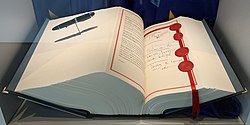
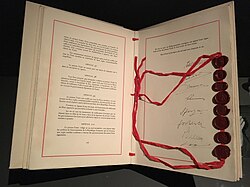
Six countries—Belgium, France, West Germany, Italy, Luxembourg, and the Netherlands—signed the Treaty of Paris, creating the European Coal and Steel Community, the first supranational organization in Europe and the precursor to the EU.
Image source: Treaty of Paris (1951)
Jul 23, 1952
% complete
The ECSC formally came into being with Jean Monnet as its first president, creating a common market for coal and steel among the six founding member states and proving that supranational cooperation was workable.
Image source: European Coal and Steel Community
Mar 25, 1957
% complete
The six founding members signed the Treaties of Rome, establishing the European Economic Community (EEC) and Euratom, aiming to create a common market and progressively harmonize economic policies across Western Europe.
Image source: Treaty of Rome
Jan 1, 1962
% complete
The EEC introduced its Common Agricultural Policy, providing subsidies and guaranteed prices for farmers. It became one of the most significant and costly policies of European integration, ensuring food security and rural incomes.
Jul 1, 1967
% complete
The Merger Treaty combined the executives of the ECSC, EEC, and Euratom into a single institutional structure, streamlining decision-making and creating a unified Commission and Council for the European Communities.
Jan 1, 1973
% complete
The United Kingdom, Ireland, and Denmark joined the European Communities, expanding membership from six to nine states and marking the first wave of enlargement beyond the original founding members.
Image source: 1973 enlargement of the European Communities
Jan 1, 1981
% complete
Greece became the tenth member of the European Communities, its accession seen as cementing the country's return to democracy after the fall of the military junta in 1974.
Image source: 1981 enlargement of the European Communities
Jan 1, 1986
% complete
Spain and Portugal acceded to the Communities following their transitions from dictatorship to democracy, bringing membership to twelve states and extending the Community across the Iberian Peninsula.
Image source: 1986 enlargement of the European Communities
Nov 9, 1989
% complete
The collapse of the Berlin Wall symbolized the end of the Cold War division of Europe, opening the way for the reunification of Germany and eventually the EU's eastern enlargement.
Image source: Fall of the Berlin Wall
Oct 3, 1990
% complete
East and West Germany were reunified, with the former East German territory joining the European Communities as part of a united Germany, dramatically increasing the bloc's population and economic weight.
Image source: German reunification
Jan 1, 1995
% complete
Three neutral Nordic and Alpine states joined the EU, bringing membership to fifteen and strengthening the union's presence in northern Europe.
Image source: 1995 enlargement of the European Union
May 1, 2004
% complete
Ten countries, mostly former communist states of Central and Eastern Europe plus Cyprus and Malta, joined the EU simultaneously—the largest single enlargement in its history, raising membership to twenty-five.
Image source: 2004 enlargement of the European Union
Jan 1, 2007
% complete
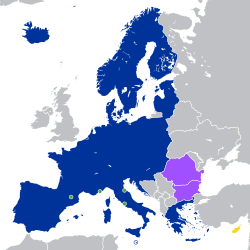
Bulgaria and Romania completed the fifth enlargement wave, bringing EU membership to twenty-seven states and extending the union to the Black Sea and lower Danube.
Image source: 2007 enlargement of the European Union
Jul 1, 2013
% complete
Croatia joined the EU after a decade-long accession process, becoming the second former Yugoslav republic to join and demonstrating the continued pull of EU membership in the Western Balkans.
Image source: 2013 enlargement of the European Union
Dec 9, 1974
% complete
Heads of state or government agreed to meet regularly as the European Council, giving national leaders a direct role in setting the political direction of the Communities; it later became a formal EU institution.
Image source: European Council
Jun 7, 1979
% complete
Citizens of the member states voted directly for Members of the European Parliament for the first time, greatly enhancing the democratic legitimacy of the European project.
Image source: 1979 European Parliament election
Feb 17, 1986
% complete
The Single European Act revised the Treaty of Rome, committing members to complete the single market by the end of 1992 and introducing qualified majority voting in the Council to speed up decision-making.
Feb 7, 1992
% complete
The Maastricht Treaty established the European Union, introduced EU citizenship, set out plans for a common currency, and created the three-pillar structure covering economic, foreign policy, and justice cooperation.
Image source: Maastricht Treaty
Jan 1, 1993
% complete
The European Single Market came into effect, allowing the free movement of goods, services, capital, and people—the 'four freedoms'—across member states, one of the EU's greatest achievements.
Image source: European single market
Mar 26, 1995
% complete
Internal border checks between participating states were abolished under the Schengen Agreement, allowing passport-free travel across much of Europe and becoming one of the EU's most tangible benefits for citizens.
Image source: Schengen Area
Oct 2, 1997
% complete
The Amsterdam Treaty strengthened the powers of the European Parliament, expanded cooperation on justice and home affairs, and reformed the EU's institutions in preparation for eastern enlargement.
Image source: Treaty of Amsterdam
Jan 1, 1999
% complete
Eleven member states adopted the euro for non-cash transactions, fixing exchange rates and transferring monetary policy to the new European Central Bank—a landmark step in economic integration.
Image source: Euro
Feb 26, 2001
% complete
The Nice Treaty reformed voting weights in the Council and capped the size of the Commission, adjusting EU institutions to function with many more member states ahead of the big eastern expansion.
Jan 1, 2002
% complete
Physical euro notes and coins replaced national currencies in twelve countries in the largest currency changeover in history, making the euro a daily reality for over 300 million Europeans.
Dec 13, 2007
% complete
The Lisbon Treaty reformed the EU's governing structures after the failed Constitutional Treaty, creating a permanent President of the European Council, a High Representative for foreign affairs, and expanding Parliament's powers.
Image source: Treaty of Lisbon
Dec 1, 2009
% complete
After ratification delays including a second Irish referendum, the Lisbon Treaty took effect, giving the EU a legal personality, Herman Van Rompuy became the first permanent President of the European Council, and Catherine Ashton became High Representative.
Sep 15, 2008
% complete
The global financial crisis exposed deep fiscal weaknesses in several eurozone members, leading to sovereign debt crises in Greece, Ireland, and Portugal and forcing unprecedented bailouts and austerity measures.
Image source: European debt crisis
Sep 2, 2015
% complete
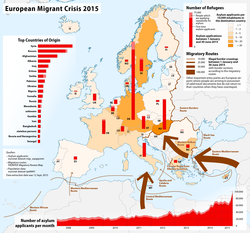
Over a million refugees and migrants, many fleeing the Syrian civil war, arrived in Europe in 2015, straining the EU's asylum system, dividing member states over quotas, and fueling the rise of populist parties.
Image source: 2015 European migrant crisis
Jun 23, 2016
% complete
In a historic referendum, 51.9% of British voters chose to leave the European Union, triggering Article 50 negotiations and marking the first time a member state decided to withdraw from the bloc.
Image source: 2016 United Kingdom European Union membership referendum
Jan 31, 2020
% complete
After nearly four years of negotiations and political turmoil, the UK officially exited the EU, ending forty-seven years of membership and reducing the union to twenty-seven member states.
Image source: Brexit
Jul 21, 2020
% complete
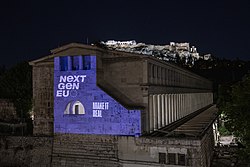
In response to the COVID-19 pandemic, EU leaders agreed on a €750 billion recovery fund financed by joint borrowing—a landmark moment of fiscal solidarity and the largest stimulus package in EU history.
Image source: Next Generation EU
Or browse the full history timeline directory, with more than 2,000 topics.
This European Union timeline was generated with the help of AI, using information found on the internet.
We work hard to keep these timelines accurate, but mistakes do get through. If you spot one, email us at [email protected] and we'll fix it for future visitors.
Generate yours with AI or build it from scratch, for free.
Export your timeline, add your own events, edit or remove AI-generated events, and much more
No credit card required.
Cancel anytime.
Cancel anytime.
You can create an unlimited number of timelines with up to 10 events on each one, customize how they look, export them to PDF, PNG, PowerPoint, CSV, and Excel, and share them with a link. Paid plans raise the event limit and add features like spreadsheet imports and collaborators.
Yes. You can cancel your subscription from your account page at any time, and you will not be charged again. Your subscription stays active for the rest of the period you already paid for.
Yes. We will email you a reminder before the annual renewal, and we will also email you a receipt.
Yes. You can email us within 15 days of any payment, and we will issue you a full refund.
Check out our pricing docs or send us an email anytime: [email protected].