-
Use Cases
-
Resources
-
Pricing
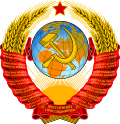
The Soviet Union, officially the Union of Soviet Socialist Republics (USSR), was a socialist state spanning Eurasia from 1922 to 1991. Founded after the Russian Revolution and Civil War, it became a global superpower under leaders like Stalin, Khrushchev, Brezhnev, and Gorbachev. The USSR played a central role in World War II and the Cold War before dissolving in 1991 into fifteen independent republics. More Less
Mar 8, 1917
% complete
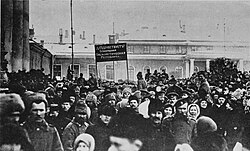
Mass protests and mutinies in Petrograd forced Tsar Nicholas II to abdicate, ending over three centuries of Romanov rule. A Provisional Government was established alongside the Petrograd Soviet of workers' and soldiers' deputies, creating a dual power structure that would soon be contested by the Bolsheviks.
Image source: February Revolution
Apr 16, 1917
% complete
Vladimir Lenin returned from exile in Switzerland aboard a sealed train provided by Germany. He immediately issued the April Theses, calling for 'All Power to the Soviets,' no support for the Provisional Government, and an end to the war, setting the Bolshevik agenda for the coming months.
Image source: Sealed train
Nov 7, 1917
% complete
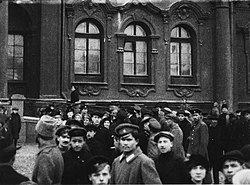
The Bolsheviks, led by Lenin and organized by Leon Trotsky, stormed the Winter Palace and overthrew the Provisional Government in a nearly bloodless coup in Petrograd. The new Soviet government immediately began issuing decrees on peace and land, laying the foundation for a communist state.
Image source: October Revolution
Nov 11, 1917 - Jun 16, 1923
% complete
The Bolshevik Red Army fought the anti-communist White armies, along with anarchist forces and foreign interventionists, across the former Russian Empire. The brutal conflict, marked by famine and the Red Terror, ended with Bolshevik victory and the consolidation of communist control over most of the former empire.
Image source: Russian Civil War
Mar 3, 1918
% complete
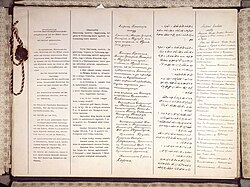
The new Soviet government signed a harsh peace with the Central Powers, ceding vast territories including Poland, the Baltics, and Ukraine. Though enormously costly, the treaty allowed the Bolsheviks to exit World War I and focus on consolidating power at home.
Image source: Treaty of Brest-Litovsk
Jul 17, 1918
% complete
Tsar Nicholas II, his wife Alexandra, their five children, and their servants were shot by Bolshevik guards in Yekaterinburg. The execution eliminated any possibility of monarchist restoration around the former imperial family and became one of the revolution's most infamous acts.
Image source: Murder of the Romanov family
Dec 30, 1922
% complete
Russia, Ukraine, Belorussia, and Transcaucasia united to form the Union of Soviet Socialist Republics, a federal state nominally composed of equal republics but dominated by the Communist Party. The USSR would become the world's first constitutionally socialist state.
Image source: Treaty on the Creation of the Union of Soviet Socialist Republics
Jan 21, 1924
% complete
Lenin died after a series of strokes, triggering a succession struggle within the Communist Party. His body was embalmed and placed in a mausoleum in Red Square, and Petrograd was renamed Leningrad in his honor. Joseph Stalin would ultimately emerge as his successor.
Image source: Death and state funeral of Vladimir Lenin
Dec 1, 1927
% complete
At the Fifteenth Party Congress, Stalin defeated Leon Trotsky and the Left Opposition, expelling them from the party. Through skillful maneuvering against rivals like Zinoviev and Kamenev, Stalin established himself as the unchallenged leader of the Soviet Union.
Image source: Joseph Stalin's rise to power
Oct 1, 1928 - Dec 31, 1932
% complete
Stalin's ambitious plan aimed to rapidly industrialize the agrarian Soviet economy through massive investment in heavy industry. Factories, dams, and steel mills rose at breakneck speed, transforming the USSR into an industrial power, though at enormous human cost and with widespread inefficiency.
Image source: First five-year plan
Jan 1, 1929 - Dec 31, 1933
% complete
The forced consolidation of individual peasant farms into collective farms (kolkhozes) met fierce resistance. Millions of 'kulaks' were deported or executed, livestock was slaughtered by peasants, and agricultural output collapsed, contributing to devastating famines.
Image source: Collectivization in the Soviet Union
Jan 1, 1932 - Dec 31, 1933
% complete
A catastrophic famine, exacerbated by grain requisition quotas and export demands, killed millions of Ukrainians. Many historians consider it a man-made genocide directed by Stalin's policies, and it remains a defining trauma of Ukrainian history.
Image source: Holodomor
Aug 1, 1936 - Nov 12, 1938
% complete
Stalin's campaign of political repression eliminated real and imagined enemies through show trials, executions, and mass imprisonment in the Gulag. Old Bolsheviks, military officers, intellectuals, and ordinary citizens perished; hundreds of thousands were executed and millions sent to labor camps.
Image source: Great Purge
Aug 23, 1939
% complete
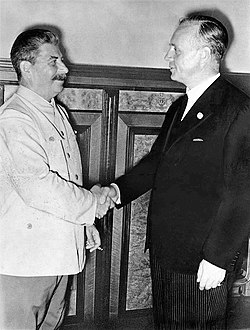
The Soviet Union and Nazi Germany signed a non-aggression pact that secretly divided Eastern Europe into spheres of influence. The agreement stunned the world and cleared the way for both powers to invade Poland, igniting World War II.
Image source: Molotov–Ribbentrop Pact
Sep 17, 1939 - Oct 6, 1939
% complete
Sixteen days after Germany attacked from the west, the Red Army invaded eastern Poland, seizing territory assigned to the Soviet sphere under the Molotov-Ribbentrop Pact. Poland was partitioned between the two totalitarian powers, and tens of thousands of Polish officers and officials were captured.
Image source: Soviet invasion of Poland
Nov 30, 1939 - Mar 13, 1940
% complete
The Soviet Union invaded Finland after it refused territorial demands. Despite overwhelming numerical superiority, Soviet forces suffered humiliating losses against Finnish defenders using guerrilla tactics in brutal winter conditions. Finland retained independence but ceded significant territory in the Moscow Peace Treaty.
Image source: Winter War
Apr 1, 1940 - May 31, 1940
% complete
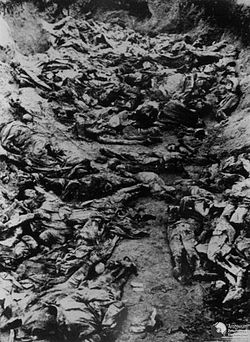
The NKVD systematically executed approximately 22,000 Polish prisoners, mostly officers and intelligentsia, in forests near Katyn and elsewhere. The Soviet Union blamed the Nazis for decades until admitting responsibility in 1990, making Katyn a lasting symbol of Stalinist crimes.
Image source: Katyn massacre
Jun 22, 1941
% complete
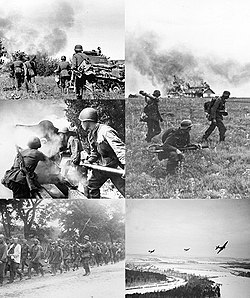
Nazi Germany launched Operation Barbarossa, the largest military invasion in history, breaking the Molotov-Ribbentrop Pact. Millions of Axis troops surged across the border, catching the Red Army unprepared. The invasion opened the Eastern Front, which would become the deadliest theater of World War II.
Image source: Operation Barbarossa
Sep 8, 1941 - Jan 27, 1944
% complete
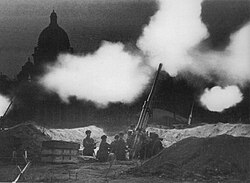
German and Finnish forces encircled Leningrad for nearly 900 days. Over a million civilians died from starvation, cold, and bombardment, yet the city never surrendered. The siege became a symbol of Soviet endurance and sacrifice during the Great Patriotic War.
Image source: Siege of Leningrad
Oct 2, 1941 - Jan 7, 1942
% complete
German forces came within sight of the Soviet capital before being halted by determined defense, Siberian reinforcements, and the brutal Russian winter. The first major German defeat of the war shattered the myth of Wehrmacht invincibility and doomed the blitzkrieg strategy.
Image source: Battle of Moscow
Aug 23, 1942 - Feb 2, 1943
% complete
One of the bloodiest battles in history raged through the ruins of Stalingrad. Soviet forces encircled and destroyed the German Sixth Army, capturing Field Marshal Paulus. The victory marked the turning point of the war in Europe, after which German forces were in retreat.
Image source: Battle of Stalingrad
Jul 5, 1943 - Aug 23, 1943
% complete
The largest tank battle in history saw German forces launch their last major offensive on the Eastern Front. Forewarned by intelligence, Soviet defenses absorbed the assault and then counterattacked, permanently seizing the strategic initiative from Germany.
Image source: Battle of Kursk
Apr 16, 1945 - May 2, 1945
% complete
Soviet forces stormed Berlin in ferocious street fighting, raising the red flag over the Reichstag. Adolf Hitler committed suicide in his bunker, and Germany surrendered unconditionally on May 8, ending the war in Europe at the cost of enormous Soviet casualties.
Image source: Battle of Berlin
Aug 8, 1945 - Sep 2, 1945
% complete
Fulfilling its Yalta commitments, the USSR declared war on Japan and invaded Manchuria with over a million troops. The rapid rout of the Japanese Kwantung Army, combined with the atomic bombings, hastened Japan's surrender and gave the Soviets influence in Northeast Asia.
Image source: Soviet–Japanese War
Mar 5, 1946
% complete
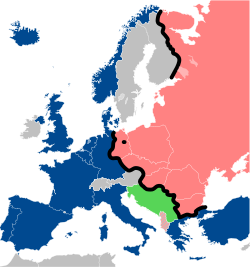
Former British Prime Minister Winston Churchill declared in Fulton, Missouri that 'an iron curtain has descended across the Continent,' dividing Soviet-controlled Eastern Europe from the West. The speech crystallized Western fears of Soviet expansionism and heralded the Cold War.
Image source: Iron Curtain
Jun 24, 1948 - May 12, 1949
% complete
Stalin cut off all land access to West Berlin to force the Western Allies out of the city. In response, the United States and Britain mounted a massive airlift supplying the city for nearly a year until Stalin relented, marking the first major Cold War crisis.
Image source: Berlin Blockade
Aug 29, 1949
% complete
The Soviet Union detonated RDS-1 ('First Lightning') at Semipalatinsk, ending the American nuclear monopoly years ahead of Western predictions. Accelerated by espionage, the test ushered in the nuclear arms race and the doctrine of mutual deterrence.
Image source: RDS-1
Mar 5, 1953
% complete
Stalin died after a stroke, ending nearly three decades of dictatorial rule. His death triggered a power struggle among his lieutenants, a brief thaw in Cold War tensions, and eventually Nikita Khrushchev's rise to leadership and denunciation of Stalinism.
Image source: Death and state funeral of Joseph Stalin
Feb 25, 1956
% complete
In a closed session of the Twentieth Party Congress, Khrushchev denounced Stalin's cult of personality and crimes, shocking delegates worldwide. The speech initiated de-Stalinization, released millions of Gulag prisoners, and inspired reform movements across the communist bloc.
Image source: On the Cult of Personality and Its Consequences
Oct 4, 1957
% complete
The Soviet Union launched Sputnik 1, the first artificial satellite, stunning the world and demonstrating Soviet technological prowess. The achievement triggered the Space Race, prompted the creation of NASA, and intensified Cold War competition in science and education.
Image source: Sputnik 1
Apr 12, 1961
% complete
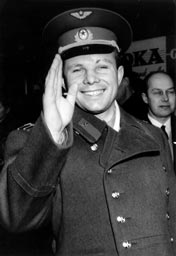
Yuri Gagarin orbited Earth aboard Vostok 1, becoming the first human in space and a global celebrity. The triumph cemented Soviet leadership in the early Space Race and remains celebrated annually as Cosmonautics Day in Russia.
Image source: Vostok 1
Oct 16, 1962 - Oct 28, 1962
% complete
The placement of Soviet nuclear missiles in Cuba brought the world to the brink of nuclear war. After thirteen tense days of confrontation, Khrushchev agreed to withdraw the missiles in exchange for an American pledge not to invade Cuba and a secret removal of US missiles from Turkey.
Image source: Cuban Missile Crisis
Oct 14, 1964
% complete
Khrushchev was ousted in a palace coup and replaced by Leonid Brezhnev. His eighteen-year rule brought political stability, expanded social welfare, and détente with the West, but also economic stagnation, corruption, and renewed repression of dissent.
Image source: Leonid Brezhnev
Aug 20, 1968
% complete
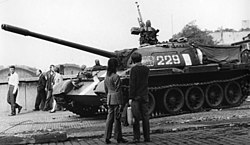
Half a million Warsaw Pact troops invaded Czechoslovakia to end Alexander Dubček's liberalizing reforms. The Brezhnev Doctrine, asserting the right to intervene in socialist states, was articulated in response, chilling reformist hopes throughout the Eastern Bloc.
Image source: Warsaw Pact invasion of Czechoslovakia
Aug 1, 1975
% complete
Thirty-five nations, including the USSR and the United States, signed agreements recognizing postwar European borders while committing to human rights principles. Soviet dissidents used the human rights provisions to pressure their government, seeding future opposition movements.
Image source: Helsinki Accords
Dec 24, 1979 - Feb 15, 1989
% complete
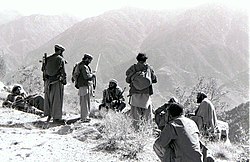
Soviet forces intervened to prop up Afghanistan's communist government, becoming mired in a decade-long guerrilla war against US-backed mujahideen fighters. The costly quagmire drained resources, damaged Soviet prestige, and is often called the USSR's Vietnam.
Image source: Soviet–Afghan War
Mar 11, 1985
% complete
After three elderly leaders died in quick succession, the relatively young Mikhail Gorbachev took charge. He soon launched sweeping reforms intended to revive the stagnant system, ultimately unleashing forces that transformed and dissolved the Soviet Union itself.
Image source: Mikhail Gorbachev
Apr 26, 1986
% complete
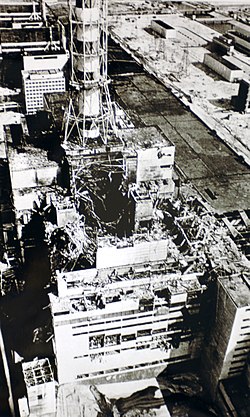
An explosion at the Chernobyl Nuclear Power Plant in Ukraine released massive radioactive contamination across Europe. The disaster exposed systemic failures, cost billions to contain, eroded public trust in the government, and accelerated Gorbachev's push for openness.
Image source: Chernobyl disaster
Jan 27, 1987
% complete
Gorbachev's policies of glasnost (openness) and perestroika (restructuring) liberalized the press, released political prisoners, introduced limited market mechanisms, and allowed unprecedented criticism of the party. The reforms emboldened nationalist movements across the union's republics.
Nov 9, 1989
% complete
East Germany opened its borders amid mass protests, and jubilant crowds dismantled the Berlin Wall. Gorbachev's refusal to intervene militarily signaled the end of Soviet control over Eastern Europe, where communist regimes collapsed one after another.
Image source: Fall of the Berlin Wall
Aug 19, 1991 - Aug 21, 1991
% complete
Hardline communists attempted to seize power and reverse Gorbachev's reforms, placing him under house arrest. Russian President Boris Yeltsin led resistance from atop a tank in Moscow, and the coup collapsed within days, fatally discrediting the Communist Party.
Image source: 1991 Soviet coup d'état attempt
Dec 26, 1991
% complete
Following the Belovezha Accords and Gorbachev's resignation, the Supreme Soviet formally voted the USSR out of existence. Its fifteen republics became independent states, ending nearly seventy years of Soviet rule and reshaping the geopolitical order of the post-Cold War world.
Image source: Dissolution of the Soviet Union
Or browse the full history timeline directory, with more than 2,000 topics.
This Soviet Union timeline was generated with the help of AI, using information found on the internet.
We work hard to keep these timelines accurate, but mistakes do get through. If you spot one, email us at [email protected] and we'll fix it for future visitors.
Generate yours with AI or build it from scratch, for free.
Export your timeline, add your own events, edit or remove AI-generated events, and much more
No credit card required.
Cancel anytime.
Cancel anytime.
You can create an unlimited number of timelines with up to 10 events on each one, customize how they look, export them to PDF, PNG, PowerPoint, CSV, and Excel, and share them with a link. Paid plans raise the event limit and add features like spreadsheet imports and collaborators.
Yes. You can cancel your subscription from your account page at any time, and you will not be charged again. Your subscription stays active for the rest of the period you already paid for.
Yes. We will email you a reminder before the annual renewal, and we will also email you a receipt.
Yes. You can email us within 15 days of any payment, and we will issue you a full refund.
Check out our pricing docs or send us an email anytime: [email protected].