
-
Use Cases
-
Resources
-
Pricing
The Cold War arms race was a competition between the United States and the Soviet Union to build superior nuclear weapons and military technology. The Soviet Union tested its first atomic bomb in 1949, and the rivalry lasted until it dissolved in 1991. More Less
Build a timeline like this one in minutes, for free. Start Yours →
Part of our collection of Cold War timelines.
Jun 24, 1948 - May 12, 1949
In response to the Soviet Union's blockade of West Berlin, Western Allies initiated the Berlin Airlift, supplying food, fuel, and other necessities to the city via air transport. This successful operation demonstrated the resolve of the Western powers and highlighted the growing tensions between East and West.
Image source: Berlin Blockade

Nov 17, 1969 - May 26, 1972
The United States and Soviet Union engaged in the Strategic Arms Limitation Talks (SALT I), resulting in the signing of the SALT I Treaty. This agreement limited the number of intercontinental ballistic missiles (ICBMs) and submarine-launched ballistic missiles (SLBMs) possessed by each superpower.
Image source: Strategic Arms Limitation Talks

Mar 23, 1983
U.S. President Ronald Reagan announced the Strategic Defense Initiative (SDI), a proposed missile defense system intended to protect the United States from potential nuclear attacks. This initiative sparked controversy and raised concerns about the potential destabilization of the balance of power.
Image source: Strategic Defense Initiative

Jul 31, 1991
The United States and Soviet Union signed the Strategic Arms Reduction Treaty (START I), which aimed to reduce and limit the number of strategic nuclear weapons possessed by both countries. This treaty marked a significant step towards nuclear disarmament.
Image source: START I

Jun 25, 1950 - Jul 27, 1953
The Korean War began when North Korean forces, supported by the Soviet Union and China, invaded South Korea. The conflict escalated into a proxy war between the United States and its allies, and the Soviet Union and China. The war ended in a stalemate, with the division of Korea into North and South.
Image source: Korean War

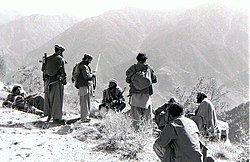
Dec 24, 1979 - Feb 15, 1989
The Soviet Union invaded Afghanistan to support the communist government against various resistance groups. The conflict became a costly and protracted war for the Soviets, leading to a significant drain on resources and international condemnation.
Image source: Soviet–Afghan War
Nov 9, 1989
The fall of the Berlin Wall symbolized the end of the Cold War era. The wall, which had divided East and West Berlin since 1961, was dismantled, allowing free movement between the two sides and paving the way for the reunification of Germany.
Image source: Berlin Wall

Dec 26, 1991
The Soviet Union officially dissolved, marking the end of the Cold War and the bipolar world order. The dissolution resulted in the formation of independent states, ending the ideological standoff between the United States and the Soviet Union.
Oct 4, 1957
The Soviet Union launched Sputnik 1, the world's first artificial satellite, marking the beginning of the Space Age. This event shocked the United States and intensified the competition between the superpowers in space exploration.
Image source: Sputnik 1

Jul 20, 1969
The United States achieved a major victory in the Space Race when the Apollo 11 mission successfully landed astronauts Neil Armstrong and Buzz Aldrin on the moon. This historic event demonstrated American technological prowess and marked a significant milestone in human exploration of space.
Image source: Apollo 11

Build a timeline like this one in minutes, for free. Start Yours →
This Cold War Arms Race timeline was generated with the help of AI, using information found on the internet.
We work hard to keep these timelines accurate, but mistakes do get through. If you spot one, email us at [email protected] and we'll fix it for future visitors.
Generate yours with AI or build it from scratch, for free.

