-
Use Cases
-
Resources
-
Pricing
The Atomic Age refers to the historical period beginning in 1945 when humanity first harnessed nuclear energy, marked by the development of atomic weapons during World War II and followed by the Cold War nuclear arms race, the rise of nuclear power for civilian use, and ongoing debates about nuclear technology's benefits and dangers. More Less
1896
% complete
Henri Becquerel noticed that uranium gives off an unknown radiation which fogs photographic film, marking the discovery of radioactivity and laying the groundwork for the study of atomic energy.
Image source: Henri Becquerel
1898
% complete
Marie Curie discovered that thorium gives off a similar radiation to uranium, expanding the understanding of radioactive elements and their properties.
Image source: Marie Curie
1901
% complete
Frederick Soddy and Ernest Rutherford discovered that radioactivity was part of the process by which atoms changed from one kind to another, involving the release of energy.
Image source: Ernest Rutherford
1903
% complete
Ernest Rutherford began to speak publicly of the possibility of harnessing atomic energy, anticipating future developments in nuclear science.
1905
% complete
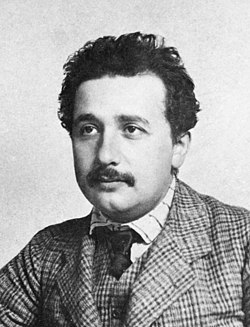
Albert Einstein formulated the special theory of relativity, which explained the phenomenon of radioactivity as mass-energy equivalence, captured in his famous equation E=mc².
Image source: Special relativity
1911
% complete
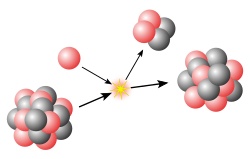
Ernest Rutherford formulated a theory about the structure of the atomic nucleus based on his experiments with alpha particles, revealing the dense core at the center of atoms.
Image source: Atomic nucleus
1930
% complete
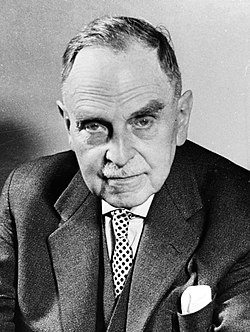
Otto Hahn wrote an article with his prophecy 'The Atom – the source of power of the future?' in the newspaper Deutsche Allgemeine Zeitung, foreshadowing the coming atomic era.
Image source: Otto Hahn
1932
% complete
James Chadwick discovered the neutron, a neutral particle in the nucleus whose discovery would shortly lead to the hypothesis of nuclear chain reactions.
Image source: James Chadwick
1933
% complete
Shortly after James Chadwick's discovery of the neutron, the concept of a self-sustaining nuclear chain reaction was hypothesized, setting the theoretical foundation for both reactors and weapons.
Image source: Nuclear chain reaction
1934
% complete
Enrico Fermi began bombarding uranium with slow neutrons, while Ida Noddack predicted that uranium nuclei would break up under bombardment by fast neutrons.
Image source: Enrico Fermi
Feb 26, 1941
% complete
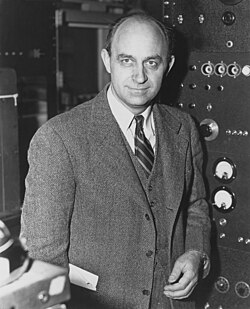
Glenn Seaborg and Arthur Wahl discovered plutonium, a new element that would later become crucial for nuclear weapons and reactors.
Image source: Plutonium
Oct 11, 1939
% complete
The Einstein–Szilárd letter, suggesting that the United States construct a nuclear weapon, was delivered to President Franklin D. Roosevelt, helping set American nuclear policy in motion.
Image source: Einstein–Szilard letter
Dec 6, 1941
% complete
President Franklin D. Roosevelt signed the order to build a nuclear weapon, formally committing the United States to developing an atomic bomb.
Image source: Manhattan Project
Sep 1942
% complete
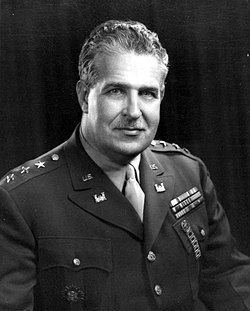
General Leslie Groves took charge of the Manhattan Project, overseeing the massive American effort to build the first atomic bombs.
Image source: Leslie Groves
Dec 2, 1942
% complete
Under the leadership of Enrico Fermi, the first artificial self-sustaining nuclear chain reaction took place at Chicago Pile-1, proving that controlled nuclear reactions were possible.
Image source: Chicago Pile-1
Jul 16, 1945
% complete
The first nuclear weapon was detonated near Socorro, New Mexico, in the successful Trinity test. This event is generally considered the beginning of the Atomic Age.
Aug 6, 1945
% complete
The second nuclear weapon, and the first deployed in combat, was detonated when the Little Boy uranium bomb was dropped on the Japanese city of Hiroshima.
Image source: Atomic bombings of Hiroshima and Nagasaki
Aug 9, 1945
% complete
The third nuclear weapon—and the second and last to be deployed in combat—was detonated when the Fat Man plutonium bomb was dropped on the Japanese city of Nagasaki.
1949
% complete
The Soviet Union tested its first nuclear weapon, ending the American monopoly on nuclear arms and intensifying the Cold War arms race.
Image source: RDS-1
Nov 1, 1952
% complete
The first hydrogen bomb, largely designed by Edward Teller, was tested at Eniwetok Atoll, demonstrating thermonuclear explosive power far beyond earlier fission weapons.
Image source: Ivy Mike
1957 - 1959
% complete
The Soviet Union and the United States both began deployment of intercontinental ballistic missiles, making nuclear strikes possible across continents within minutes.
Image source: Intercontinental ballistic missile
1958
% complete
The neutron bomb, a tactical nuclear weapon designed to release a large portion of its energy as energetic neutron radiation, was invented by Samuel Cohen of the Lawrence Livermore National Laboratory.
Image source: Neutron bomb
1960
% complete
Herman Kahn published On Thermonuclear War, a controversial analysis of nuclear strategy that shaped Cold War thinking about deterrence and fallout shelters.
Image source: On Thermonuclear War
Nov 1961
% complete
An article by Gilbert Burck in Fortune magazine outlined plans by Nelson Rockefeller, Edward Teller, Herman Kahn, and Chet Holifield for an enormous network of underground fallout shelters throughout the United States sufficient to shelter millions in case of nuclear war.
Image source: Fallout shelter
Oct 12, 1962 - Oct 28, 1962
% complete
The Cuban Missile Crisis brought the world to the brink of nuclear war during thirteen tense days of confrontation between the United States and the Soviet Union over Soviet missiles in Cuba.
Image source: Cuban Missile Crisis
Oct 10, 1963
% complete
The Partial Test Ban Treaty went into effect, banning above-ground nuclear testing and reducing radioactive fallout from atmospheric tests.
Image source: Partial Nuclear Test Ban Treaty
Jan 27, 1967
% complete
The Outer Space Treaty banned the deployment of nuclear weapons in space, establishing space as a domain reserved for peaceful purposes.
Image source: Outer Space Treaty
1968
% complete
Physicist Freeman Dyson proposed building a space ark using an Orion nuclear-pulse propulsion rocket powered by hydrogen bombs, which would have cost $367 billion in 1968 dollars, about $3.3 trillion in 2024 dollars.
Image source: Project Orion (nuclear propulsion)
Oct 11, 1986 - Oct 12, 1986
% complete
Ronald Reagan and Mikhail Gorbachev met at the Reykjavík Summit and agreed after negotiations to go farther than a nuclear freeze—they agreed to reduce nuclear arsenals.
Image source: Reykjavík Summit
Dec 8, 1987
% complete
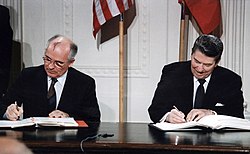
The Intermediate-Range Nuclear Forces Treaty was signed in Washington, eliminating an entire class of nuclear missiles and marking a major step in Cold War arms control.
Image source: Intermediate-Range Nuclear Forces Treaty
Jul 31, 1991
% complete
As the Cold War ended, the Start I treaty was signed by the United States and the Soviet Union, reducing the deployed nuclear warheads of each side to no more than 6,000 each. The fall of the Soviet Union later that year is considered by many to mark the end of the Atomic Age.
Image source: START I
1945
% complete
The pocketbook The Atomic Age heralded untapped atomic power in everyday objects and depicted a future where fossil fuels would go unused.
Image source: Atomic Age
1945
% complete
Edna Mae Anderson formed the Atomaton chapter of Sweet Adelines, saying 'We have an atom of an idea and a ton of energy,' just three days before the Trinity test.
Image source: Sweet Adelines International competition
Jul 5, 1946
% complete
The bikini swimsuit, named after Bikini Atoll where Operation Crossroads atomic bomb tests had taken place days earlier, was introduced at a fashion show in Paris.
Image source: Bikini
1954
% complete
The film Them!, about humanity's battle with giant mutant ants, was one of the first 'nuclear monster' movies, and Godzilla debuted as a gigantic irradiated dinosaur transformed from hydrogen bomb test fallout.
Jan 23, 1957
% complete
Walt Disney Productions released the film 'Our Friend the Atom', describing the marvelous benefits of atomic power to the public.
1958
% complete
Ford Motor Company displayed to the public the Ford Nucleon concept car, envisioning a future where automobiles would be powered by small nuclear reactors.
Image source: Ford Nucleon
1982
% complete
Jonathan Schell's book Fate of the Earth, about the consequences of nuclear war, was published, and the documentary film The Atomic Cafe, detailing society's attitudes toward the atomic bomb in the early Atomic Age, debuted to widespread acclaim.
Image source: The Fate of the Earth
Nov 20, 1983
% complete
The Day After, an American television movie depicting the aftermath of nuclear war, aired on the ABC Television Network and in the Soviet Union, shocking audiences on both sides of the Cold War.
Jan 21, 1954
% complete
The first nuclear submarine, the USS Nautilus (SSN-571), was launched into the Thames River near New London, Connecticut, ushering in nuclear propulsion for naval vessels.
Image source: USS Nautilus (SSN-571)
Jun 27, 1954
% complete
The first nuclear power plant began operation near Obninsk, USSR, marking the start of civilian nuclear electricity generation.
Image source: Obninsk Nuclear Power Plant
Oct 17, 1956
% complete
The world's first nuclear power station to deliver electricity in commercial quantities opened at Calder Hall in the UK.
Image source: Calder Hall nuclear power station
1957
% complete
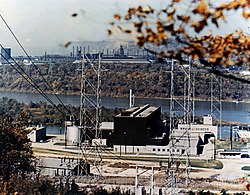
When the Shippingport reactor went online it produced electricity at a cost roughly ten times that of coal-fired generation, highlighting early economic challenges of nuclear power.
Image source: Shippingport Atomic Power Station
Sep 29, 1957
% complete
More than 200 people died as a result of the Mayak nuclear waste storage tank explosion in Chelyabinsk, Soviet Union, and 270,000 people were exposed to dangerous radiation levels.
Image source: Kyshtym disaster
1958
% complete
Scientists at the AEC's Brookhaven Laboratory wrote a report describing accident scenarios in which 3,000 people would die immediately and another 40,000 injured; these consequences were ignored and downplayed until the program was terminated in 1977 after $770 million had been spent.
Image source: Brookhaven National Laboratory
Aug 26, 1966
% complete
The first pebble-bed reactor went online in Jülich, West Germany; some nuclear engineers thought the design could be adapted for atomic-powered vehicles.
Image source: Pebble-bed reactor
1973
% complete
Concerning a flourishing nuclear power industry, the United States Atomic Energy Commission predicted that by the turn of the 21st century, 1,000 reactors would be producing electricity for homes and businesses across the U.S.
Image source: United States Atomic Energy Commission
1973
% complete
After 1973, reactor orders declined sharply as electricity demand fell and construction costs rose, halting the rapid growth predicted by the AEC.
Image source: Nuclear power in the United States
Mar 28, 1979
% complete
The Three Mile Island accident occurred near Harrisburg, Pennsylvania, dampening enthusiasm in the United States for nuclear power and causing a dramatic shift in its growth.
Image source: Three Mile Island accident
Apr 26, 1986
% complete
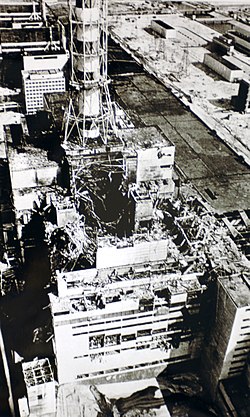
The Chernobyl disaster occurred at the Chernobyl Nuclear Power Plant near Pripyat, Ukraine, USSR, reducing enthusiasm for nuclear power among many people in the world and causing a dramatic shift in the growth of nuclear power.
Image source: Chernobyl disaster
1993 - 2007
% complete
From 1993 to 2007, nuclear power served as the primary source of electricity in France, showcasing large-scale reliance on atomic energy for civilian needs.
Image source: Nuclear power in France
1993 - 2013
% complete
Russia and the United States agreed to the Megatons to Megawatts Program, implemented from 1995. By completion in 2013, five hundred tonnes of uranium derived from 20,000 Russian nuclear warheads were converted to reactor-grade uranium and used in US plants to generate electricity.
1958
% complete
The peace symbol was designed for the British nuclear disarmament movement by Gerald Holtom, becoming an enduring icon of anti-nuclear activism worldwide.
Image source: Peace symbols
May 6, 1979
% complete
A large anti-nuclear demonstration was held in Washington, D.C., when 125,000 people including the governor of California attended a march and rally against nuclear power.
Image source: Anti-nuclear movement in the United States
Sep 23, 1979
% complete
In New York City, almost 200,000 people attended a protest against nuclear power, one of the largest anti-nuclear demonstrations in history.
Jun 12, 1982
% complete
One million people demonstrated in New York City's Central Park against nuclear weapons and for an end to the Cold War arms race.
Image source: Anti-nuclear protests
Jun 20, 1983
% complete
International Day of Nuclear Disarmament protests were held at 50 sites across the United States, mobilizing widespread opposition to the nuclear arms race.
1986
% complete
Hundreds of people walked from Los Angeles to Washington, D.C., in the Great Peace March for Global Nuclear Disarmament.
Image source: Great Peace March for Global Nuclear Disarmament
2006
% complete
Patrick Moore, an early member of Greenpeace, along with environmentalists such as Stewart Brand, suggested deploying more advanced nuclear power technology like pebble-bed reactors to combat global warming.
Image source: Patrick Moore (consultant)
2006 - 2009
% complete
Nuclear engineers began suggesting that, to combat global warming, it would be more efficient to build nuclear reactors operating on the thorium cycle.
Image source: Thorium-based nuclear power
Nov 21, 2006
% complete
Implementation of the ITER fusion power reactor project near Cadarache, France was begun, with construction hoped to allow practical commercial fusion power plants by 2050.
Image source: ITER
Apr 8, 2010
% complete
The New START treaty was signed by the United States and Russia in Prague, continuing the process of reducing deployed strategic nuclear arsenals.
Image source: New START
2011 - 2022
% complete
Germany planned to completely phase out nuclear energy by 2022, though it was still deriving 11.9% of its power from nuclear sources in 2021.
Image source: Nuclear power phase-out
Mar 11, 2011
% complete
A tsunami resulting from the Tōhoku earthquake caused severe damage to the Fukushima I nuclear power plant in Japan, causing partial nuclear meltdowns in several reactors.
Image source: Fukushima nuclear accident
Sep 2012
% complete
In reaction to the Fukushima disaster, Japan announced it would completely phase out nuclear power by 2030, although the likelihood of this goal became unlikely during the subsequent Abe administration.
Image source: Nuclear power in Japan
2022
% complete
Following the Russian invasion of Ukraine, the United Kingdom pledged to build up to 8 new reactors to reduce reliance on gas and oil, hoping 25% of all energy produced will come from nuclear means.
Image source: Nuclear power in the United Kingdom
Or browse the full history timeline directory, with more than 2,000 topics.
This Atomic Age timeline was generated with the help of AI, using information found on the internet.
We work hard to keep these timelines accurate, but mistakes do get through. If you spot one, email us at [email protected] and we'll fix it for future visitors.
Generate yours with AI or build it from scratch, for free.
Export your timeline, add your own events, edit or remove AI-generated events, and much more
No credit card required.
Cancel anytime.
Cancel anytime.
You can create an unlimited number of timelines with up to 10 events on each one, customize how they look, export them to PDF, PNG, PowerPoint, CSV, and Excel, and share them with a link. Paid plans raise the event limit and add features like spreadsheet imports and collaborators.
Yes. You can cancel your subscription from your account page at any time, and you will not be charged again. Your subscription stays active for the rest of the period you already paid for.
Yes. We will email you a reminder before the annual renewal, and we will also email you a receipt.
Yes. You can email us within 15 days of any payment, and we will issue you a full refund.
Check out our pricing docs or send us an email anytime: [email protected].