-
Use Cases
-
Resources
-
Pricing
The Late Middle Ages was the period of European history from approximately 1300 to 1500, marked by profound crises and transformations. This era witnessed devastating events such as the Black Death, the Hundred Years' War between England and France, the Great Famine, and the Avignon Papacy, alongside significant developments like the rise of powerful monarchies, the Italian Renaissance, the invention of the printing press, and the fall of Constantinople in 1453, which collectively ended the medieval world and paved the way for the Early Modern period. More Less
Apr 12, 1204
% complete
Crusader armies diverted to Constantinople stormed and brutally sacked the Byzantine capital, looting its treasures and establishing the Latin Empire. The sack deepened the schism between Eastern and Western Christianity and fatally weakened the Byzantine Empire, which would never fully recover its former power.
Image source: Sack of Constantinople
Jul 16, 1212
% complete
A coalition of Christian kingdoms from Castile, Aragon, Navarre, and Portugal decisively defeated the Almohad Caliphate in southern Spain. The victory marked a turning point in the Reconquista, breaking Muslim power in Iberia and paving the way for the eventual Christian domination of the peninsula.
Image source: Battle of Las Navas de Tolosa
1217 - 1221
% complete
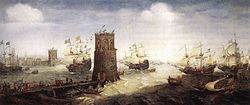
Western European forces launched a campaign against Egypt, capturing the port city of Damietta in 1219. Despite initial success, the crusade ended in failure when an advance toward Cairo stalled and the army surrendered, illustrating the growing difficulty of crusading ventures in the eastern Mediterranean.
Image source: Fifth Crusade
Feb 18, 1229
% complete
Emperor Frederick II, despite excommunication, negotiated a treaty with Sultan al-Kamil that returned Jerusalem, Bethlehem, and Nazareth to Christian control without bloodshed. The peaceful recovery lasted until 1244, when Khwarazmian forces captured the city again.
Image source: Sixth Crusade
1237 - 1240
% complete
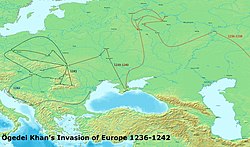
Batu Khan's Mongol armies swept through the Russian principalities, destroying cities including Ryazan, Vladimir, and Kiev. The devastation subjugated Rus' lands under the Golden Horde's dominance for over two centuries, isolating them from Western European developments.
Image source: Mongol invasion of Kievan Rus'
Mar 30, 1282
% complete
The people of Palermo rose up against Angevin French rule, massacring French inhabitants on Easter Monday. The revolt invited Peter III of Aragon to claim Sicily, triggering a twenty-year war that shifted Mediterranean power from France to Aragon and split Sicily from mainland southern Italy.
Image source: War of the Sicilian Vespers
May 18, 1291
% complete
Mamluk forces under al-Ashraf Khalil besieged and captured Acre, the last major Crusader stronghold in the Holy Land. The fall ended nearly two centuries of Latin presence in the Levant and forced military orders such as the Hospitallers to relocate, eventually to Rhodes.
Image source: Siege of Acre (1291)
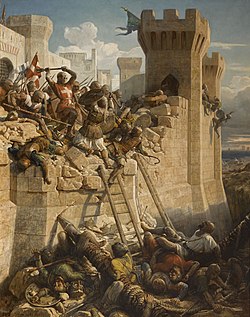
Sep 11, 1297 - 1305
% complete
William Wallace defeated an English army at Stirling Bridge and governed Scotland as Guardian in the name of John Balliol. After defeat at Falkirk in 1298 he continued resistance until capture and execution in 1305, becoming a lasting symbol of Scottish independence.
Image source: William Wallace
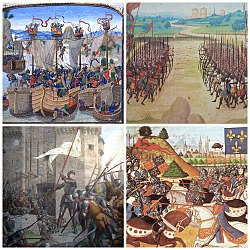
1337 - 1453
% complete
Edward III claimed the French crown, launching intermittent warfare between England and France that lasted over a century. Marked by famous battles such as Crécy, Poitiers, and Agincourt, the war transformed military tactics, fueled national identities, and left both kingdoms profoundly changed.
Image source: Hundred Years' War
1362
% complete
Murad I's forces captured Adrianople in Thrace and made it the Ottoman capital. The conquest consolidated Ottoman control over the Balkan approaches, enabling further expansion into southeastern Europe and bringing Turkish power to the very borders of Christendom.
Image source: Edirne
May 8, 1429
% complete
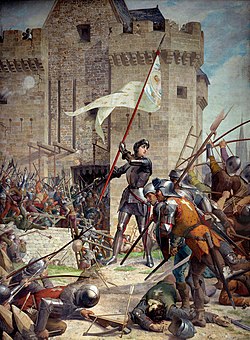
Inspired by visions, peasant girl Joan of Arc accompanied French forces that broke the English siege of Orléans, reversing Hundred Years' War momentum. She enabled Charles VII's coronation before being captured and burned by the English in 1431; she was later canonized as a saint.
Image source: Siege of Orléans
May 29, 1453
% complete
Sultan Mehmed II's armies breached the Theodosian Walls after a weeks-long siege, ending the Byzantine Empire after more than a thousand years. The conquest shocked Christian Europe, made Istanbul an imperial capital, and spurred searches for new trade routes to the East.
Image source: Fall of Constantinople
Jul 17, 1453
% complete
French artillery crushed English forces at Castillon, killing John Talbot and effectively concluding the Hundred Years' War. England retained only Calais, while France emerged unified under the Valois monarchy with a strengthened crown and early modern military organization.
Image source: Battle of Castillon
1209
% complete
Francis of Assisi received papal approval for his order of friars devoted to poverty, humility, and itinerant preaching. The Franciscans revitalized lay spirituality across Europe, ministered in cities among the poor, and produced influential mystics and scholars such as Bonaventure and Duns Scotus.
Image source: Franciscans
Dec 22, 1216
% complete
Pope Honorius III approved the Order of Preachers founded by Dominic de Guzmán. The Dominicans emphasized preaching, teaching, and combating heresy through education rather than force alone, becoming leading scholars at medieval universities and playing a major role in the Inquisition.
Image source: Dominican Order
1274
% complete
Pope Gregory X convened the council seeking reunion with the Orthodox Church and support for crusading. Greek delegates accepted union under pressure, but the agreement was rejected by most Byzantine clergy and laity and soon collapsed, leaving the churches divided.
1309 - 1376
% complete
Under pressure from King Philip IV of France, Pope Clement V moved the papal court to Avignon, where popes resided for nearly seven decades. Critics denounced their dependence on French kings, and calls for reform grew, setting the stage for crisis within the Church.
Image source: Avignon Papacy
1378 - 1417
% complete
Rival elections after Gregory XI returned to Rome produced two, then three, simultaneous popes, dividing European powers into competing allegiances. The scandal eroded papal prestige and prompted conciliarist movements culminating in the Council of Constance.
Image source: Western Schism
1414 - 1418
% complete
The council deposed rival popes, elected Martin V, and healed the Western Schism, restoring a single pontiff. It also burned reformer Jan Hus for heresy, provoking decades of Hussite Wars in Bohemia and leaving unresolved demands for deeper church reform.
Image source: Council of Constance
Jun 15, 1215
% complete
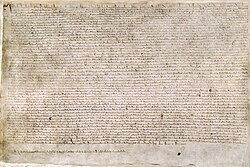
King John of England was forced by rebellious barons to seal Magna Carta at Runnymede, limiting royal authority and affirming that the king was subject to law. Though initially a failure, it became a foundational document for constitutional government and the rule of law in England and beyond.
Image source: Magna Carta
Oct 1, 1273
% complete
Rudolf of Habsburg was elected King of the Romans, ending the Great Interregnum after the fall of the Hohenstaufen dynasty. His victory over Ottokar II of Bohemia established Habsburg power in Austria, beginning centuries of Habsburg influence in Central Europe.
Image source: Rudolf I of Germany
1284
% complete
Following Edward I's conquest of Wales, the Statute of Rhuddlan organized the Principality of Wales under English law and administration. It marked the incorporation of Welsh territory into the English crown's domain, completed by castle-building programs like those at Caernarfon and Conwy.
Image source: Statute of Rhuddlan
Nov 7, 1295
% complete
Edward I summoned a parliament including barons, clergy, knights, and burgesses to raise funds for wars in Scotland and France. Its broad composition set a template for representative government, shaping the development of the English Parliament as an institution.
Image source: Model Parliament
May 1358 - Jun 1358
% complete
French peasants in the Oise valley rose against noble exploitation amid the chaos following King John II's capture at Poitiers. The uprising was violently suppressed within weeks, but it exposed deep rural grievances intensified by war, plague, and heavy taxation.
Image source: Jacquerie
Jun 1381
% complete
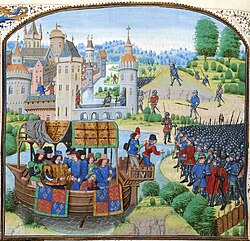
Thousands of English rebels protesting poll taxes and serfdom marched on London, burning records and executing officials including the Archbishop of Canterbury. Fourteen-year-old Richard II met the rebels at Smithfield, and promises were broken as leaders like Wat Tyler were killed.
Image source: Peasants' Revolt
Aug 14, 1385
% complete
Grand Duke Jogaila of Lithuania agreed to marry Queen Jadwiga of Poland and convert to Christianity, creating a personal union between the two realms. The alliance formed one of Europe's largest states and laid foundations for the Polish-Lithuanian Commonwealth.
Image source: Union of Krewo
1231
% complete
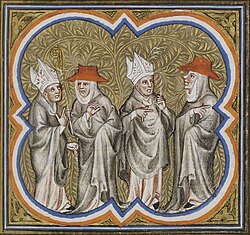
Pope Gregory IX issued Parens scientiarum, granting the University of Paris self-governance and academic privileges after student riots. Often called the 'Magna Carta' of universities, it strengthened institutional learning and made Paris the premier center of theology in Europe.
Image source: University of Paris
1271 - 1295
% complete
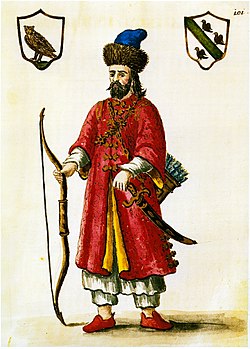
Venetian merchant Marco Polo traveled with his father and uncle along the Silk Road to the court of Kublai Khan in China. His account of the journey, dictated while imprisoned in Genoa, inspired European curiosity about Asia and later explorers including Christopher Columbus.
Image source: Marco Polo
1315 - 1317
% complete
Torrential rains ruined harvests across northern Europe, causing crop failures, skyrocketing food prices, and mass starvation. Millions died, social order broke down in places, and the famine weakened populations just decades before the Black Death struck the continent.
Image source: Great Famine of 1315–1317
1320
% complete
Florentine exile Dante Alighieri finished his epic poem describing a journey through Hell, Purgatory, and Paradise. Written in Tuscan vernacular rather than Latin, the Comedy established Italian as a literary language and stands as one of the greatest works of world literature.
Image source: Divine Comedy
1347 - 1351
% complete
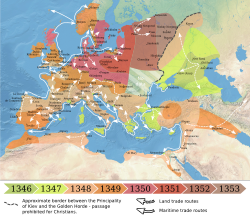
Bubonic plague arrived via Genoese ships at Messina and spread rapidly across Europe, killing between one-third and one-half of the population. The demographic catastrophe disrupted economies, undermined feudal structures, provoked religious fervor and persecution, and reshaped European society permanently.
Image source: Black Death
1440
% complete
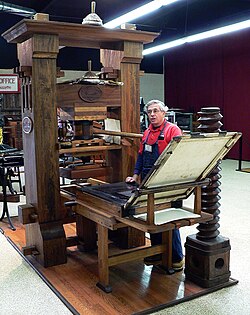
Johannes Gutenberg developed movable metal type printing in Mainz, producing the celebrated 42-line Bible around 1455. Mass production of books dramatically lowered costs, spread literacy and ideas, and revolutionized communication, fueling the Renaissance and Reformation to come.
Image source: Printing press
Or browse the full history timeline directory, with more than 2,000 topics.
This Late Middle Ages timeline was generated with the help of AI, using information found on the internet.
We work hard to keep these timelines accurate, but mistakes do get through. If you spot one, email us at [email protected] and we'll fix it for future visitors.
Generate yours with AI or build it from scratch, for free.
Export your timeline, add your own events, edit or remove AI-generated events, and much more
No credit card required.
Cancel anytime.
Cancel anytime.
You can create an unlimited number of timelines with up to 10 events on each one, customize how they look, export them to PDF, PNG, PowerPoint, CSV, and Excel, and share them with a link. Paid plans raise the event limit and add features like spreadsheet imports and collaborators.
Yes. You can cancel your subscription from your account page at any time, and you will not be charged again. Your subscription stays active for the rest of the period you already paid for.
Yes. We will email you a reminder before the annual renewal, and we will also email you a receipt.
Yes. You can email us within 15 days of any payment, and we will issue you a full refund.
Check out our pricing docs or send us an email anytime: [email protected].