-
Use Cases
-
Resources
-
Pricing
The Soviet Space Program was the rocketry and space exploration effort of the USSR, which achieved historic firsts including the first artificial satellite (Sputnik 1), the first human in space (Yuri Gagarin), the first woman in space (Valentina Tereshkova), and pioneering lunar, Venusian, and Mars probes. Driven by Cold War competition with the United States, it operated from the mid-1950s until the dissolution of the Soviet Union in 1991. More Less
Aug 1946
% complete
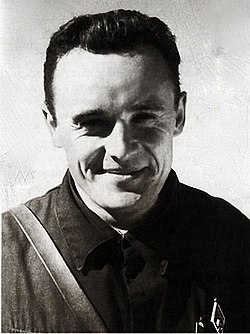
Sergei Korolev was appointed chief designer of long-range ballistic missiles, laying the organizational foundation for the Soviet space program. Drawing on German V-2 technology and Soviet engineering talent, his bureau at OKB-1 would go on to develop the rockets that launched the first satellites, animals, and humans into space.
Image source: Sergei Korolev
Aug 21, 1957
% complete
The R-7 Semyorka completed its first successful full-range test flight, becoming the world's first operational intercontinental ballistic missile. Its powerful design made it ideal as a space launch vehicle, and modified versions launched Sputnik 1, the first cosmonauts, and many later missions.
Image source: R-7 (rocket family)
Oct 4, 1957
% complete
The Soviet Union launched Sputnik 1, a polished metal sphere transmitting radio pulses, aboard an R-7 rocket from Baikonur Cosmodrome. It became the first artificial satellite to orbit Earth, shocking the world, igniting the Space Race with the United States, and demonstrating Soviet technological prowess.
Image source: Sputnik 1
Nov 3, 1957
% complete
Sputnik 2 carried Laika, a stray dog from Moscow, into orbit, making her the first living creature to circle Earth. The mission proved that a living organism could survive launch and weightlessness, though Laika died within hours due to overheating, as no reentry plan existed.
Image source: Laika
Feb 21, 1969
% complete
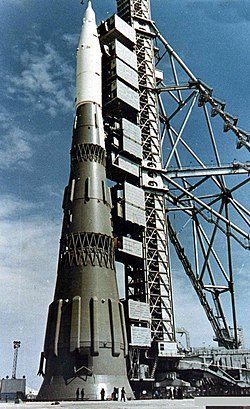
The N1, the Soviet Union's giant super-heavy-lift rocket intended for crewed lunar landings, broke apart shortly after liftoff on its first test flight. Subsequent failures, including a catastrophic pad explosion in July 1969, doomed the Soviet crewed lunar program before any cosmonaut reached the Moon.
Image source: N1 (rocket)
Nov 15, 1988
% complete
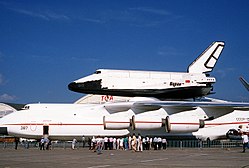
Buran, the Soviet Union's answer to the US Space Shuttle, completed an unpiloted orbital flight and automatic runway landing — a feat never matched by NASA's shuttles. The program was cancelled after the collapse of the Soviet Union, and Buran was destroyed when its hangar collapsed in 2002.
Image source: Buran (spacecraft)
Jan 2, 1959
% complete
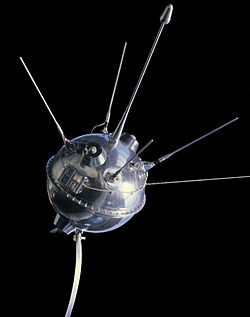
Luna 1 became the first spacecraft to reach escape velocity from Earth and pass near the Moon. Intended to impact the lunar surface, it missed by about 6,000 kilometers and entered orbit around the Sun, but it detected no lunar magnetic field and released sodium vapor visible from Earth.
Image source: Luna 1
Sep 14, 1959
% complete
Luna 2 impacted the Moon east of Mare Imbrium, becoming the first human-made object to reach another celestial body. It carried Soviet pennants and confirmed the absence of a significant lunar magnetic field, marking a major propaganda and scientific victory for the USSR.
Image source: Luna 2
Oct 7, 1959
% complete
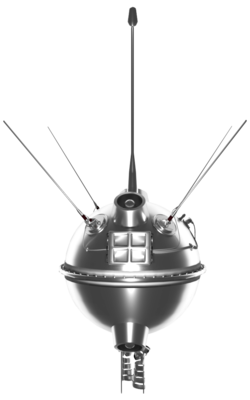
Luna 3 swung around the Moon and transmitted the first-ever images of its far side, which is never visible from Earth. The grainy photographs revealed that the far side had fewer maria than the near side, and led to the naming of features such as the Sea of Moscow.
Image source: Luna 3
Feb 3, 1966
% complete
Luna 9 touched down gently in Oceanus Procellarum and transmitted the first photographs taken from the lunar surface, proving that a lander would not sink into deep dust. The images were received by the Jodrell Bank Observatory and published worldwide before official Soviet release.
Image source: Luna 9
Apr 3, 1966
% complete
Luna 10 entered lunar orbit, becoming the first artificial satellite of the Moon. It broadcast the Internationale to the Communist Party Congress and conducted months of scientific measurements of the lunar environment, including radiation levels and micrometeoroid flux.
Image source: Luna 10
Jun 12, 1967 - Oct 18, 1967
% complete
Venera 4 became the first probe to transmit data directly from another planet's atmosphere, descending through Venus's clouds and measuring temperature, pressure, and composition before being crushed. It revealed that Venus's atmosphere was mostly carbon dioxide, reshaping scientific understanding of the planet.
Image source: Venera 4
Sep 15, 1968 - Sep 21, 1968
% complete
Zond 5 carried tortoises, insects, plants, and other lifeforms on a circumlunar trajectory, returning them safely to Earth after looping around the Moon. It was the first spacecraft to carry living beings around the Moon and back, demonstrating systems needed for a crewed lunar mission.
Image source: Zond 5
Sep 12, 1970 - Sep 24, 1970
% complete
Luna 16 landed in Mare Fecunditatis, drilled about 100 grams of lunar soil, and returned it to Earth — the first successful robotic sample return mission. It demonstrated that uncrewed probes could retrieve material from another world, complementing the Apollo crewed sample returns.
Image source: Luna 16
Nov 17, 1970 - Oct 4, 1971
% complete
Delivered by Luna 17, Lunokhod 1 became the first remote-controlled rover to operate on another celestial body. Over ten months it traveled more than 10 kilometers across Mare Imbrium, returning tens of thousands of television images and conducting soil analyses along its route.
Image source: Lunokhod 1
Dec 15, 1970
% complete
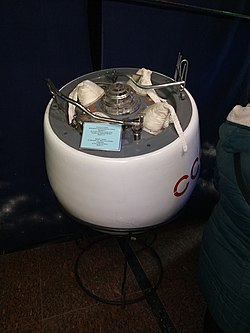
Venera 7 became the first spacecraft to successfully soft-land on another planet, touching down on Venus and transmitting surface data for about 23 minutes. It measured a scorching surface temperature near 475 degrees Celsius and crushing pressures, confirming Venus as an infernal world.
Image source: Venera 7
May 28, 1971 - Dec 2, 1971
% complete
Mars 3 achieved the first soft landing on Mars, but its lander transmitted for only about 20 seconds before going silent, possibly due to a dust storm or electrical failure. Despite the brief signal, it marked the first human-made object to reach the Martian surface intact.
Image source: Mars 3
Mar 1, 1982
% complete
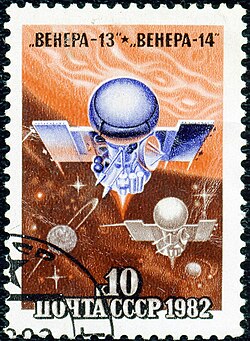
Venera 13 landed on Venus and survived for 127 minutes — far beyond its design life — transmitting the first color panoramic photographs of the planet's rocky, orange-hued surface. It also analyzed soil samples with an X-ray fluorescence spectrometer, finding basalt-like rock.
Image source: Venera 13
Apr 12, 1961
% complete
Yuri Gagarin completed one orbit of Earth aboard Vostok 1, becoming the first human in space. His 108-minute flight made him an international celebrity and a symbol of Soviet achievement, and April 12 is still celebrated worldwide as the International Day of Human Space Flight.
Image source: Vostok 1
Aug 6, 1961 - Aug 7, 1961
% complete
Gherman Titov flew aboard Vostok 2 for over 25 hours, completing more than 17 orbits of Earth. At age 25 he remains the youngest person ever to fly in space, and he was the first person to sleep in orbit and the first to experience space sickness.
Image source: Vostok 2
Aug 11, 1962 - Aug 15, 1962
% complete
Andriyan Nikolayev aboard Vostok 3 and Pavel Popovich aboard Vostok 4 flew nearly simultaneously, passing within about 5 kilometers of each other. The mission demonstrated the ability to coordinate multiple crewed spacecraft in orbit and studied how cosmonauts tolerated longer durations in weightlessness.
Image source: Vostok 3 and 4
Jun 16, 1963 - Jun 19, 1963
% complete
Valentina Tereshkova flew aboard Vostok 6, spending almost three days in orbit and completing 48 circuits of Earth. She remains the only woman to have flown a solo space mission, and her flight was a major showcase of Soviet claims to gender equality and technological leadership.
Image source: Valentina Tereshkova
Oct 12, 1964 - Oct 13, 1964
% complete
Voskhod 1 carried three cosmonauts — Vladimir Komarov, Konstantin Feoktistov, and Boris Yegorov — into orbit without spacesuits, a risky decision made to beat American Gemini flights. It was the first spacecraft with more than one person aboard and included the first physician and civilian engineer in space.
Image source: Voskhod 1
Mar 18, 1965
% complete
Alexei Leonov exited Voskhod 2 through an inflatable airlock and spent about 12 minutes floating free in space, tethered to the spacecraft. His suit ballooned in vacuum, forcing him to vent air to squeeze back inside, but the mission achieved the first extravehicular activity in history.
Image source: Voskhod 2
Apr 23, 1967 - Apr 24, 1967
% complete
Soyuz 1, piloted by Vladimir Komarov, suffered solar panel failures and attitude control problems in orbit. During reentry the parachute system failed, and the capsule crashed at high speed, killing Komarov — the first in-flight spaceflight fatality — and delaying further Soyuz missions for over a year.
Image source: Soyuz 1
Jan 16, 1969
% complete
Soyuz 4 and Soyuz 5 docked in orbit, and two cosmonauts performed an external transfer between the vehicles. The mission demonstrated docking techniques essential for lunar missions and created, briefly, the first experimental space station structure composed of two linked spacecraft.
Image source: Soyuz 4
Jul 15, 1975 - Jul 24, 1975
% complete
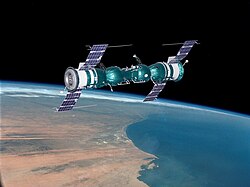
An Apollo spacecraft carrying American astronauts docked with a Soviet Soyuz in orbit, allowing crews to visit each other's ships. The joint mission symbolized détente between the superpowers and established technical standards and goodwill that foreshadowed later international cooperation in space.
Image source: Apollo–Soyuz
Apr 19, 1971 - Oct 11, 1971
% complete
Salyut 1 became the world's first space station, placed in orbit to test long-duration habitation. The crew of Soyuz 11 spent 23 days aboard, but all three cosmonauts died during reentry when their capsule depressurized, leading to redesigns of the Soyuz spacecraft.
Image source: Salyut 1
Feb 20, 1986 - Mar 23, 2001
% complete
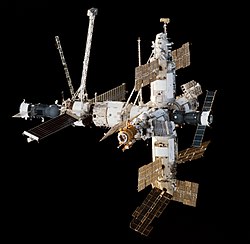
Mir, the first modular space station, was assembled in orbit over a decade and hosted cosmonauts and astronauts from many nations. It set records for continuous human presence in space and long single stays, including Valeri Polyakov's 437-day mission, before being deorbited into the Pacific Ocean in 2001.
Image source: Mir
Or browse the full history timeline directory, with more than 2,000 topics.
This Soviet Space Program timeline was generated with the help of AI, using information found on the internet.
We work hard to keep these timelines accurate, but mistakes do get through. If you spot one, email us at [email protected] and we'll fix it for future visitors.
Generate yours with AI or build it from scratch, for free.
Export your timeline, add your own events, edit or remove AI-generated events, and much more
No credit card required.
Cancel anytime.
Cancel anytime.
You can create an unlimited number of timelines with up to 10 events on each one, customize how they look, export them to PDF, PNG, PowerPoint, CSV, and Excel, and share them with a link. Paid plans raise the event limit and add features like spreadsheet imports and collaborators.
Yes. You can cancel your subscription from your account page at any time, and you will not be charged again. Your subscription stays active for the rest of the period you already paid for.
Yes. We will email you a reminder before the annual renewal, and we will also email you a receipt.
Yes. You can email us within 15 days of any payment, and we will issue you a full refund.
Check out our pricing docs or send us an email anytime: [email protected].