-
Use Cases
-
Resources
-
Pricing
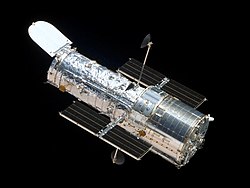
The Hubble Space Telescope is a NASA-ESA observatory launched in 1990 that orbits Earth above the atmosphere's distortion. Despite an initial flawed mirror corrected by astronauts in 1993, Hubble has revolutionized astronomy with stunning images and discoveries about the universe's age, expansion, black holes, and distant galaxies. More Less
1946
% complete
Astronomer Lyman Spitzer authored a report advocating for a large telescope in space, arguing it could observe the universe free from Earth's atmosphere. His vision laid the intellectual foundation for what would eventually become the Hubble Space Telescope.
Image source: Lyman Spitzer
1977
% complete
NASA secured congressional funding for the Large Space Telescope project, with the European Space Agency joining as a partner contributing instruments and solar panels in exchange for observing time. The mission was later renamed the Hubble Space Telescope.
Image source: Hubble Space Telescope
1981
% complete
Perkin-Elmer Corporation finished grinding and polishing Hubble's 2.4-meter primary mirror to extraordinary precision. Tragically, a testing error left the mirror's edge too flat by a fraction of a human hair, a flaw that would later require corrective optics.
1985
% complete
NASA formalized its Great Observatories program, positioning Hubble alongside future missions like Compton, Chandra, and Spitzer to observe the universe across multiple wavelengths, with Hubble serving as the flagship visible-light observatory.
Image source: Great Observatories program
Jan 28, 1986
% complete
The destruction of the Space Shuttle Challenger grounded the shuttle fleet for nearly three years, postponing Hubble's planned launch. During the delay, engineers performed extensive testing and improvements on the telescope while it was stored in a clean room.
Image source: Space Shuttle Challenger disaster
Apr 24, 1990
% complete
The Space Shuttle Discovery carried Hubble into orbit at an altitude of about 540 kilometers. The following day, astronauts deployed the telescope from the shuttle's cargo bay, beginning its journey as humanity's premier observatory above the atmosphere.
Image source: STS-31
Jun 1990
% complete
After initial images came back disappointingly blurry, scientists diagnosed spherical aberration caused by the misfigured primary mirror. The flaw limited Hubble's capabilities and became an embarrassment for NASA, prompting plans for a repair mission.
Dec 2, 1993 - Dec 13, 1993
% complete
Astronauts aboard the Space Shuttle Endeavour installed corrective optics (COSTAR) and replaced the Wide Field and Planetary Camera during an ambitious eleven-day mission. The repair restored Hubble's promised sharpness, marking one of NASA's greatest triumphs.
Image source: STS-61
Feb 11, 1997 - Feb 21, 1997
% complete
Discovery astronauts replaced the Goddard High Resolution Spectrograph and Faint Object Spectrograph with new instruments, including the Space Telescope Imaging Spectrograph, extending Hubble's infrared and imaging capabilities.
Image source: STS-82
Dec 19, 1999 - Dec 27, 1999
% complete
After gyroscopic failures forced Hubble into safe mode, Discovery astronauts conducted an urgent repair mission, replacing all six gyroscopes along with a fine guidance sensor and computer upgrades, restoring the telescope to full operation.
Image source: STS-103
Mar 1, 2002 - Mar 12, 2002
% complete
Columbia astronauts installed the Advanced Camera for Surveys, which dramatically increased Hubble's discovery efficiency, and replaced the solar arrays with smaller, more powerful ones, giving the telescope renewed vigor.
Image source: STS-109
May 11, 2009 - May 24, 2009
% complete
Atlantis astronauts performed the most ambitious upgrade yet, installing Wide Field Camera 3, repairing the Advanced Camera for Surveys and Space Telescope Imaging Spectrograph, and adding new batteries and gyros, extending Hubble's life well into the 2020s.
Image source: STS-125
1994 - 1999
% complete
Hubble's multi-year Key Project measured Cepheid variable stars in nearby galaxies to precisely determine the rate of cosmic expansion, pinning down the age of the universe at approximately 12 to 14 billion years.
Image source: Hubble's law
Jul 16, 1994 - Jul 22, 1994
% complete
Hubble provided spectacular images of comet fragments slamming into Jupiter, creating Earth-sized fireball scars in the planet's atmosphere. The event demonstrated Hubble's unique ability to capture dynamic phenomena across the solar system.
Image source: Comet Shoemaker–Levy 9
Dec 18, 1995 - Dec 28, 1995
% complete
Hubble stared at a tiny, seemingly empty patch of sky for ten consecutive days, revealing thousands of previously unseen galaxies. The Hubble Deep Field revolutionized astronomy by showing that the early universe was densely populated with forming galaxies.
Image source: Hubble Deep Field
1997
% complete
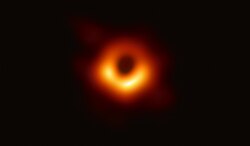
Using Hubble observations, astronomers confirmed that supermassive black holes reside at the centers of many galaxies, including compelling evidence from gas dynamics near galactic cores. This work cemented the link between black holes and galaxy evolution.
Image source: Supermassive black hole
1998
% complete
Two teams using Hubble observations of distant supernovae discovered that the universe's expansion is speeding up, implying the existence of dark energy. The finding earned the 2011 Nobel Prize in Physics and transformed cosmology.
Image source: Accelerating expansion of the universe
Nov 27, 2001
% complete
Hubble detected sodium in the atmosphere of an exoplanet transiting its star, the first direct detection of an exoplanet's atmosphere. This pioneering observation opened the field of comparative exoplanetology.
Image source: HD 209458 b
Sep 24, 2003 - Jan 16, 2004
% complete
Hubble accumulated roughly one million seconds of exposure on a small region of the constellation Fornax, producing the deepest image of space ever taken at the time. It revealed galaxies dating back to within a few hundred million years of the Big Bang.
Image source: Hubble Ultra-Deep Field
Jun 15, 2005
% complete
Using Hubble imagery, astronomers discovered two small moons orbiting Pluto beyond Charon. The discovery expanded understanding of the Pluto system ahead of the New Horizons flyby and revealed the complexity of Kuiper Belt objects.
Image source: Nix (moon)
Nov 2013
% complete
Hubble began using massive galaxy clusters as natural gravitational lenses to magnify extremely distant background galaxies, pushing observations closer to the era of first galaxy formation than ever before.
Image source: Hubble Space Telescope
Dec 3, 2013
% complete
Hubble spectroscopy revealed clear evidence of water vapor in the atmosphere of the exoplanet Tau Boötis b, demonstrating the telescope's power to probe the chemical composition of worlds light-years away.
Image source: Tau Boötis b
Apr 25, 2019
% complete
Hubble measurements of nearby Cepheids and supernovae refined the local expansion rate with high precision, deepening the 'Hubble tension' — a significant mismatch between local measurements and those inferred from the cosmic microwave background.
Image source: Hubble's law
Oct 12, 2019
% complete
Hubble captured detailed images of 2I/Borisov, only the second known interstellar object to visit our solar system, providing unprecedented views of material originating from another star system.
Image source: 2I/Borisov
Apr 2020
% complete
Hubble documented the dramatic disintegration of Comet ATLAS into dozens of fragments, offering rare insight into how comets die and providing clues about the structure of cometary nuclei.
Image source: C/2019 Y4 (ATLAS)
Oct 4, 2011
% complete
Saul Perlmutter, Brian Schmidt, and Adam Riess received the Nobel Prize for the discovery of the accelerating universe, a breakthrough enabled substantially by Hubble's precise supernova distance measurements.
Image source: List of Nobel laureates in Physics
May 2, 2019
% complete
Astronomers assembled nearly 7,500 exposures taken over 16 years into a single panoramic portrait containing roughly 265,000 galaxies, stretching back 13.3 billion years — a monumental legacy dataset for future research.
Image source: Hubble Legacy Field
Apr 24, 2020
% complete
Three decades after launch, Hubble had made over 1.4 million observations and contributed to more than 16,000 scientific papers. NASA celebrated the anniversary despite the pandemic, highlighting the telescope's enduring scientific and cultural impact.
Jun 13, 2021 - Jul 15, 2021
% complete
Hubble entered safe mode after its payload computer stopped responding. Engineers spent weeks diagnosing the issue before identifying a faulty power control unit, successfully switching to backup hardware and resuming full science operations.
Dec 25, 2021
% complete
NASA launched the James Webb Space Telescope, designed to complement and extend Hubble's work with powerful infrared observations. Rather than replacing Hubble, Webb joined it in a continuing partnership exploring the cosmos.
Image source: James Webb Space Telescope
Or browse the full history timeline directory, with more than 2,000 topics.
This Hubble Space Telescope timeline was generated with the help of AI, using information found on the internet.
We work hard to keep these timelines accurate, but mistakes do get through. If you spot one, email us at [email protected] and we'll fix it for future visitors.
Generate yours with AI or build it from scratch, for free.
Export your timeline, add your own events, edit or remove AI-generated events, and much more
No credit card required.
Cancel anytime.
Cancel anytime.
You can create an unlimited number of timelines with up to 10 events on each one, customize how they look, export them to PDF, PNG, PowerPoint, CSV, and Excel, and share them with a link. Paid plans raise the event limit and add features like spreadsheet imports and collaborators.
Yes. You can cancel your subscription from your account page at any time, and you will not be charged again. Your subscription stays active for the rest of the period you already paid for.
Yes. We will email you a reminder before the annual renewal, and we will also email you a receipt.
Yes. You can email us within 15 days of any payment, and we will issue you a full refund.
Check out our pricing docs or send us an email anytime: [email protected].