-
Use Cases
-
Resources
-
Pricing
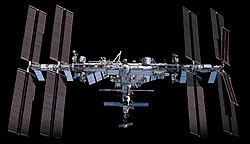
The International Space Station (ISS) is a habitable modular space station in low Earth orbit, jointly built and operated by NASA, Roscosmos, ESA, JAXA, and CSA. Launched beginning in 1998, it has served continuously as a microgravity laboratory for scientific research, technology demonstrations, and international cooperation, hosting crews of astronauts from around the world since November 2000. More Less
Jan 25, 1984
% complete
In his State of the Union address, President Ronald Reagan directed NASA to build a permanently crewed space station within a decade. The project, initially called Space Station Freedom, laid the groundwork for what would eventually become the International Space Station after years of redesigns and budget struggles.
Image source: Space Station Freedom
Mar 14, 1995
% complete
The Space Shuttle Atlantis docked with the Russian space station Mir during STS-71, marking the first docking between a US shuttle and a Russian station. This Shuttle-Mir program built critical operational experience and international trust that paved the way for the International Space Station partnership.
Image source: Shuttle–Mir program
Jan 29, 1998
% complete
Fifteen nations, including the United States, Russia, Japan, Canada, and members of the European Space Agency, signed the Intergovernmental Agreement establishing the framework for the design, development, operation, and utilization of the International Space Station.
Image source: International Space Station program
Nov 20, 1998
% complete
A Russian Proton-K rocket launched Zarya, the Functional Cargo Block funded by the United States but built by Russia, into orbit. As the first component of the International Space Station, Zarya provided initial propulsion, power, and storage during the early stages of assembly.
Image source: Zarya (ISS module)
Dec 6, 1998
% complete
During mission STS-88, astronauts Jerry Ross and James Newman performed three spacewalks to attach the American-built Unity connecting node to Zarya, creating the first two-module configuration of the International Space Station.
Image source: Unity (ISS module)
Jul 26, 2000
% complete
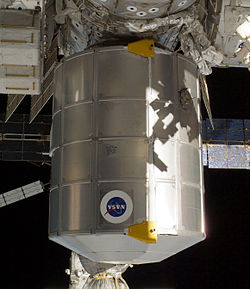
The Russian Zvezda service module docked with the orbiting complex, providing living quarters, life support systems, and attitude control. Its arrival made the station habitable for the first time and enabled permanent human presence in orbit.
Image source: Zvezda (ISS module)
Dec 3, 2000
% complete
Astronauts installed the P6 truss segment with its pair of solar array wings, temporarily mounted on top of the station's backbone. These arrays provided crucial additional electrical power to support expanded operations and scientific work.
Image source: Integrated Truss Structure
Feb 10, 2001
% complete
Space Shuttle Atlantis delivered the US Destiny laboratory, the primary research facility for science experiments aboard the station. Destiny became the centerpiece of American scientific operations in orbit.
Image source: Destiny (ISS module)
Apr 19, 2001
% complete
Space Shuttle Endeavour carried the Canadian-built Canadarm2, also known as the Space Station Remote Manipulator System, to the ISS. The 17-meter robotic arm became essential for capturing visiting spacecraft and maneuvering large modules during assembly.
Image source: Mobile Servicing System
Jul 15, 2001
% complete
Space Shuttle Atlantis delivered the Quest Joint Airlock, allowing both American EMU spacesuits and Russian Orlan suits to be used for spacewalks from the station, greatly expanding extravehicular activity capabilities.
Image source: Quest Joint Airlock
Apr 11, 2002
% complete
Space Shuttle Atlantis delivered the S0 truss, the center segment of the Integrated Truss Structure, which was mounted atop the Destiny laboratory. It served as the foundation for future truss segments and housed critical systems including the Mobile Transporter.
Jun 5, 2002
% complete
With the delivery of the Mobile Base System by Space Shuttle Endeavour on STS-111, Canadarm2 gained the ability to move along rails spanning the station's truss, dramatically increasing its reach and utility for construction tasks.
Image source: Mobile Servicing System
Sep 12, 2006
% complete
Shuttle missions resumed after the Columbia disaster, and Atlantis delivered the P3/P4 truss with its solar arrays during STS-115, followed by further segments, steadily doubling the station's electrical generating capacity as assembly resumed in earnest.
Oct 23, 2007
% complete
Space Shuttle Discovery delivered the Harmony connecting node, which later became the attachment point for the European Columbus laboratory and the Japanese Kibo experiment module, expanding the station's international research capacity.
Image source: Harmony (ISS module)
Feb 11, 2008
% complete
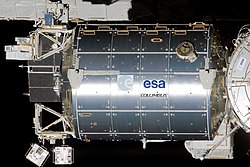
Space Shuttle Atlantis delivered the European Space Agency's Columbus laboratory, Europe's primary research facility aboard the station. Columbus hosts experiments in biology, fluid physics, materials science, and human physiology.
Image source: Columbus (ISS module)
Mar 11, 2008 - Jul 31, 2009
% complete
Across three shuttle flights, the Japanese Experiment Module Kibo was assembled on the station, becoming the largest single laboratory module. It includes an exposed facility for external experiments and its own small robotic arm.
Image source: Kibō (ISS module)
Feb 8, 2010
% complete
Space Shuttle Endeavour delivered the Tranquility node with the seven-window Cupola, providing panoramic views of Earth and serving as the primary control post for Canadarm2 operations during spacecraft captures.
Image source: Cupola (ISS module)
May 18, 2010
% complete
Space Shuttle Atlantis carried the Russian Rassvet module to the station, where it was attached to the Zarya nadir port. Rassvet provides additional storage space and a new docking port for Soyuz and Progress spacecraft.
Image source: Rassvet (ISS module)
Mar 1, 2011
% complete
During STS-133, the Italian-built Leonardo logistics module was permanently attached to the station as the Permanent Multipurpose Module, converting from a reusable cargo carrier into a fixed storage facility.
Image source: Leonardo (ISS module)
Jul 21, 2011
% complete
Space Shuttle Atlantis landed after mission STS-135, concluding NASA's Space Shuttle program. With the station essentially complete at over 400 metric tons, resupply shifted to Russian, European, Japanese, and soon commercial American vehicles.
Image source: STS-135
Jul 29, 2021
% complete
After years of delays, Russia's Nauka multipurpose laboratory module docked with the Zvezda nadir port. Hours later its thrusters accidentally fired, briefly tilting the entire station before ground controllers restored attitude control.
Image source: Nauka (ISS module)
Nov 2, 2000
% complete
Commander Bill Shepherd and cosmonauts Yuri Gidzenko and Sergei Krikalev arrived aboard a Soyuz TM-31 spacecraft, becoming the first long-duration crew of the International Space Station. Their arrival began an unbroken human presence in low Earth orbit that continues today.
Image source: Expedition 1
May 29, 2009
% complete
With the arrival of Expedition 20 crew members via Soyuz TMA-15, the station's population grew from three to six residents for the first time, enabling significantly more hours of scientific research each week.
Image source: Expedition 20
Sep 17, 2009
% complete
Japan's uncrewed HTV cargo spacecraft successfully berthed with the ISS, demonstrating a new automated resupply capability and delivering supplies, spare parts, and experiments to the growing outpost.
Image source: H-II Transfer Vehicle
May 25, 2012
% complete
SpaceX's Dragon spacecraft became the first commercial vehicle to berth with the ISS during its demonstration flight, ushering in a new era of commercially operated resupply missions under NASA's Commercial Resupply Services contracts.
Image source: SpaceX CRS-1
May 30, 2020 - Aug 2, 2020
% complete
NASA astronauts Bob Behnken and Doug Hurley flew SpaceX's Crew Dragon to the ISS, marking the first crewed orbital launch from American soil since 2011 and restoring independent US crew transportation to the station.
Image source: Crew Dragon Demo-2
May 19, 2011
% complete
Space Shuttle Endeavour delivered the Alpha Magnetic Spectrometer-2, a state-of-the-art particle physics detector searching for dark matter, antimatter, and cosmic rays. It has collected billions of cosmic ray events since installation.
Image source: Alpha Magnetic Spectrometer
Apr 16, 2016
% complete
The BEAM experimental inflatable habitat was attached to the Tranquility node and expanded to full size, testing expandable module technology that could reduce launch mass and volume for future deep space habitats.
Image source: Bigelow Expandable Activity Module
Sep 2, 2017
% complete
Astronaut Peggy Whitson returned to Earth after 288 days in space, bringing her cumulative total to 665 days, the most of any American astronaut. During her Expedition 50/51/52 stay she conducted four spacewalks and extensive life science research.
Image source: Peggy Whitson
Nov 2, 2020
% complete
The International Space Station marked two decades of continuous human habitation, having hosted more than 240 visitors from 19 countries and supported thousands of experiments in microgravity across biology, physics, astronomy, and human health.
Image source: International Space Station
Or browse the full history timeline directory, with more than 2,000 topics.
This International Space Station timeline was generated with the help of AI, using information found on the internet.
We work hard to keep these timelines accurate, but mistakes do get through. If you spot one, email us at [email protected] and we'll fix it for future visitors.
Generate yours with AI or build it from scratch, for free.
Export your timeline, add your own events, edit or remove AI-generated events, and much more
No credit card required.
Cancel anytime.
Cancel anytime.
You can create an unlimited number of timelines with up to 10 events on each one, customize how they look, export them to PDF, PNG, PowerPoint, CSV, and Excel, and share them with a link. Paid plans raise the event limit and add features like spreadsheet imports and collaborators.
Yes. You can cancel your subscription from your account page at any time, and you will not be charged again. Your subscription stays active for the rest of the period you already paid for.
Yes. We will email you a reminder before the annual renewal, and we will also email you a receipt.
Yes. You can email us within 15 days of any payment, and we will issue you a full refund.
Check out our pricing docs or send us an email anytime: [email protected].