-
Use Cases
-
Resources
-
Pricing
1907 - 1908
The United States and Japan reached an informal agreement under which Japan stopped issuing passports to laborers traveling to the continental United States, while President Theodore Roosevelt's administration opposed San Francisco's segregation of Japanese American schoolchildren. The agreement restricted Japanese immigration without formally barring all Japanese immigrants.
1913
California enacted an alien land law barring immigrants ineligible for citizenship—primarily Japanese and other Asian immigrants—from owning agricultural land. The statute limited leases and property rights and became a major component of institutional discrimination against Japanese Americans.
1920
California voters approved a stronger alien land law that prohibited immigrants ineligible for citizenship from leasing agricultural land and used anti-evasion provisions to target Japanese American farmers. Japanese American communities responded by using citizen children and corporations to preserve farms and businesses.
Nov 13, 1922
The Supreme Court unanimously ruled that Takao Ozawa, a Japanese immigrant who had lived in the United States for decades, was not eligible for naturalization because he was not legally classified as white. The decision reinforced racial restrictions on citizenship.
May 24, 1924
The Immigration Act of 1924 established national-origins quotas and excluded immigrants who were ineligible for citizenship, effectively ending immigration from Japan. It intensified the legal isolation of Japanese American communities and divided many families between Japan and the United States.
Image source: Immigration Act of 1924
Dec 7, 1941
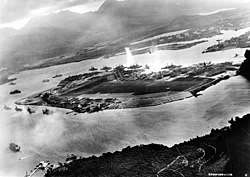
Japan's attack on Pearl Harbor brought the United States into World War II. Although Japanese Americans overwhelmingly supported the United States, public suspicion and military fears rapidly focused on them because of their ancestry.
Image source: Attack on Pearl Harbor
Dec 7, 1941 - Dec 8, 1941
Immediately after Pearl Harbor, the FBI arrested thousands of Issei community leaders, including Buddhist priests, language-school teachers, Japanese association officers, and businesspeople. Officials generally selected people from secret lists and detained them without individualized proof of espionage or sabotage.
Dec 7, 1941
The Treasury Department froze Japanese American bank accounts and other assets under wartime regulations. The action disrupted businesses, farms, and families and made it difficult for detainees to pay mortgages, taxes, employees, or legal expenses.
Feb 19, 1942
President Franklin D. Roosevelt signed Executive Order 9066, authorizing military commanders to exclude any or all persons from designated military areas. The order did not name Japanese Americans, but it provided the legal framework for their mass removal from the West Coast.
Image source: Executive Order 9066
Mar 2, 1942
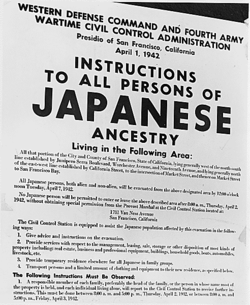
Western Defense Command issued curfew and movement restrictions for people of Japanese ancestry in designated military areas. Japanese Americans had to remain home during specified nighttime hours and carry identification, despite the absence of evidence that the population posed a collective security threat.
Mar 2, 1942
Lieutenant General John L. DeWitt issued Public Proclamation No. 1, dividing the West Coast into military areas and announcing that persons of Japanese ancestry would soon be excluded. The proclamation marked the beginning of the forced-removal process.
Mar 18, 1942
Executive Order 9102 created the War Relocation Authority, a civilian agency directed by Milton S. Eisenhower and later Dillon S. Myer. The WRA administered the incarceration camps and the forced relocation of Japanese Americans.
Image source: War Relocation Authority
Mar 21, 1942
Manzanar opened in California's Owens Valley and became one of the best-known incarceration centers. Ultimately, more than 10,000 Japanese Americans were held there, including many removed from Los Angeles and surrounding areas.
Image source: Manzanar
Mar 24, 1942
The first Civilian Exclusion Order, covering Bainbridge Island, Washington, required Japanese Americans to leave their homes and report for removal. Similar orders soon applied across the West Coast, usually allowing only a few days to prepare.
Mar 30, 1942
The U.S. Army removed 227 Japanese Americans from Bainbridge Island and transported them to the Manzanar Assembly Center. They were the first West Coast Japanese Americans forcibly removed under the exclusion program.
Apr 1, 1942
Large-scale removals began as Japanese Americans reported to temporary assembly centers, often located at fairgrounds, racetracks, and livestock facilities. Families were forced to sell or abandon homes, farms, businesses, and personal property at severe losses.
Apr 1942 - Jun 1942
The Army and WRA operated temporary assembly centers while permanent incarceration camps were constructed. More than 100,000 Japanese Americans lived in cramped barracks, converted exhibition halls, or horse stalls under military guard and surrounded by barbed wire.
May 1942 - Oct 1942
By the fall of 1942, approximately 120,000 people of Japanese ancestry had been confined in ten WRA camps. Around two-thirds were U.S. citizens, including many children, and nearly all had been removed without criminal charges or individual hearings.
Mar 20, 1943
The Army transferred primary responsibility for the mass detention program to the War Relocation Authority. This administrative shift formalized the WRA's central role in operating the ten permanent camps.
May 26, 1943
Tule Lake in northern California was converted into a maximum-security segregation center for people labeled disloyal after the WRA loyalty questionnaire. The center held more than 18,000 people and became the largest and most restrictive incarceration site.
Jun 21, 1943
The Supreme Court upheld Gordon Hirabayashi's convictions for violating the wartime curfew and exclusion orders. The ruling accepted the government's claim that military necessity justified race-based restrictions, although it did not directly approve the entire incarceration program.
Image source: Hirabayashi v. United States
Oct 11, 1944
The Supreme Court heard Fred Korematsu's challenge to his conviction for violating the exclusion order. Korematsu argued that the exclusion of Japanese Americans was unconstitutional racial discrimination.
Dec 17, 1944
The War Department announced that the West Coast exclusion orders would end on Jan. 2, 1945. Japanese Americans were permitted to return, although many still faced hostility, housing shortages, economic losses, and continuing restrictions.
Dec 18, 1944
The Supreme Court unanimously ruled that the government could not continue detaining a concededly loyal U.S. citizen. The case, brought by Mitsuye Endo, helped compel the administration to end the exclusion and begin closing the camps.
Dec 18, 1944
The Supreme Court upheld Fred Korematsu's conviction, distinguishing exclusion from the detention of loyal citizens. The decision accepted the government's assertion of military necessity and became one of the most criticized civil-liberties rulings in U.S. history.
1945 - Mar 20, 1946
The WRA closed the permanent camps as inmates returned to the West Coast or relocated elsewhere. The last WRA facility, Tule Lake, closed on March 20, 1946, leaving many families to rebuild lives after losing homes and livelihoods.
1942 - 1945
The Japanese American Citizens League generally cooperated with federal authorities during the war and promoted Nisei military service, believing that demonstrations of loyalty could secure civil rights. Its wartime stance later became controversial among former inmates and activists.
Image source: Japanese American Citizens League
Dec 5, 1942 - Dec 11, 1942
Tensions over informants, labor conditions, political factions, and the arrest of Harry Ueno led to protests and violence at Manzanar. Military police fired into a crowd, killing two inmates and wounding others, exposing the coercive conditions within the camps.
Feb 1943 - Mar 1943
The WRA administered a controversial questionnaire to adult inmates, including questions about willingness to serve in the U.S. military and to swear unqualified allegiance to the United States. Poor wording, family obligations, and distrust produced many 'no-no' answers and intensified divisions within the camps.
Feb 1, 1943
The U.S. Army activated the 442nd Regimental Combat Team, a segregated unit composed largely of Nisei volunteers. Its motto, 'Go for Broke,' came to symbolize Japanese American military service despite incarceration and discrimination at home.
Apr 1943
The 442nd Regimental Combat Team began training and later fought in Europe. Japanese American soldiers served with distinction while their families remained incarcerated, creating a powerful contradiction between military service and domestic exclusion.
1944
The Heart Mountain Fair Play Committee argued that Japanese American men should not be drafted while their families were imprisoned and their citizenship rights were suspended. Sixty-three resisters were convicted of draft violations, making the group one of the most visible organized challenges to the incarceration system.
Oct 30, 1944
The 442nd Regimental Combat Team rescued roughly 211 soldiers of the encircled 141st Regiment in the Vosges Mountains of France. The operation cost the 442nd hundreds of casualties and became one of its most celebrated actions.
Jul 2, 1948
Congress enacted the Japanese American Evacuation Claims Act, allowing some former inmates to seek compensation for documented property losses caused by removal. The law excluded many economic and personal harms and required extensive proof, so payments covered only a fraction of losses.
1952
In Oyama v. California, the Supreme Court struck down a discriminatory application of California's alien land law, ruling that it violated the equal-protection rights of a U.S.-born citizen. The decision weakened the legal structure that had targeted Japanese American landownership.
Jun 27, 1952
The Immigration and Nationality Act of 1952 eliminated racial bars to naturalization, allowing Issei and other Asian immigrants to become U.S. citizens. It retained national-origins quotas and other restrictions but ended one of the central legal disabilities imposed on Japanese immigrants.
1978 - 2021
Japanese American communities began organizing annual Day of Remembrance events to commemorate the signing of Executive Order 9066 and educate the public about incarceration. The observances became a national civil-rights tradition emphasizing the warning against government-sanctioned racial targeting.
Jul 31, 1980
Congress established the Commission on Wartime Relocation and Internment of Civilians to investigate the facts, circumstances, and consequences of the removal and detention of Japanese Americans and other civilians during World War II.
Dec 1982
The congressional commission published Personal Justice Denied, concluding that the incarceration resulted from 'race prejudice, war hysteria, and a failure of political leadership,' not military necessity. Its findings provided the foundation for a federal apology and monetary redress.
Nov 10, 1983
A federal district court in San Francisco vacated Fred Korematsu's wartime conviction after attorneys demonstrated that the government had withheld and altered evidence regarding the alleged military necessity of exclusion. The ruling did not overturn the Supreme Court precedent but cleared Korematsu's criminal record.
Aug 10, 1988
President Ronald Reagan signed the Civil Liberties Act, formally apologizing for the incarceration and authorizing $20,000 payments to each surviving eligible detainee. The law acknowledged that the policy was driven by racial prejudice, wartime hysteria, and political failure.
Oct 9, 1990
The federal government issued the first redress checks and apology letters to former Japanese American inmates. Nearly 82,000 eligible survivors ultimately received payments under the Civil Liberties Act.
Jan 15, 1998
President Bill Clinton awarded Fred Korematsu the Presidential Medal of Freedom for his lifelong commitment to civil rights. The honor recognized his challenge to wartime exclusion and his later role as an educator and advocate.
Image source: Fred Korematsu
Or browse the full history timeline directory, with more than 2,500 topics.
This Japanese American Internment timeline was generated with the help of AI, using information found on the internet.
We work hard to keep these timelines accurate, but mistakes do get through. If you spot one, email us at [email protected] and we'll fix it for future visitors.
Generate yours with AI or build it from scratch, for free.
Export your timeline, add your own events, edit or remove AI-generated events, and much more
No credit card required.
Cancel anytime.
Cancel anytime.
You can create an unlimited number of timelines with up to 10 events on each one, customize how they look, export them to PDF, PNG, PowerPoint, CSV, and Excel, and share them with a link. Paid plans raise the event limit and add features like spreadsheet imports and collaborators.
Yes. You can cancel your subscription from your account page at any time, and you will not be charged again. Your subscription stays active for the rest of the period you already paid for.
Yes. We will email you a reminder before the annual renewal, and we will also email you a receipt.
Yes. You can email us within 15 days of any payment, and we will issue you a full refund.
Check out our pricing docs or send us an email anytime: [email protected].