-
Use Cases
-
Resources
-
Pricing
Jul 30, 1619
% complete
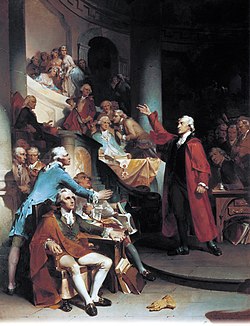
Virginia's House of Burgesses met at Jamestown in 1619 as the first elected legislative assembly in English America. Although voting was limited and the assembly remained subject to royal authority, it helped establish the tradition of representative government in the colonies.
Image source: House of Burgesses
Nov 11, 1620
% complete
The Mayflower Compact was signed by English colonists aboard the Mayflower before they established Plymouth Colony. It created a covenant for self-government and majority rule, establishing an early precedent for written constitutional arrangements in English North America.
Image source: Mayflower Compact
Jan 14, 1639
% complete
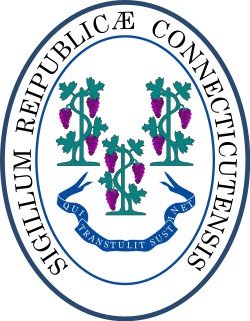
The Fundamental Orders of Connecticut established a representative government for several Connecticut River settlements. Often described as one of the first written constitutions, it organized elected offices and civic authority without relying on a separate colonial proprietor.
Image source: Fundamental Orders of Connecticut
Oct 28, 1701
% complete
William Penn's Charter of Privileges granted Pennsylvania's colonists a representative legislature, religious toleration, and protections for political participation. It became an influential example of colonial constitutional government and protected local authority within a proprietary colony.
Image source: Charter
Jun 19, 1754 - Jul 11, 1754
% complete
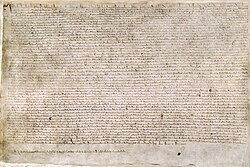
Delegates from seven colonies met at the Albany Congress during the French and Indian War. Benjamin Franklin's Albany Plan of Union proposed a central council for defense and administration, revealing both the possibilities and limits of intercolonial cooperation.
Image source: Albany Congress
Feb 10, 1763
% complete
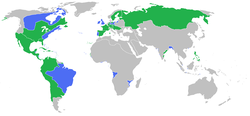
The Treaty of Paris ended the French and Indian War and transferred France's mainland North American possessions east of the Mississippi River to Great Britain. Britain's new debts and expanded empire prompted policies that intensified disputes over colonial taxation and political authority.
Image source: Treaty of Paris (1763)
Mar 22, 1765
% complete
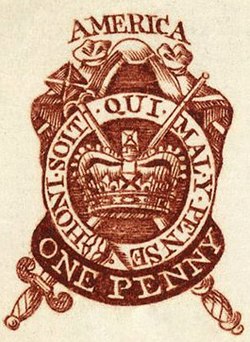
Parliament's Stamp Act imposed a direct tax on printed materials in the American colonies. Colonial protests popularized the argument that taxation required representation, while the Stamp Act Congress and resistance organizations strengthened intercolonial political cooperation.
Image source: Stamp Act 1765
Oct 19, 1765
% complete
Delegates from nine colonies adopted a Declaration of Rights and Grievances at the Stamp Act Congress. They asserted that colonists possessed the rights of English subjects and that only their own representatives could constitutionally impose internal taxes.
Image source: Stamp Act Congress
Jun 29, 1767
% complete
The Townshend Acts placed duties on imported goods and strengthened imperial enforcement in the colonies. Colonial resistance, boycotts, and constitutional arguments against taxation without representation further eroded confidence in Parliament's authority.
Image source: Townshend Acts
Mar 5, 1770
% complete
British soldiers killed five civilians during a confrontation in Boston. Patriot leaders used the incident to criticize military occupation and imperial rule, while John Adams's legal defense of the soldiers illustrated the emerging importance of due process and the rule of law.
Image source: Boston Massacre
Dec 16, 1773
% complete
Boston protestors destroyed tea belonging to the East India Company rather than accept Parliament's tea tax and the principle of taxation without colonial consent. Britain's punitive response transformed a local dispute into a broader constitutional crisis.
Image source: Boston Tea Party
Sep 5, 1774 - Oct 26, 1774
% complete
Delegates from twelve colonies met in Philadelphia to coordinate resistance to the Coercive Acts. The Congress adopted the Continental Association, petitioned King George III, and asserted colonial rights while still seeking reconciliation within the British Empire.
Image source: First Continental Congress
Apr 19, 1775
% complete
Fighting between Massachusetts militia and British troops at Lexington and Concord began the American Revolutionary War. The battles shifted the political dispute from constitutional protest to armed resistance and encouraged the colonies to organize a continental military response.
Image source: Battles of Lexington and Concord
May 10, 1775
% complete
The Second Continental Congress assumed national responsibilities during the Revolution. It created the Continental Army, appointed George Washington as commander, managed diplomacy and finance, and gradually moved toward declaring independence.
Image source: Second Continental Congress
Jul 4, 1776
% complete
The Continental Congress adopted the Declaration of Independence, announcing that the thirteen colonies were independent states. Drawing on natural-rights theory and the social-contract tradition, it justified revolution through principles of equality, consent, and resistance to tyranny.
Image source: United States Declaration of Independence
Nov 15, 1777
% complete
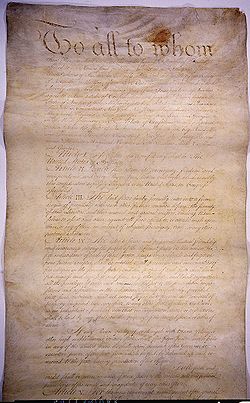
Congress adopted the Articles of Confederation as the first written framework for the United States. The document created a league of states with a weak central government, limited taxing power, and no independent executive or national judiciary.
Image source: Articles of Confederation
Sep 3, 1783
% complete
The Treaty of Paris ended the Revolutionary War and recognized the independence of the United States. It established national boundaries to the Mississippi River and gave the new republic an international legal foundation.
Image source: Treaty of Paris (1783)
May 20, 1785
% complete
The Land Ordinance of 1785 created a systematic rectangular survey of western lands and provided for their sale and settlement. Its reservation of sections for schools linked territorial administration to public education and established a durable federal land policy.
Image source: Land Ordinance of 1785
Aug 29, 1786 - Feb 25, 1787
% complete
Massachusetts farmers, many facing debt and foreclosure, resisted state courts and tax collection in Shays' Rebellion. The uprising exposed weaknesses in state and Confederation governance and strengthened calls for a more capable national government.
Image source: Shays' Rebellion
Sep 14, 1786
% complete
Delegates meeting at Annapolis called for a broader convention to address problems with interstate commerce and the Articles of Confederation. Their recommendation led directly to the Philadelphia Convention of 1787.
May 25, 1787 - Sep 17, 1787
% complete
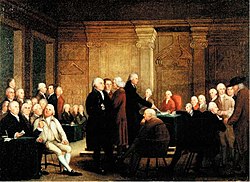
Delegates met in Philadelphia to revise the Articles of Confederation but eventually designed an entirely new constitutional system. Their debates addressed representation, federalism, executive power, judicial authority, slavery, and the balance between national and state governments.
Image source: Constitutional Convention (United States)
Jul 12, 1787
% complete
The convention counted three-fifths of enslaved people for purposes of congressional representation and direct taxation. The compromise strengthened the political power of slaveholding states while embedding slavery in the constitutional design.
Image source: Three-fifths Compromise
Jul 13, 1787
% complete
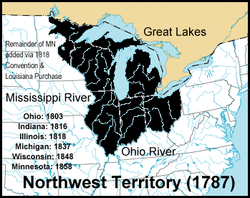
The Northwest Ordinance organized the territory north and west of the Ohio River and established a path from territorial status to statehood. It protected certain civil liberties, encouraged public education, and prohibited slavery in the territory.
Image source: Northwest Ordinance
Jul 16, 1787
% complete
The Great Compromise created a bicameral Congress with representation by population in the House and equal state representation in the Senate. It resolved the central dispute between large and small states and shaped the structure of the federal legislature.
Image source: Connecticut Compromise
Sep 17, 1787
% complete
Thirty-nine delegates signed the proposed Constitution in Philadelphia. The document established a federal republic based on enumerated powers, separated institutions, checks and balances, popular representation, and a process for amendment.
Image source: Constitution of the United States
Oct 27, 1787 - May 28, 1788
% complete
Alexander Hamilton, James Madison, and John Jay published essays under the name Publius to advocate ratification of the Constitution. The essays remain a major source for interpreting the framers' arguments about federalism, faction, separation of powers, and republican government.
Image source: The Federalist Papers
Dec 7, 1787
% complete
Delaware became the first state to ratify the Constitution. Its unanimous convention vote provided an early boost to the national ratification campaign and demonstrated that a state could accept the new framework without amendments.
Jun 21, 1788
% complete
New Hampshire became the ninth state to ratify the Constitution, satisfying the document's requirement for approval by nine states. Ratification made the new federal government legally operative, although major states including Virginia and New York had not yet joined.
Mar 4, 1789
% complete
The constitutional government formally began operations after ratification by the required states. The First Congress assembled, establishing the institutional framework that replaced the Confederation government.
Apr 30, 1789
% complete
George Washington took the presidential oath in New York City, becoming the first president under the Constitution. His inauguration established important precedents for executive authority, public ceremony, and the peaceful transfer of constitutional office.
Image source: First inauguration of George Washington
Sep 24, 1789
% complete
The Judiciary Act of 1789 created the federal court system required by Article III. It established district and circuit courts, organized the Supreme Court, and defined the jurisdiction and responsibilities of federal judges and legal officers.
Image source: Judiciary Act of 1789
1790 - 1791
% complete
Treasury Secretary Alexander Hamilton's program addressed national and state debts, created a national bank, and imposed federal financial measures. The debates over these policies clarified competing interpretations of implied powers and the scope of federal authority.
Dec 15, 1791
% complete
The first ten amendments to the Constitution were ratified as the Bill of Rights. They protected freedoms of religion, speech, press, assembly, and petition and recognized safeguards involving criminal procedure, due process, arms, and reserved powers.
Image source: United States Bill of Rights
Feb 7, 1795
% complete
The Eleventh Amendment limited the ability of individuals to sue states in federal court. It emerged from concerns about state sovereignty and helped define the constitutional relationship between state governments and federal judicial power.
Feb 24, 1803
% complete
The Supreme Court's decision in Marbury v. Madison established the principle of judicial review. Chief Justice John Marshall held that courts could invalidate laws conflicting with the Constitution, making the judiciary a central interpreter of constitutional limits.
Image source: Marbury v. Madison
Apr 30, 1803
% complete
The United States acquired the Louisiana Territory from France, dramatically expanding the nation's territory. The purchase tested constitutional arguments about executive treaty power, territorial governance, and the federal government's authority to incorporate new lands.
Image source: Louisiana Purchase
Mar 6, 1819
% complete
In McCulloch v. Maryland, the Supreme Court upheld Congress's authority to create a national bank under the Necessary and Proper Clause and rejected Maryland's tax on it. The ruling strengthened federal supremacy and established a broad interpretation of implied congressional powers.
Mar 6, 1820
% complete
The Missouri Compromise admitted Missouri as a slave state and Maine as a free state while restricting slavery in much of the Louisiana Territory north of latitude 36°30′. It temporarily preserved sectional balance in Congress while exposing the constitutional crisis over slavery.
Image source: Missouri Compromise
Mar 2, 1824
% complete
Gibbons v. Ogden interpreted the Commerce Clause to give Congress broad authority over interstate navigation and commerce. The decision limited conflicting state monopolies and expanded the constitutional foundation for national economic regulation.
Jul 9, 1868
% complete
The Fourteenth Amendment established national citizenship and required states to provide due process and equal protection of the laws. It transformed the constitutional relationship between citizens and state governments and became the basis for many later civil-rights decisions.
Feb 3, 1870
% complete
The Fifteenth Amendment prohibited denying the right to vote on the basis of race, color, or previous condition of servitude. It constitutionalized a major expansion of political citizenship after the Civil War, although discriminatory enforcement continued for decades.
Aug 18, 1920
% complete
The Nineteenth Amendment prohibited denying the vote on account of sex. It completed the constitutional basis for women's suffrage nationwide after decades of organizing, state campaigns, and national advocacy.
Or browse the full history timeline directory, with more than 2,000 topics.
This Foundations of American Government timeline was generated with the help of AI, using information found on the internet.
We work hard to keep these timelines accurate, but mistakes do get through. If you spot one, email us at [email protected] and we'll fix it for future visitors.
Generate yours with AI or build it from scratch, for free.
Export your timeline, add your own events, edit or remove AI-generated events, and much more
No credit card required.
Cancel anytime.
Cancel anytime.
You can create an unlimited number of timelines with up to 10 events on each one, customize how they look, export them to PDF, PNG, PowerPoint, CSV, and Excel, and share them with a link. Paid plans raise the event limit and add features like spreadsheet imports and collaborators.
Yes. You can cancel your subscription from your account page at any time, and you will not be charged again. Your subscription stays active for the rest of the period you already paid for.
Yes. We will email you a reminder before the annual renewal, and we will also email you a receipt.
Yes. You can email us within 15 days of any payment, and we will issue you a full refund.
Check out our pricing docs or send us an email anytime: [email protected].