-
Use Cases
-
Resources
-
Pricing
The North Atlantic Treaty Organization (NATO) is a military alliance founded in 1949 by twelve Western nations to provide collective defense against Soviet aggression. Over the decades, NATO has expanded eastward, intervened in conflicts such as those in the Balkans and Afghanistan, and remains a cornerstone of transatlantic security cooperation. More Less
Mar 17, 1948
% complete
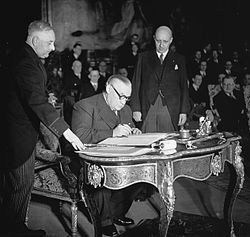
Belgium, France, Luxembourg, the Netherlands, and the United Kingdom signed the Treaty of Brussels, creating a collective defense pact in Western Europe. This agreement laid the groundwork for broader transatlantic security cooperation and demonstrated European commitment to mutual defense against potential Soviet aggression.
Image source: Treaty of Brussels
Jun 24, 1948 - May 12, 1949
% complete
The Soviet Union blocked all land and water routes to West Berlin, prompting the Western Allies to launch the Berlin Airlift to supply the city. The crisis underscored the need for a formal transatlantic military alliance and accelerated discussions that would lead to NATO's creation.
Image source: Berlin Blockade
Apr 4, 1949
% complete
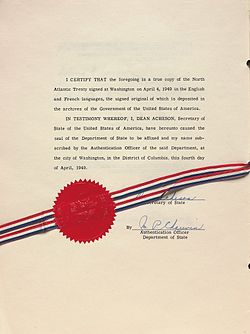
Twelve nations—the United States, Canada, the United Kingdom, France, Belgium, the Netherlands, Luxembourg, Norway, Denmark, Iceland, Italy, and Portugal—signed the North Atlantic Treaty in Washington, D.C., formally establishing NATO. Its Article 5 declared that an attack on one member would be considered an attack on all.
Image source: North Atlantic Treaty
Feb 18, 1952
% complete
Greece and Turkey became the first countries to join NATO after its founding members, extending the alliance's southeastern flank into the Eastern Mediterranean and strengthening its strategic position against Soviet influence in the region.
Image source: Enlargement of NATO
Apr 4, 1952
% complete
British statesman Lord Ismay became NATO's first Secretary General, famously stating that NATO's purpose was 'to keep the Russians out, the Americans in, and the Germans down.' His leadership helped shape the alliance's early political structure.
Image source: Secretary General of NATO
May 9, 1955
% complete
West Germany's accession to NATO marked a major turning point in Cold War politics, integrating a rearmed Germany into the Western alliance. In response, the Soviet Union formed the Warsaw Pact just days later, formalizing the division of Europe into rival military blocs.
May 14, 1955
% complete
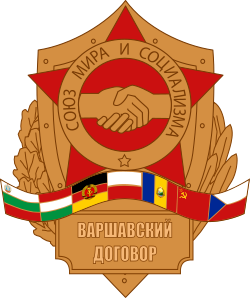
The Soviet Union and seven Eastern Bloc satellite states signed the Warsaw Pact in Poland, creating a unified military command as a direct counterweight to NATO. The pact institutionalized the military confrontation at the heart of the Cold War.
Image source: Warsaw Pact
Jul 1, 1966
% complete
Under President Charles de Gaulle, France withdrew from NATO's integrated military command while remaining a member of the alliance. De Gaulle sought independent nuclear capability and greater national autonomy, prompting NATO to relocate its headquarters from Paris to Brussels.
Image source: France and NATO
Jan 1, 1967
% complete
NATO formally adopted the strategy of flexible response, moving away from massive retaliation by allowing for graduated military responses to aggression. This doctrine gave alliance leaders more options short of full nuclear war in responding to crises.
Image source: Flexible response
Dec 13, 1967
% complete
NATO adopted the Harmel Report, which redefined the alliance's dual mission of maintaining military defense while pursuing political détente with the Eastern bloc. This document shaped NATO's strategy of combining deterrence with dialogue during the Cold War.
Image source: Pierre Harmel
Aug 20, 1968
% complete
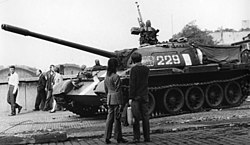
Warsaw Pact forces invaded Czechoslovakia to suppress the Prague Spring reform movement. The invasion reaffirmed the Brezhnev Doctrine and reminded NATO members of the continued threat posed by Soviet military power in Europe.
Image source: Warsaw Pact invasion of Czechoslovakia
Nov 7, 1983 - Nov 11, 1983
% complete
NATO conducted Able Archer 83, a command post exercise simulating nuclear release procedures. Some Soviet leaders reportedly feared it was cover for a real first strike, bringing the superpowers dangerously close to miscalculation during a period of heightened tension.
Image source: Able Archer 83
Oct 11, 1986 - Oct 12, 1986
% complete
U.S. President Ronald Reagan and Soviet leader Mikhail Gorbachev met in Reykjavik, Iceland, discussing sweeping arms reductions. Though no agreement was reached, the summit paved the way for the INF Treaty and signaled the beginning of the end of the Cold War standoff.
Image source: Reykjavík Summit
Nov 9, 1989
% complete
The Berlin Wall fell as East Germany opened its borders, symbolizing the collapse of communist control in Eastern Europe. This momentous event transformed NATO's strategic environment and sparked debates about the alliance's future purpose and enlargement.
Image source: Fall of the Berlin Wall
Jul 5, 1990 - Jul 6, 1990
% complete
At the London summit, NATO leaders declared that the alliance would adapt to the new post-Cold War era, proposing reduced reliance on nuclear weapons and offering friendship to former adversaries, including the Soviet Union and Eastern European nations.
Image source: London Declaration
Nov 19, 1990 - Nov 21, 1990
% complete
Leaders from NATO and Warsaw Pact nations signed the CFE Treaty limiting conventional forces in Europe and adopted the Paris Charter, formally declaring an end to the Cold War and committing to democratic principles across the continent.
Image source: Paris Charter
Feb 25, 1991 - Jul 1, 1991
% complete
The Warsaw Pact was formally dissolved at a meeting in Prague, ending the Soviet-led military alliance that had opposed NATO for over three decades. The dissolution removed NATO's principal adversary structure and reshaped European security architecture.
Dec 20, 1991
% complete
NATO created the North Atlantic Cooperation Council to foster dialogue and cooperation with former Warsaw Pact states and newly independent post-Soviet republics, beginning the process of building partnerships across Central and Eastern Europe.
Image source: Euro-Atlantic Partnership Council
Dec 26, 1991
% complete
The Soviet Union officially ceased to exist, marking the definitive end of the Cold War. NATO suddenly faced a fundamentally altered strategic landscape, prompting reflection on its future role and opening the door to cooperation with former adversaries.
Image source: Dissolution of the Soviet Union
Jan 10, 1994
% complete
NATO launched Partnership for Peace at the Brussels summit, allowing non-member states, particularly former Soviet bloc countries, to cooperate with the alliance on military exercises, peacekeeping, and defense reform, serving as a pathway toward eventual membership.
Image source: Partnership for Peace
Aug 30, 1995 - Sep 20, 1995
% complete
NATO conducted a sustained air campaign against Bosnian Serb forces besieging Sarajevo. The operation helped bring combatants to the negotiating table and led to the Dayton Accords, marking NATO's first major combat air campaign in its history.
Image source: Operation Deliberate Force
Dec 20, 1995 - Dec 20, 2004
% complete
Following the Dayton Agreement, NATO deployed IFOR (later SFOR) to enforce peace in Bosnia and Herzegovina. It was the alliance's first major ground operation, demonstrating NATO's new role in out-of-area crisis management and peacekeeping after the Cold War.
Image source: Implementation Force
Mar 12, 1999
% complete
The Czech Republic, Hungary, and Poland became the first former Warsaw Pact members to join NATO, realizing the alliance's first post-Cold War enlargement and extending its borders eastward toward Russia.
Mar 24, 1999 - Jun 10, 1999
% complete
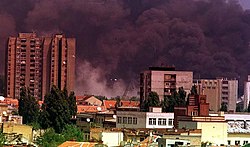
NATO launched Operation Allied Force, a 78-day air campaign against Yugoslavia to halt ethnic cleansing in Kosovo. It was the alliance's first use of force against a sovereign state without UN Security Council authorization, sparking international debate about humanitarian intervention.
Image source: NATO bombing of Yugoslavia
Sep 12, 2001
% complete
One day after the September 11 terrorist attacks on the United States, NATO invoked Article 5 for the first time in its history, declaring the attacks an attack on all members and pledging collective support for the American response.
Image source: North Atlantic Treaty
Dec 20, 2001 - Dec 28, 2014
% complete
NATO took command of ISAF, its first deployment outside the Euro-Atlantic area, to stabilize Afghanistan and support reconstruction. The mission grew to over 130,000 troops from dozens of nations before transitioning to Operation Resolute Support.
Image source: International Security Assistance Force
Mar 29, 2004
% complete
Estonia, Latvia, Lithuania, Slovakia, Slovenia, Romania, and Bulgaria joined NATO in its largest single expansion, bringing the alliance directly to Russia's borders and incorporating former Soviet republics for the first time.
Aug 7, 2008 - Aug 12, 2008
% complete
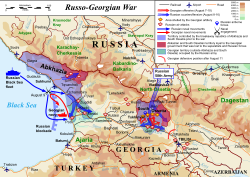
Russia's war with Georgia, following NATO's Bucharest summit promise of eventual Georgian membership, sharply deteriorated relations between Moscow and the alliance. The conflict froze NATO enlargement debates and foreshadowed renewed East-West confrontation.
Image source: Russo-Georgian War
Mar 19, 2011 - Oct 31, 2011
% complete
NATO enforced a UN-mandated no-fly zone over Libya under Operation Unified Protector, conducting airstrikes that helped topple Muammar Gaddafi's regime. The intervention was controversial for its aftermath, contributing to Libya's prolonged instability.
Image source: 2011 military intervention in Libya
Jun 5, 2017
% complete
Montenegro became NATO's 29th member, continuing the alliance's expansion into the Balkans despite strong Russian opposition. Its accession reflected NATO's ongoing effort to consolidate stability in Southeastern Europe.
Image source: Montenegro–NATO relations
Mar 27, 2020
% complete
North Macedonia became NATO's 30th member after resolving its long-standing name dispute with Greece through the Prespa Agreement, completing a significant chapter in Balkan integration into Euro-Atlantic institutions.
Image source: North Macedonia–NATO relations
Apr 4, 2023
% complete
Finland ended decades of military non-alignment and joined NATO in response to Russia's 2022 invasion of Ukraine, dramatically extending the alliance's border with Russia and transforming Northern European security dynamics.
Image source: Finland–NATO relations
Or browse the full history timeline directory, with more than 2,000 topics.
This NATO timeline was generated with the help of AI, using information found on the internet.
We work hard to keep these timelines accurate, but mistakes do get through. If you spot one, email us at [email protected] and we'll fix it for future visitors.
Generate yours with AI or build it from scratch, for free.
Export your timeline, add your own events, edit or remove AI-generated events, and much more
No credit card required.
Cancel anytime.
Cancel anytime.
You can create an unlimited number of timelines with up to 10 events on each one, customize how they look, export them to PDF, PNG, PowerPoint, CSV, and Excel, and share them with a link. Paid plans raise the event limit and add features like spreadsheet imports and collaborators.
Yes. You can cancel your subscription from your account page at any time, and you will not be charged again. Your subscription stays active for the rest of the period you already paid for.
Yes. We will email you a reminder before the annual renewal, and we will also email you a receipt.
Yes. You can email us within 15 days of any payment, and we will issue you a full refund.
Check out our pricing docs or send us an email anytime: [email protected].